
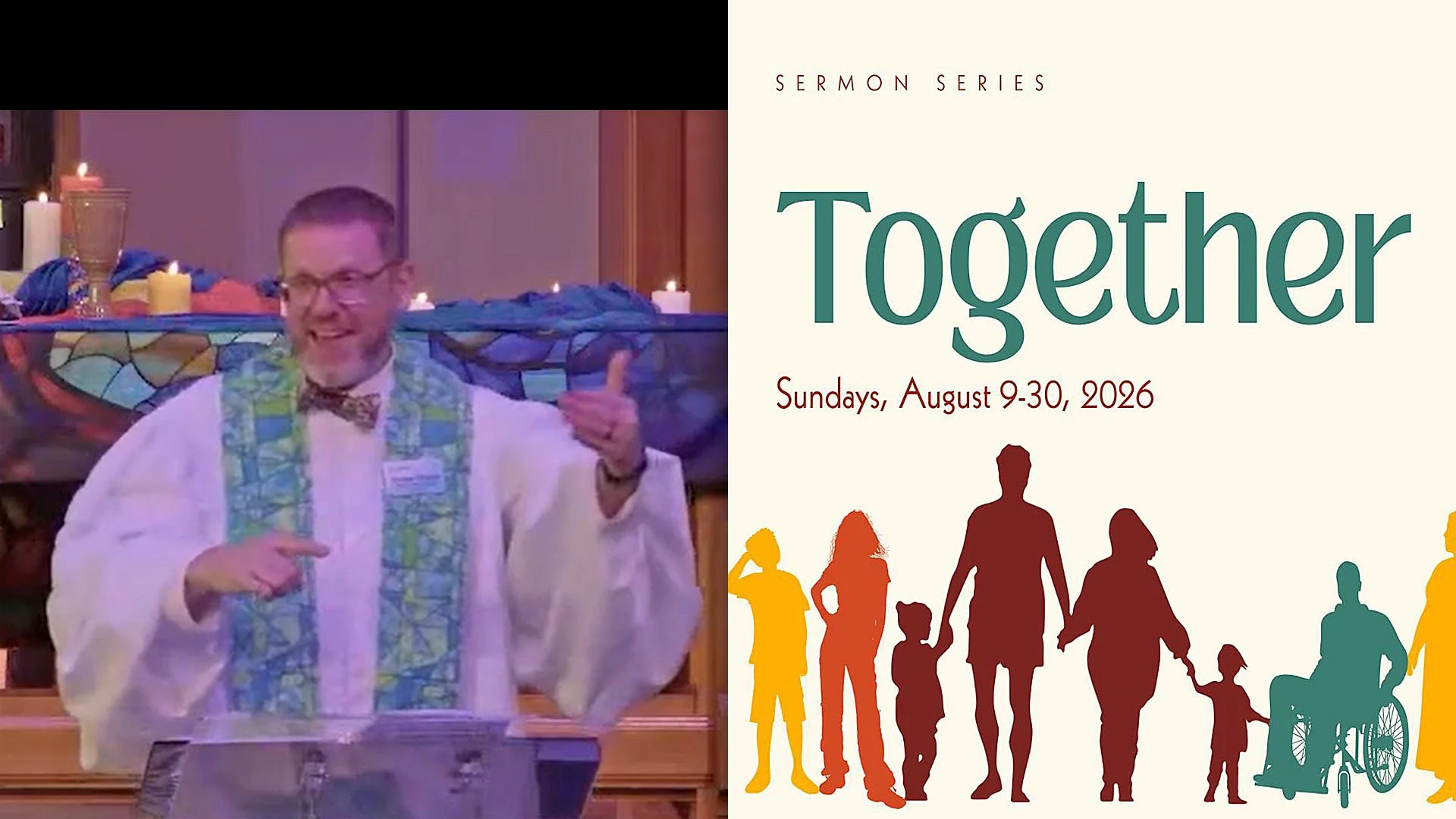
Sanctify. Draw Near. Step In. | 8/9/26
-
What does “sanctify yourself” mean to you personally? What might it look like to intentionally prepare your heart and mind for what God may be doing?
When you think about “drawing near” to God and to others, what would that look like in your life? Is there a community or relationship where you sense an invitation to become more present?
Are there places where you are tempted to stay comfortable on the riverbank rather than step into the water? What fear might be keeping you there?
What would it look like for you to trust God’s faithfulness even when you cannot yet see how things will unfold?
As you look toward the season ahead, what is one practical step you could take to prepare your heart, draw nearer to others, or courageously follow where God may be leading?
Transcript:
Have you ever experienced a feeling of building up to something over a long season of time? You know, like waiting for the big event, or journeying towards that long-awaited destination? Maybe it was a project that you worked on with a team of people over years, or maybe it was a recital that you prepared for, or that performance that you practiced and practiced and practiced for. The process of getting to where you need to be can be a grueling one, in which you often ask yourself whether or not you were even wise to start out on the journey or project. But then you get to this point when you're almost done, you're almost there. You know that you are close, that you're within touching distance of the final destination, and all it is going to take is that final push to get you over the finish line.
That last leg of the journey is the place where we are picking up today's scripture reading. Israel has been journeying for generations towards the land that was promised to them by God. They have been led all the way by a guy called Moses — put your hand up if you've heard of Moses. So glad to see all those hands up. But he's not around anymore, and a new leader has been raised up among them. That's his name in the big letters on screen — Joshua — who is the one tasked with leading the people in this final push. He leads them from Shittim to the banks of the Jordan River, and after being camped there for three days, Joshua sends word out to all the people that they are to watch for the Ark of the Covenant, which will be carried by Levitical priests. When the people see this, they are to follow after it so that they will know the way they are to go, for they have never passed this way before.
In Joshua chapter three, verses five through seventeen, Joshua then speaks up again and says these words to the people.
Sanctify yourselves, for tomorrow the Lord will do wonders among you. To the priests Joshua said, "Take up the ark of the covenant, and pass on in front of the people." So they took up the ark of the covenant and went in front of the people. The Lord said to Joshua, "This day I will begin to exalt you in the sight of all Israel, so that they may know that I will be with you as I was with Moses. You are the one who shall command the priests who bear the ark of the covenant. When you come to the edge of the waters of the Jordan, you shall stand still in the Jordan." Joshua then said to the Israelites, "Draw near and hear the words of the Lord your God." Joshua said, "By this you shall know that among you is the living God, who without fail will drive out from before you the Canaanites, Hittites, Hivites, Perizzites, Amorites, and Jebusites. The ark of the covenant of the Lord of all the earth is going to pass before you into the Jordan. So now select twelve men from the tribes of Israel, one from each tribe. When the soles of the feet of the priests who bear the ark of the Lord — the Lord of all the earth — when they come to rest in the waters of the Jordan, the waters of the Jordan flowing from above shall be cut off. They shall stand in a single heap." When the people set out from their tents to cross over the Jordan, the priests bearing the ark of the covenant were in front of the people. Now the Jordan overflows all its banks throughout the time of harvest. So when those who bore the ark had come to the Jordan, and the feet of the priests bearing the ark were dipped in the edge of the water, the waters flowing from above stood still, rising up in a single heap far off at Adam, the city that is beside Zarethan, while those flowing toward the sea of the Arabah — that is, the Dead Sea — were wholly cut off. Then the people crossed over opposite Jericho. While all Israel were crossing over on dry ground, the priests who bore the ark of the covenant of the Lord stood firmly on dry ground in the middle of the Jordan, until the entire nation finished crossing over the Jordan.
This is the very long Word of God for the people of God. Thank you, God.
"Sanctify yourselves, for tomorrow the Lord will do wonders among you." Now, you would not imagine it from looking at my appearance and seeing my stature, but I have completed four marathons in recent years. After crossing the finish line of the last one in February 2025, I said that I would never, ever do another one. I was happy for there to be no more long runs on my calendar. And then it did not take long for there to be no runs at all on my calendar, which was great. If you were to tell me that I absolutely had to make a choice between running and not running, I would choose the latter, because I really don't love it. "So how have you done all these marathons if you don't love it?" You know what, that's a great question — I'm so glad you asked it today. I suppose I just love a challenge. I mean, I really do. Because what I said at the end of that last one about doing no more marathons — yeah, I got that wrong. Because as it turns out, I am currently in training to run the New York City Marathon on November 1st this year, and that one will definitely, definitely be my last one. You all can hold me to that.
The thing about marathons is that they involve an intense season of preparation and commitment, in which everything has to be planned and built around making sure that your training runs get done. If I were to bypass that training and think that I could just show up on November 1st and run 26.2 miles, well, I would be wrong. The preparation has to be done — there is no getting around that. The body and the mind have to be trained up and ready. They have to be prepared in order to get done what needs to be done on race day.
Now, when Joshua tells Israel that they are to sanctify themselves, he's telling them that they have preparation to do in order to be ready for what is in front of them. Only Joshua is not talking about physical conditioning here — he's talking about heart readiness for what they are about to experience. As I read the passage this week, I was struck by that directive from Joshua: sanctify yourselves. I started to wonder what that might actually have meant for that body of people at that time. I mean, was it a reference to some kind of ritual cleansing that they had to do? Or was it the very specific words of a prayer that they had to pray at home with their family? Was it simply a matter of checking a box and getting done what ritually had to be done in order to be ready? Or was there something more to it?
Now, in the ancient world, of course, sanctification certainly involved physical rituals such as the washing of clothes or cleansing of the body. But in this passage, and at its core, I believe Joshua is inviting Israel into something much deeper. Here he's inviting them to an internal consecration — a setting apart of their hearts and minds for what God was about to do among them.
Now, as I consider what this word "sanctify" might have meant for the people of Israel during this moment of movement forward in their story, I also then wondered what it might mean for us. My new friends, we ourselves are in a moment of movement forward in our story here at Trinity United Methodist Church. And giving thanks for all that has happened in and through this church family in years gone by, we also now are looking forward together and wondering what might be in the days ahead. Perhaps then, the directive to sanctify yourselves is a directive that we need to hear today as we get started on our journey forward together. What might that look like for us? What might it look like for you and for me to be intentional about preparing our hearts and minds for the things that God is about to do in and through us?
I mean, it's so easy to become distracted from our faith journeys. Put your hand up if you've experienced how easy it is to get distracted in your faith journey. Yes, every single hand should be up right now — I'm telling you, it's so easy to become distracted. Busy lives, multiple commitments, a world around us that is changing so rapidly that we really struggle to actually keep up with it — all of these things can distract us from the call to sanctify ourselves. And so, as we listen for God's leading and guiding in this new season before us, I want to say to you today that I think it's vital that we sanctify ourselves, that we enter into the work of preparing our hearts and minds, and that we then are ready for the work that we are about to witness God do in and through our life together here at Trinity.
The next directive that Joshua gives the people asks them to draw near and hear the words of the Lord your God. When I hear that phrase, "draw near," I immediately think about the quiet personal practices that I think about when I think about us sanctifying ourselves. Drawing near to God feels like a major part of the process of sanctifying ourselves. It feels just like another way of instructing the people to tend to their own hearts in order to be ready to hear the words of the Lord. But I think Joshua is saying a little bit more here. He's not sending the people back to their tents to pray a little bit longer and a little bit harder. No, he is calling the people together.
I told you last week that I played rugby for many years, that it taught me a lot about what it is to operate as part of a team. And every single week when we would play — before the game, many times during the game, and then after the game also — we would always huddle up as one team all together, which of course is not unique to the sport of rugby. But I think you'll agree it's just more beautiful when rugby players do it, right? Yes it is. The specific purposes of these huddles were varied. We would use them to gear each other up, or maybe to receive some inspiration and encouragement from the team captain. Or, as the case might have been from time to time, to receive the dressing down that we needed because we were not playing to our potential. Huddles were also sometimes gathered so that we could receive instructions from a coach on how we might approach the game that day, or to find out what specific play we were about to run. The purpose was always to communicate and to remind each individual team member around that huddle that we were united as a team. Drawing near and huddling together was and is a vital part of what it is for individuals to function and move forward together as one.
When Joshua says, "Draw near and hear the words of the Lord your God," he is calling the people of Israel to huddle together and to listen for God's Word to them. He's calling them to physically step out of their individual tents and to gather in together and listen as one body. My friends, as we enter into this next leg of Trinity's journey, I want to emphasize the point and the importance of our own drawing near. We cannot lead or serve well by remaining scattered out in our own individual tents. In a culture that more and more feels like it is working hard to divide and keep us from one another, drawing near in community is a vital act of resistance to that. And doing so then means bringing our whole selves into the space, choosing to tune out the background noise of our world, gathering shoulder to shoulder with one another, and then asking collectively, "Lord, what are you saying to us as we journey forward into what's next?" Draw near, Trinity. Draw near.
The final piece in this passage is what happens when those carrying the Ark of the Covenant get to the water's edge. Now, the promise is that when they put their feet into the water, the waters will part and the people will walk through on dry land. That's the promise. That doesn't make it easy, though, right?
You know, Margaret and I first moved to the United States in 2003 and spent three years living in Port St. Lucie, Florida, before then returning to Northern Ireland in 2006. It was there that I trained for ministry in the Irish Methodist Church, and I was ordained as an Irish Methodist clergyman in 2012. Less than one year later, in 2013, we were presented with an opportunity to return to Florida, where I was being invited to become the pastor of the United Methodist Church in Titusville, Florida — where the rockets go up to space. Now, we had never been in Titusville before. We'd only driven past it on 95 heading north and read the word on a sign. We knew nothing about that community. We knew nothing about that church except what the district superintendent was telling me. And let me tell you — district superintendents, when they want you to go to a church, they only tell you nice things about that church. Okay, that is true.
And there were going to be restrictions on the visa that it would take for us to get here and do that — the restriction being that I would be permitted to work, but Margaret would not be permitted to work until such time as she had a green card. That process would take us five years. This was an invitation to get our feet wet. Saying yes, packing up and moving our lives to that place, would upend everything for us. It would move us 4,000 miles from any family connection, and it would plant us in a place that we knew absolutely nothing about, and it was going to put us in a very different financial footing as a family. Saying yes to this invitation would require great trust in God's faithfulness and God's promise of sufficient grace. So we decided to get our feet wet. And thirteen years on, we can say that we have continued to experience God's faithfulness and the sufficiency of God's grace all along the way.
In the text, both the leaders of Israel and the people of Israel have a decision to make. Will they trust in God's faithfulness in a way that will enable them to courageously step into the waters of the river? Or will they stay camped where they are, and allow their fear of the river to remain as a barrier, keeping them from that which God has promised them? As we read, those appointed to carry the Ark of the Covenant ahead of the people did trust in the faithfulness of God. They stepped into the water's edge and got their feet wet. And when they did, they experienced God's power and presence in a way that they would not have done had they remained on the bank of the river, dry-footed in the comfort of their fears.
Listen, friends, I just got here, and we're just at the beginning of getting to know each other. I can't stand here this morning and pretend to know exactly the things that God will be calling us to in the months and years ahead. But this I do know, and I can say with confidence: God continues to be at work in the world. Amen. God continues to be at work in the world, at work right here in our own community. And just as Trinity has always been invited to join in on and be part of that good work, we — the church family of Trinity United Methodist Church in these days — continue to be invited to join in on that work of God in the world. And just as doing so required the generations before us to get their feet wet as they trusted in God's faithfulness, the places God calls us to in the years ahead will require us to get our feet wet too.
God is doing wonders among us and through our life together, Trinity. I've only been in the office for a week and I'm already seeing evidence of that. So let's enter into this together. Let's enter into this together. Let our hearts be prepared. Let's continue to draw near together, listening for the Word of the Lord our God. And when the time comes, let's be willing to step into the waters. Trinity, how about we get our feet wet too?
May it be so, in the name of God who is Father, Son, and Holy Spirit.
Amen.