
-
The king in the story says, "Just as you did it to one of the least of these, you did it to me." How does it change things to imagine that Christ is personally present in the people who are overlooked or struggling around you?
Being asked "Am I a goat or a sheep?" can feel uncomfortable, but it was offered as an invitation rather than a source of shame. When you honestly take stock of where you've been this year, what do you notice?
The Ignatian Examen begins by becoming aware of God's presence and then moves into gratitude. What are you most thankful for as this year comes to a close?
Honest review means looking not only at the joys but also at the hard or sad moments, and at the places where you fell short. Is there a moment from this past year you've been avoiding looking at, and what might it look like to bring it into God's grace?
The final step of the Examen is to leave yesterday in the rearview mirror and commit to something different. As a new church year begins, what is one choice or habit you'd like to set out with, trusting that God is already calling you forward?
Transcript:
Happy New Year's Eve, y'all! Yes, I am well aware that Thanksgiving is this Thursday and it's not New Year's Eve in how we understand it, but this is the last Sunday in the liturgical calendar for the life of the church, a cycle of church life. And the year always begins with the first Sunday of Advent, which is next Sunday, and it always ends with today, Christ the King Sunday. Well, I actually should not say always, because Christ the King Sunday was not instituted as a high holy day of the church until 1925, when Pope Pius XI made the decision to set this day apart as a counter-narrative to what was happening in the world around at the time, namely the rise of destructive ideologies like secularism and what would become the beginnings of Nazism.
The goal of this particular day is to proclaim Christ as the goal of human history, the focal point of the desires of history, and the center of humankind, to the joy of all hearts and the fulfillment of all aspiration. This Sunday's placement at the end of November also makes a curious counter-narrative in our shared culture together as American Christians, because it falls in the very same month as important national elections, reminding us that amid the ebb and flow of powers and principalities, as the Reverend Adam Hamilton says in his book Incarnation, our highest allegiance, our deepest devotion, and our greatest commitment is not to country, or political party, or even to family, but to Christ our King, whose kingdom is the climax of human history.
As you can see on the screen, Adam Hamilton might be a familiar name to you, because not only is he one of the most prolific United Methodist writers of our time and the leader of the largest United Methodist church in our country, but he is now senator-elect from Kansas, who ran a successful campaign with this very value at the forefront of the conversation. He wrote the book I just quoted from, Incarnation, in the year 2020, before he felt God's call toward public office himself. It's a book that focuses on the season of Advent, with an additional chapter that focuses on our understanding of Christ the King.
You know, sometimes it can be hard to put flesh on the idea of Christ as our king, because we don't live in a country that uses a monarchy as a way of governance. The kingly framework can feel a little farfetched for us. So in this book, Adam focuses on the idea of Christ's leadership and authority, re-imagining his life and ministry as a political campaign. But rather than running for an elected office like we have come to understand it, Christ was campaigning for the Kingdom of God. He says it this way: "At the age of 30, Jesus began his campaign for the office of King. He traveled from town to town, giving various stump speeches about the Kingdom of God. In these campaign speeches, he called people to love God, their neighbors, and even their enemies. He called his hearers to humility, kindness, integrity, forgiveness, and selflessness. He asked them to care for the hungry, the thirsty, the naked, the sick, the imprisoned, and the immigrant. He decried arrogance and hypocrisy."
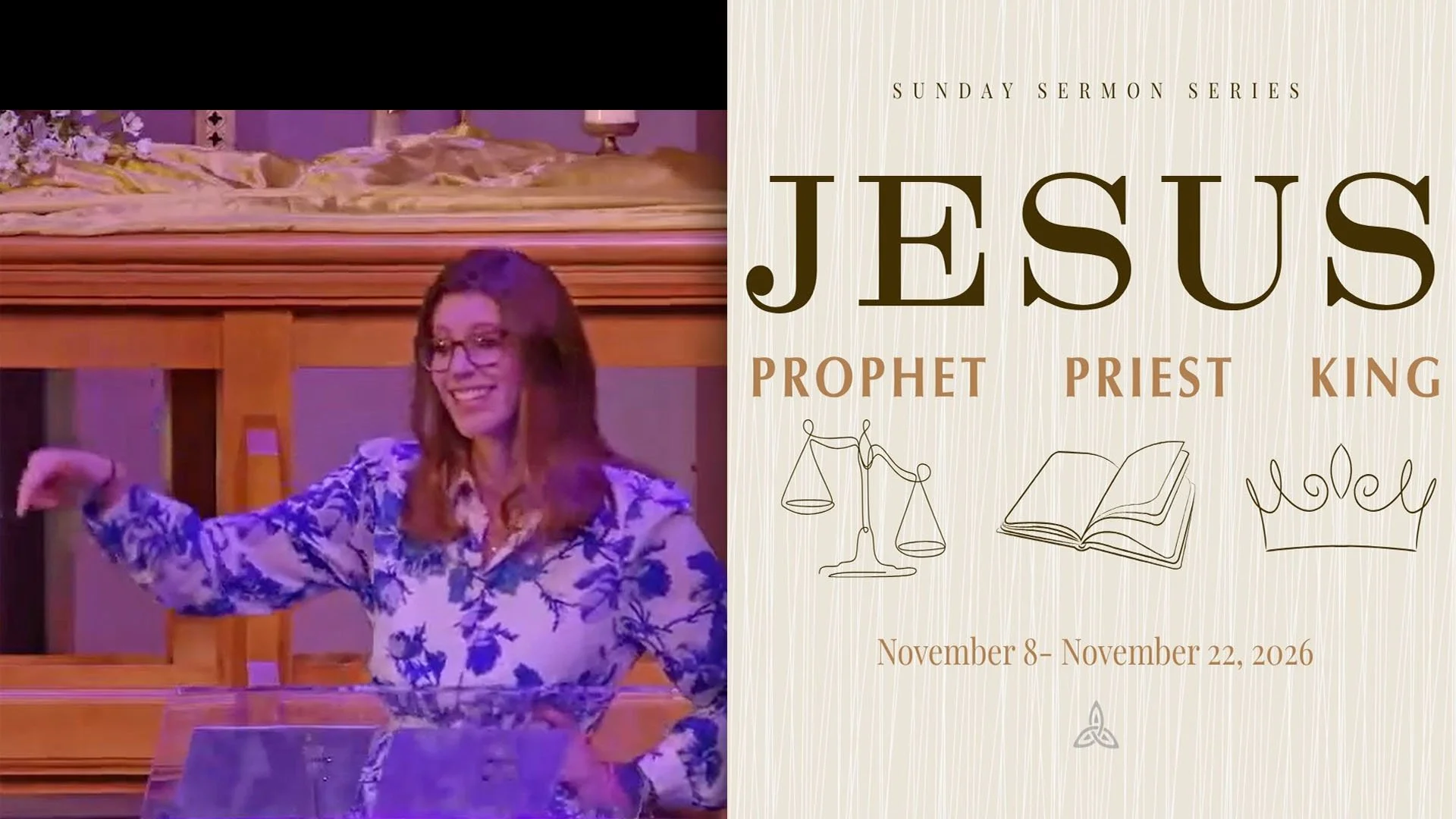
This is the very work that Christ was in the midst of in the passage that we have been exploring together as a community of faith over the last few weeks. Together we have used Matthew 25, a rather well-known and well-quoted passage, to tease out the roles that Christ embodies in his ministry: Christ as priest, Christ as prophet, and today, Christ as King. As we read this passage together again this morning, I invite you to be thinking about what it might say to us about Christ and his kingly leadership in our lives and in the world. Hear these words once again from Matthew chapter 25, verses 31 through 46:
When the Son of Man comes in all his glory, and all the angels with him, he will sit on the throne of his glory. All the nations will be gathered before him, and he will separate people one from another as a shepherd separates the sheep from the goats. He will put the sheep at his right hand and the goats at the left. Then the king will say to those at his right hand, come, you who are blessed by my Father, inherit the kingdom prepared for you from the foundation of the world. For I was hungry and you gave me food, I was thirsty and you gave me something to drink, I was a stranger and you welcomed me, I was naked and you gave me clothing, I was sick and you took care of me, I was in prison and you visited me. Then the righteous will answer him, Lord, when was it that we saw you hungry and gave you food, or thirsty and gave you something to drink? And when was it that we saw you a stranger and welcomed you, or naked and gave you clothing? And when was it that we saw you sick or in prison and visited you? And the king will answer them, truly I tell you, just as you did it to one of the least of these brothers and sisters of mine, you did it to me.
Then he will say to those on his left hand, you who are accursed, depart from me into the eternal fire prepared for the devil and his angels. For I was hungry and you gave me no food, I was thirsty and you gave me nothing to drink, I was a stranger and you did not welcome me, naked and you did not give me clothing, sick and in prison and you did not visit me. Then they will also answer, Lord, when was it that we saw you hungry or thirsty, or a stranger, or naked, or sick, or in prison, and did not take care of you? Then he will answer them, truly I tell you, just as you did not do it for one of the least of these, you did not do it to me. And these will go away into eternal punishment, but the righteous into eternal life.
Friends, this is the Word of God for us, the people of God. And we say, thanks be to God.
Will you pray with me? Christ our King, will you be present with us in these moments? By the power of your Holy Spirit, will you guide us and lead us as our hearts are opened to hear your call clearly? In your name we pray. Amen.
While this passage is not considered a parable by any scholar, I do find it helpful to hold it up in a similar way. The Gospel narrative of Matthew, the way Matthew is set up here, immediately follows two parables. So when the disciples and the other people who were gathered around Jesus to listen to his teaching were there, they would not have picked up the distinction in style. It would have simply been a continuation of Jesus's teaching. The nature of this extended metaphor of sheep and of goats invites us into an imaginative space in the same way that a parable does, and Jesus uses it as he has used other parables across his campaign through the lands. His goal was to highlight how the Kingdom of God, and the values that are upheld within that kingdom, differ from the values that are upheld and honored within the kingdoms and structures of this world.
Jesus's very use of this extended metaphor in this teaching moment is an exercise of his kingly role, just as any good ruler would. He is communicating the guideposts and the benchmarks of righteousness in this kingdom, and inviting us to take up our place within it. But for us to clearly find our place and role within this passage, and within Christ's call and invitation, it might be helpful for us to parse out the actions of the King's role within the metaphor itself. What might it say about the leadership of Christ in the scene Jesus describes for us?
We are transported into a throne room that is functioning more like a modern-day courtroom. People from all nations are being separated one from another. There is no trial, no deliberation. Each life is held to the same benchmark, their choices in that life a testimony. When each group asks for clarification, one line says everything that we need to know about the leader of God's kingdom. Jesus says, "Truly I tell you, just as you did it to one of the least of these brothers and sisters of mine, you did it to me." Just as you did it to one of the least of these brothers and sisters of mine, you did it to me. Take a moment to think about the significance of that one statement. This king did not remain at a far-off distance from the experiences of the most vulnerable of his people. Christ made it personal.
As Pastor Charlie said last week, the King of the universe isn't hiding behind palace walls or church doors. God has chosen to identify with the hungry, the thirsty, the stranger, the sick, and the imprisoned. This isn't a lofty leader who is looking down from on high. This is a leader who is truly with us. This kind of leadership is what we call servant leadership. It is exemplified in the very incarnation of Jesus Christ, a willingness to be brought low, to get grungy and dirty and messy alongside those with whom he is leading.
We see it in Jesus at the age of 13, who was so caught up in learning at the temple, listening to the teachings of the priests there, that he was left behind by his parents, who were headed home from a Passover festival. God in human flesh, willing to sit down and to learn from people who were merely human. That humility. We see it again at the beginning of his ministry, when he is sent into the wilderness and spends 40 days there being tempted by the devil. We see it when Jesus meets the woman at the well and asks her for something to drink. We see it again when Jesus didn't recoil at the touch of those who were ill and had been shunned for years from society. Or when he chose to pick up a basin and a towel and wash the nastiest feet known to humankind, the feet of his disciples. And we saw it plain as day when he was hoisted up on that cross underneath a sign that read "King of the Jews."
When we claim Christ as our King, what we are saying is we are striving to follow in his kind of leadership, the kind of leadership that serves and is not served, the kind of leadership that looks on those who are hungry or thirsty or far from home, or naked or sick or labeled as criminal, with compassion, who offers them what is needed without asking if they are worthy to receive it. A kind of leader who sees the divine mirrored in every human being they encounter.
Christ, in his kingly role, then uses this passage to hold a mirror up to those who were gathered listening to him long ago, and to us today, asking us, are we goats, or are we sheep? This mirror is not held with malice or to entice shame. It is an invitation to make a different choice. It is an invitation to examine our own hearts, to make an honest accounting of where we have been, and to see where we want to be next. Christ the King begs us to align our hearts with the very heart of God, to align our actions with those who belong to the kingdom that God has established over and above the kingdoms of this world.
Friends, it's the perfect time to do some of this self-examination work. It's the end of a year. That is what endings are intended to do, to take a look back and to evaluate where you have been, so that you might be able to set out in the new year striving to make different choices. If you're wondering how on earth to set about the process of self-examination, I would like to offer you a tool this morning. Along with your bulletin, you should have received another piece of paper as you walked in. If you did, I invite you to pull that out. If you didn't, there will be copies to pick up on the way out.
This is a tool that I strive to use daily. It's called the Ignatian Examen. It's a way to examine the choices that you have made and the actions that you have taken over the course of a day, or a week, maybe a month or a whole year. But in that process, it allows space for the power of God's healing grace to be present with you, and it includes five steps.
First, awareness of God's presence. At its core, the Ignatian Examen is a prayer. By diminishing the distractions around us, we can more clearly pay attention to the presence of the Holy Spirit guiding our thoughts through this practice. As you center on God's presence, you're then invited to express gratitude. Gratitude opens our hearts to the experience of God's everlasting love. Offering thanksgiving shifts our posture in a way that prepares us for the work that then comes in the next step: reviewing your day with honesty. Honesty is the most important part. We have a tendency to focus heavily on the joy and the good experiences without accounting for the moments of hardship or sadness. An honest review will more often than not reveal a place where God was at work, or extending an invitation to us that we might have missed in that moment.
And then we are invited, in the fourth step, to face our shortcomings. This is something that is uncomfortable, and we don't often do it, because it is hard to face the moments where we didn't get it right. But it is precisely in those moments that God's grace and forgiveness abound for us, and it is also the place where that mercy is transformed into growth and empowerment. For the final step, looking forward to the future with hope and committing to do something different, we orient our hearts to experience the Good News for ourselves again and again. It is intentionally leaving yesterday in the rearview mirror and straining forward to where God is calling us next.
I commend this practice to you because it has been transformative for me. At the beginning of this year, I was invited, with a couple of other clergy colleagues, to go through a process of mental fitness, of realigning our hearts in this work of ministry, because so often we pastors are so excited to share good news, and for you to experience the good news of Christ's overwhelming love, that we forget to do the work for ourselves. We forget that the good news is for us, too. I had lost a daily rhythm and practice of caring for my own soul as I took on being a single mother and the leadership of the church, which were all beautiful things, but sometimes we forget ourselves, too. So including a practice like this at the end of my evenings allowed me time to create space for God's grace that I could experience, too.
So I invite you to take hold of this practice and to use it as a response to the call of Christ, who is our King, who is inviting us to realign our hearts with the values of the Kingdom of God. I invite you, and may Christ meet you in these moments of honesty and prepare your hearts as we get ready to receive the good news that we will be preparing for just next week: of a baby born in Bethlehem to an unwed teenaged girl, not in a palace that was draped with fine cloths, but instead in a manger filled with hay. A baby who is the king we have all been waiting for.
In the name of the Father, and the Son, and the Holy Spirit.
Amen.