
-
When you were younger, was there a figure — an athlete, a musician, a family member, someone in your faith community — whose life made faith look appealing or even powerful to you? Looking back now, how has your understanding of what that person's faith actually meant grown or shifted?
Paul talks about praying three times for God to remove the stake from his side, and God's answer was essentially, "No, but my grace is enough." Have you ever been in a season where God didn't take away the hard thing, and what did you find on the other side of that?
The connection between a branch and a vine isn't made overnight — it takes time, constant attention, and nurturing. What spiritual practices have genuinely helped you feel more rooted and connected in past seasons of your life, and are any of those still part of your daily rhythm?
John Wesley's 4 a.m. prayer practice and hourly pauses for contemplation are admittedly extreme — but the invitation isn't to copy his schedule, it's to ask honestly what your own daily rhythm of connection looks like. If you're being real with yourself, what does a typical day actually look like when it comes to time spent with God, and is there even a small shift you could make?
Transcript:
I was in the seventh grade when I fell in love with the Florida Gators.
The year was 2007, and I knew absolutely nothing about football except that Tim Tebow was our quarterback, and I just thought he was the best thing since sliced bread. I think I was probably thirteen at the time, because every game he would wear that black face paint right there on his cheekbones with a Bible verse on it. And I bet you remember which Bible verse it was — it was Philippians 4:13, and I think I memorized it because I watched him so much. But it's "I can do all things through Christ who strengthens me." And as a very young teenager, I thought it was really cool that the faith that I had found a home in had some airtime on national TV through Tim Tebow, and so I was hooked from that point on. And I've loved the Gators ever since.
I remember thinking that it had to have simply been because of Tebow's faith that he just kind of morphed into the superhero figure for me, both on the field and off the field — that it had to be by God's strength making him into the greatest quarterback of all time, and that nothing could ever go wrong because it was God giving him some super strength. As an adult, I still deeply appreciate Tebow's time here at UF and the way that he chose to leverage his voice for what he believed in. But I do have some follow-up thoughts about the way that I interpreted his use of Scripture back then, and I wonder if maybe some of you interpreted it this way too — that God would just swoop in and save the day through Christ's strength.
This verse in Philippians that Tebow used — we see Paul highlighting the relationship between human weakness and divine strength. It's a motif that shows up for Paul in several other of his letters as well. For Paul, this correlation between weakness and strength should indicate something about how our lives can be shaped by the lordship of Christ, or the claim that Christ Jesus is the Lord of our lives.
So this morning we're going to look at a different place this idea shows up — this time in Paul's second letter to the Corinthians, chapter 12, verses nine and ten.
The Lord said to me, "My grace is enough for you, because power is made perfect in weakness." So I'll gladly spend my time bragging about my weaknesses so that Christ's power can rest on me. Therefore, I'm all right with weaknesses, insults, disasters, harassments, and stressful situations for the sake of Christ, because when I am weak, then I am strong.
My friends, this is the Word of God for us, the people of God. And we say, thanks be to God. Will you pray with me?
God of all grace, we give you thanks for all the ways that you show up in our lives and that you communicate this idea of grace — something that we do not deserve, and yet, as a gift, we receive. We ask that by your Spirit you would open each of our hearts and our minds that we might hear a word from you this day, by the power of the Holy Spirit. It's in Christ's name that we pray. Amen.
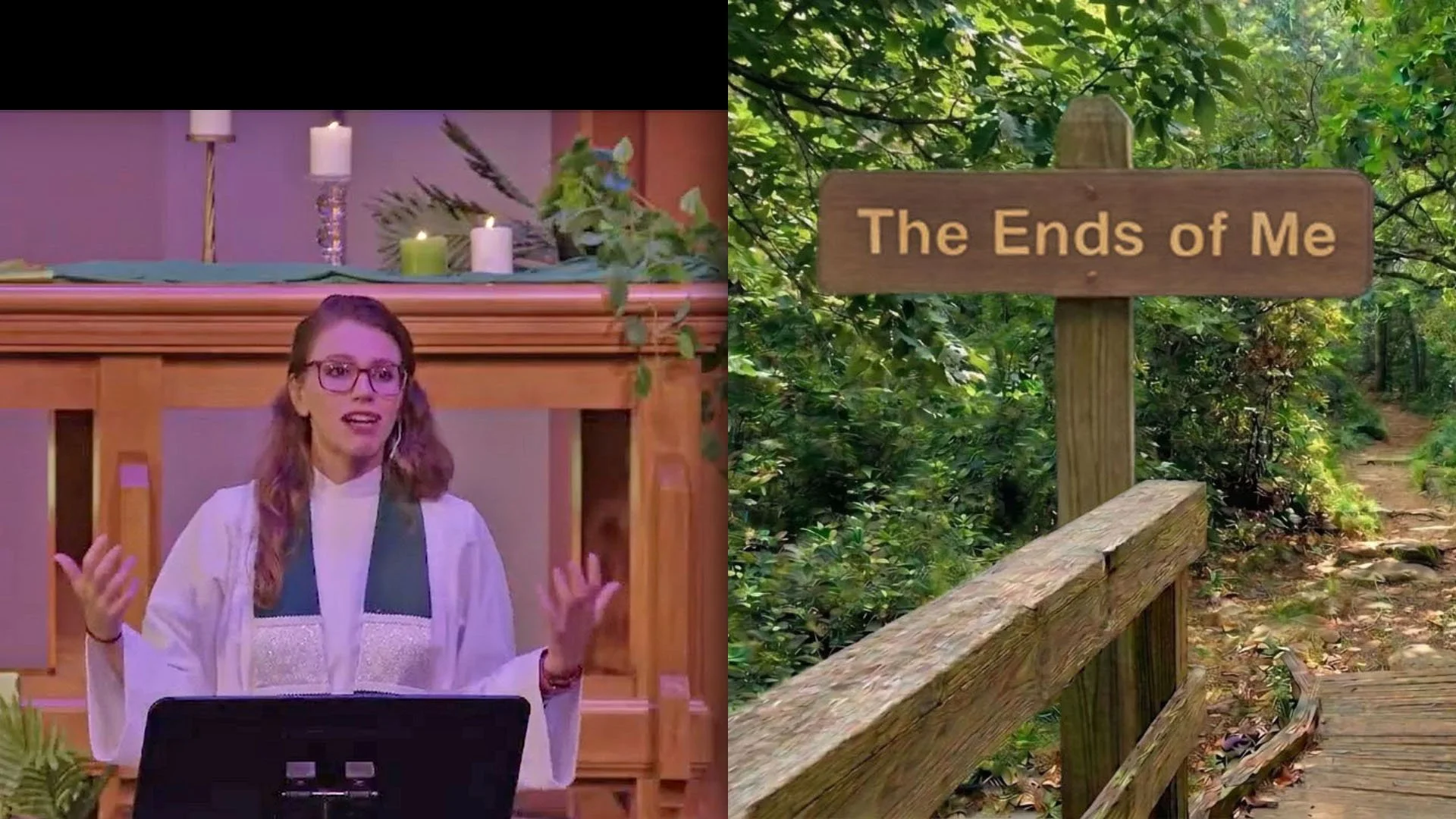
One of the most beautiful places I've experienced on this earth so far is at the top of a mountain, specifically in Whitefish, Montana, with a pair of skis on my feet. It's that moment right after you get off the ski lift. If you've never been skiing, just imagine looking out on a beautiful landscape of snow-capped mountains that are speckled with what are trees but just look like black dots. It's really hard to explain from the perspective of a girl who grew up in Florida — I'm really familiar with flat land. This was a whole new world for me, and it was the most beautiful place. And it was also the scariest place, because I had to get down somehow. And they don't let you back on the ski lift.
And so here I am, and I'm not really the world's best skier. I'm really good at putting a brave face on and trying my best. But as I was standing in awe of the scenery around me, my line of sight fell on the horizon that began the edge and the downward slope. And that was really scary. From that spot where I was standing, it looked like it might as well have been the edge of the world. I knew the slope was right there, but you had me fooled.
Life can sometimes feel like you're standing in that spot, doesn't it? Like one minute you're surveying the absolute beauty of the world around you, and then the next you're teetering on the edge of the unknown — the edge of your ability, the edge of your security — like at any moment you might just be flung into a place where you are no longer in control, or the power that you once took for granted you don't have access to any longer. It's the place where you might have one too many plates spinning in the air, where one of your very many responsibilities might crash and shatter. Or maybe it's that fear-gripping place where you are expecting the next shoe to drop at any moment, or that next medical bill to arrive, or that next rejection letter from job application after job application. Maybe it's the realization that your body is not keeping up with the rhythms of the life that you lead any longer. All of us, in one way or another, have experienced this edge — this precarious spot between here and the unknown over there. It's a place where our strength alone is not enough to carry us through the next journey.
It's in this edge place where Paul is writing to the church in Corinth. At this point in time, when he's penning his second letter to the Corinthians, the relationship between Paul and the church in Corinth has risen to new tensions. The existence of what historians have called "super apostles" or false prophets was tarnishing the validity and the reputation of the true apostolic witness that Paul professed. It's these false prophets who were boasting about elaborate visions they claimed to be receiving from God, and therefore offering alternative interpretations of Jesus's teachings that flew in the face of the Jesus that we meet in the Gospel stories — that Jesus that was portrayed through the teachings of those who had the opportunity to learn from Jesus during his lifetime. So, understandably, the church in Corinth was absolutely confused. These other prophets claimed to have these visions, and yet Paul never once spoke of visions. And on this basis, and several others, the church began to question Paul's apostolic validity.
So in response, Paul felt the pressure to defend his authority. Just a few verses before the ones that we read together moments ago, he does actually describe a vision that he had about fourteen years prior. In this vision, we've heard the language of Paul having a thorn in his side that was part of this vision and experience as well. But Greek scholars actually say that a better translation of "thorn" would have been "a stake in his side" — it's a greater impact. But historians and people who've studied Scripture really don't know the metaphor that Paul is trying to make here. Was it a metaphor for something he was experiencing in his physical body, in his spirit, emotionally, or intellectually? We don't really know. What we do know is that the stake that Paul felt was in his side was something that impeded the life that he was experiencing in that moment, that was preventing him from doing the things that he would normally do. It was something that he felt viscerally in his body.
So after praying three times for God to remove the stake from him, God responds with the words we opened the passage with: "My grace is enough." And in the words that follow, we see Paul trying to make meaning of what it means to experience this grace as it correlates with the idea of human weakness and divine strength.
Upon first glance, we might think that Paul is describing physical ability when he's talking about weakness and strength — that when we become weak in our lived experience, Jesus might just swoop in and make it all better, like a good superhero does. But I don't think that's what Paul is trying to say at all. Instead, what Paul is offering to us is a relationship between Paul's own humanity and Christ as Lord. Because when Christ is the Lord of life — because of that relationship — we cannot tell where Paul's weakness ends and Christ's strength begins. It is all bound up and tied together. It's not just about weakness and strength. What Paul is describing is an intimate connection with the Christ who is the very source of our strength, Christ who is the source of life itself.
In her book Embracing Weakness, Shannon Evans offers us a word of caution about this particular passage of Paul's. She says, "If we're not careful, we can misunderstand this passage as proving that our weakness is something to fix, to fill, to remedy as quickly as possible, rather than as a gift we are given to create longing for God from within." It's this longing, this felt need for connection, that is the invitation to the Corinthian church and to us this morning — to cultivate and evaluate the longing of our hearts for connection with Christ as our Lord. How might we be invited to cultivate this connection with the divine source of strength, like the one that Paul describes having?
It's cultivating this lasting connection with the divine that was chief on Jesus's list of concerns in the final hours he had with his disciples the night that he was taken into custody. In John's Gospel, there is a section of Jesus's teachings — multiple chapters — called the Farewell Discourse. These teachings take place right after the Last Supper and before the arrest of Christ. It almost reads like Jesus is saying, "Oh wait, don't forget this, and this, and this, and this." It's the most concise part of Scripture where Jesus is talking a lot.
It's in John 15 where Jesus implores his disciples to remain connected to him, by using an image of a grapevine. He says,
"Remain in me, and I will remain in you. A branch can't produce fruit by itself and must remain in the vine. Likewise, you can't produce fruit unless you remain in me. I am the vine, you the branches. If you remain in me and I in you, then you will produce much fruit. Without me, you cannot do anything."
If you've ever spent time in a vineyard or really studying a grapevine, it is quite an unusual plant to look at — it's not at all what you would expect. And there's a science to cultivating the perfect grape, and part of that science is connected to the intrinsic structure of the plant itself. You notice that the sturdiest part of the plant is the vine — the part that is rooted deep into the soil, the part that looks like wood. You'll also notice that the branches coming up from the vine are not as strong — in fact, they're kind of flimsy and flexible. But that's where the fruit hangs from. The strongest point of that branch is where it's attached to the vine. It is in that connection where the nutrients are shared that makes the growth of the grape possible. The stronger the connection point, the better the growth of the grapes. But this connection is not one that is made overnight — it's one that takes time and constant attention and nurturing to be able to grow.
The same is true for a life of faith, a life that is shaped by Christ. It is a way of life that is intended to be cultivated over time. It's spiritual practices that are repeated time and time again — spiritual practices that might have to shift based on what is happening in your own life in the season that you might find yourself in. But they are practices that, if done often, strengthen our connection to the Lord of life.
Bishop Tom Berlin, in his book Jesus is Lord, says it this way: "The word Lord implies a relationship that is a way of life rather than an on-again, off-again association with the parts of a religion that a person currently likes." It is an invitation that is ongoing, that ebbs and flows, but an invitation for us to remain deeply connected to the one who is our source.
John Wesley, the founder of the Wesleyan movement, was someone who knew what it looked like to stay in deep connection with the source of life. Did you know that John Wesley, over his whole life, wrote 42,000 sermons? Now, I preach a lot of sermons, and I don't know if I've got 42,000 in me. My friends, that's a lot of sermon writing, that's a lot of work. But not only did he write a lot of sermons, he also rode on horseback over the course of his life 250,000 miles. That's a lot of miles in a car where we've got comfortable seats and air conditioning and music — horseback, that's a lot of miles. And on average, depending on the season of his life, he was preaching about three sermons a day. A schedule like that would exhaust anyone. And in fact, it even shocked him. At the age of eighty-three, we see in his journal writings he said this about his schedule: "I am a wonder to myself. I am never tired, either with preaching or writing or traveling." How did he do it, even all the way into his later years? And friends, I did search through his journal — I have a copy — and there was no evidence of coffee consumption. It wasn't there. So the source of his energy had to come from somewhere, and it came from his spiritual habits, his disciplines, and the way that he structured his life so that he would remain in tune with the Spirit of the living God.
Until his final days, John would start his day in a room that is off to the side of his bedroom — it was technically a part of his bedroom — but he would wake up and go into this room and he would kneel. There's a little kneeler that folds out from underneath the desk part. Friends, he woke up at 4:00 every morning — 4 a.m. — and spent two hours there on his knees, praying and studying Scripture. Two hours kneeling, cultivating that spirit of connection, not for the sake of writing his next sermon, but simply to renew his own spiritual well-being. Not only that, every hour of the day, John Wesley was known for pausing for just a few moments to spend in prayer and quiet contemplation. And then when the day was done, after all the work was accomplished, before he went to bed, he would spend time reviewing his day and the effectiveness of his practices, and he wrote those down in his journal. Until his last breath, John remained connected to Christ. It was Christ who made it possible for him to go that whole distance. And you cannot tell where John Wesley's weakness ended and where Christ's strength began. We in this room are evidence that John's very life was a witness to the lordship of Jesus Christ.
So, friends, the strength of our connection to Christ does matter, especially if we claim that Christ is our Lord — not because it is a requirement for us to get to heaven, but because our own holistic well-being is better for it. John Wesley's practices are strict and wild, and I'm not saying we should all wake up at 4:00 in the morning, because that's a lot. But what I am inviting us to consider is what our daily practices are. How are we cultivating an ongoing relationship to Christ, who is our source of life and strength? What does it look like to add even five minutes into our daily routine if you don't have one already? Because how we nurture our connection to the source of life matters — it matters for our well-being, and it matters for our community, especially as we seek to witness to the Christ who calls us to be — repeat it with me — big-hearted, Spirit-led, Christ-minded, and bound by love.
The strength of our connection to Christ matters not because Jesus is going to swoop in and make all the hard and uncomfortable things in our life go away, or eradicate all of our weaknesses. It matters so that when the storms of life threaten to tumble us off the edge of what was once familiar, we can endure the journey because our souls are planted and rooted in a strength that is not our own, but the strength of Christ, who is our Lord.
Thanks be to God for the source of life and the rain that's now coming down outside.
Amen.