
-
Think about an orchestra or a band, where every instrument matters, even the quiet ones in the background. Is there a gift or contribution you've been holding back because it doesn't feel as important or flashy as someone else's?
Hildegard kept her visions to herself for decades out of humility or hesitation before she finally shared them. Is there something you've sensed you're meant to create, say, or offer that you've been sitting on? What's held you back?
Philip didn't have a polished plan when the Spirit told him to approach the chariot, he just went and started listening. Where might you be waiting for a clearer plan before stepping toward someone, when maybe you're already equipped to just show up?
The sermon lists very ordinary gifts, cooking, listening, organizing, gardening, as ways the church actually grows. Which of your own "ordinary" abilities might be exactly what someone around you needs right now?
Giving was described as more than a financial pledge, it's also offering the parts of yourself that can't be written on a balance sheet. Beyond money, what's one non-financial gift you could commit to offering this year?
Transcript:
You know, I've always been fascinated with the way that a great piece of music comes together, or a masterfully produced piece of art comes together. If you listen to a rich piece of music, whether it's a full orchestral symphony, or whether it's a classic album, or whether it's a song sung by a great choir, what you realize very quickly is that no single instrument is carrying the whole thing on its own. You have the bass that holds down the foundation. You have the percussion that's driving the rhythm. You have the melody that's leading the way. And then you have these subtle harmonies that are filling the background. And the thing is, if everybody tried to play the exact same instrument, or sing the exact same note at exactly the same time, it would cease to be music. It would just be noise. The beauty of a piece of music performed by a band or an orchestra or a choir lies in the diversity of gifts, all coming together in synergy, in the process, to become something that is much greater than the sum of all the individual parts.
All of those distinct talents and skills and notes, they come together to create something vast, something beautiful, something that is whole. Every single contribution matters. And if someone chooses to hold back their gifts, you know what happens, the whole composition loses something essential. Now, I hope that we know that this much is true for any musical performance, but I hope that we know it's also true in the body of Christ, in the church.
You see, by the power and by the work of the Holy Spirit, the church universal, that's you and me and our brothers and sisters throughout the world, we have been gifted for God's good work in the world. Give me an amen if you agree with that. Yes. And that means that each and every single one of us gathered here this morning, and you who are worshiping with us online as well, you have been given unique and diverse gifts from God, not so that you can hoard them and keep them hidden and just keep them all for yourself, but actually so that you can offer them back in radical gratitude to the God who gave them.
It happened again, Marisa, I'm trying technology today. Technology failed me again, it failed me again.
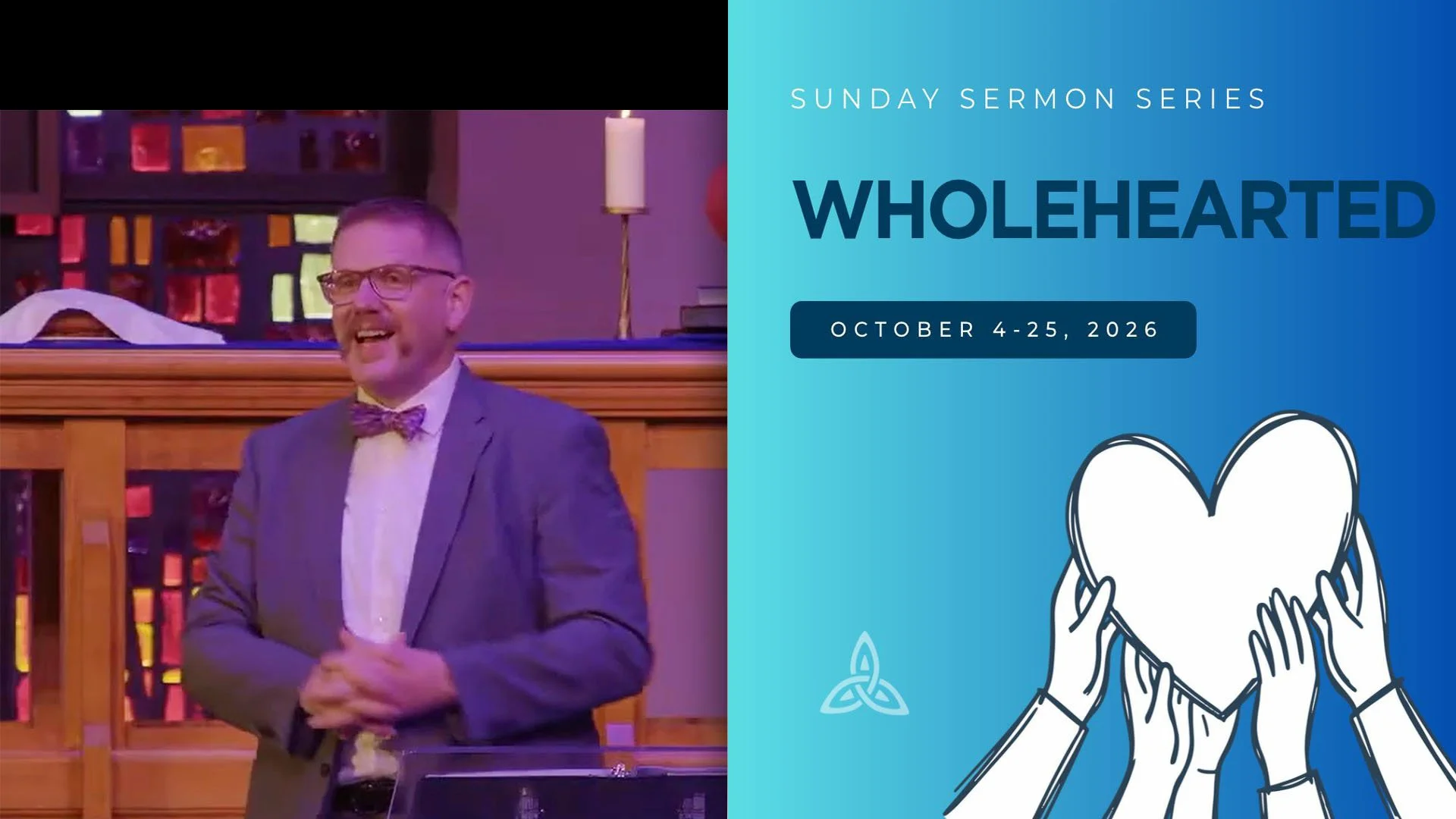
Back to paper and pen. We are closing out our Wholehearted series of sermons today. And so just one more time, we are going to now turn to the Acts of the Apostles, and we're going to listen in on a famous story from that account. It's the story of Philip and his encounter with an unexpected traveler who he meets on the road from Jerusalem to Gaza.
So, listening with me as I read to you the words of God from Acts chapter eight:
Then an angel of the Lord said to Philip, “Get up and go toward the south to the road that goes down from Jerusalem to Gaza.” (This is a wilderness road.) So he got up and went. Now, there was an Ethiopian eunuch, a court official of Candace, the queen of the Ethiopians, in charge of her entire treasury. He had come to Jerusalem to worship, and was returning home, seated in his chariot, he was reading the prophet Isaiah. Then the Spirit said to Philip, “Go over to this chariot and join it.” So Philip ran up to it and heard him reading the prophet Isaiah, and he asked, “Do you understand what you are reading?” He replied, “How can I, unless someone guides me?” And he invited Philip to get in and sit beside him. Now the passage of scripture that he was reading was this:
“Like a sheep he was led to the slaughter,
and like a lamb silent before its shearer,
so he does not open his mouth.
In his humiliation, justice was denied him.
Who can describe his generation?
For his life is taken away from the earth.”
The eunuch asked Philip, “About whom, may I ask you, does the prophet say this, about himself or about someone else?” Then Philip began to speak, and starting with this scripture, he proclaimed to him the good news about Jesus. As they were going down along the road, they came to some water, and the eunuch said, look, here is water! What is to prevent me from being baptized? He commanded the chariot to stop, and both of them, Philip and the eunuch, went down into the water, and Philip baptized him. When they came up out of the water, the Spirit of the Lord snatched Philip away. The eunuch saw him no more, and went on his way rejoicing. But Philip found himself at Azotus, and as he was passing through the region, he proclaimed the good news to all the towns until he came to Caesarea.
My friends, this is the Word of God for us, the people of God. And we say together, thanks be to God.
You know, over the last few weeks, we've been pairing these passages from the Acts of the Apostles with the stories of some of the saints of the church down through history. This week we are meeting our final saint in the series, a woman who was blessed with an extraordinary diversity of gifts. Now, she doesn't have a modern-day holiday named after her, and she might not have the household familiarity of, say, a Mother Teresa of Calcutta, or a Saint Patrick of Ireland. Yet this saint is celebrated across the world, in particular for her music, as well as for her writing and for her brilliant mind. I am referring to Hildegard of Bingen.
She was a twelfth-century Benedictine abbess. She was also an artist, an author, a composer, a mystic, a pharmacist, a theologian, a poet, and a doctor of the church. All those things wrapped up in one life. Pretty amazing, right? It's often been said, actually, of her, that she was a bit of a Renaissance woman, centuries before the Renaissance even actually happens.
Hildegard was born in Germany in 1098, during a turbulent era of political upheaval and military conflict. She was the tenth child born to a noble family, but actually she was a bit of a sickly kid, and that meant that she spent an awful lot of time in quiet solitude. Now, if you remember, I told you about Saint Patrick, who spent a lot of time in solitude as he tended sheep on the hills of Ireland. And similarly, Hildegard, just as Patrick, found God in that solitude. Hildegard and her hours of quiet also turned her heart towards God.
Well, per the tradition and custom of the day, Hildegard was placed into a monastery as a young woman under the care of a devout nun by the name of Jutta. And you could say that Hildegard gave her life to God when she entered the abbey as a youth. But the reality is that she doesn't give herself wholeheartedly to God until much later, when she responded to the Holy Spirit's promptings to begin sharing her many gifts with the world around her.
It is said that for decades, Hildegard experienced these very vivid spiritual visions, but she always kept them to herself, out of a deep sense of humility, or a deep sense of hesitation about putting her thoughts out into the world. It wasn't until she was 43 years old that she felt the Spirit compelling her to write these visions down, and to speak out more in her own words. She said this of this time: "Heaven was opened, and a fiery light of exceeding brilliance came and permeated my whole brain, and inflamed my whole heart and my whole breast." From that moment on, this river of creativity burst forth in her life.
She wrote groundbreaking books on theology, on natural science, on medicine. She composed some exquisite sacred music that is still performed and streamed millions of times across multiple platforms. In fact, there are more surviving chants by Hildegard than by any other composer from the entire Middle Ages, and she is one of the few known composers who wrote both the music and the words to go with the music.
A remarkable woman, but it wasn't just her creative and intellectual output that drew people to her. She also had this luminous faith. And so bishops and leaders of the church, as well as everyday people, would come from miles around just to spend time with and speak to Hildegard, this gentle nun with these bright eyes who saw in every person the living spark of God.
Hildegard of Bingen demonstrated that any gift, any gift, no matter how unique, can be used to glorify God. She wrote poetry. She planted medicinal gardens. She composed music. She even created recipes for what she called "cookies of joy" to bring physical and spiritual health to the sick. That's my kind of cookie, right? Cookie of joy. What mattered wasn't the category of the gift, friends. What mattered was Hildegard's complete faithfulness to where and how the Holy Spirit was calling her to use all that she had been given.
Now, just a few moments ago, we read of a very similar faithfulness to the Holy Spirit's direction in that reading that we shared from Acts chapter eight. Now, this story is actually a major turning point in the book of Acts. If you're familiar with it, you might remember that back in Acts chapter one, we read of Jesus telling the disciples that they would go on to become his witnesses in Jerusalem, and all of Judea and Samaria, and to the ends of the earth. Well, up until this moment, in chapter eight, in the story, the good news actually hadn't really traveled anywhere. It had stayed very close to home, not spreading widely at all.
But in this reading, the Holy Spirit nudges Philip, who is a Greek-speaking deacon, to walk along this wilderness road from Jerusalem to Gaza. And along the way, he encounters this high-ranking official from Ethiopia. This traveler is a man of great authority, of great wealth. He's a higher-up in the court of Queen Candace. However, the religious culture of the day stated that as an outsider, and as a eunuch, he was barred from ever being fully included in temple life. Now, this man was a religious seeker for sure, the text tells us that he had just been in Jerusalem for worship, but the reality was that according to the religious traditions of the day, he could never have been fully included in this life together of the family of God.
So I want you to take note of what happens next in the text. The Spirit does not tell Philip to preach a three-point sermon with a finely crafted invitation at the end. No, the Holy Spirit simply says, go over to this chariot and join it. Philip goes, and then uses these gifts of hospitality and evangelism. He runs up to the chariot, listens to what the man is reading, sits down beside him, and has a conversation about what the Ethiopian is reading, ultimately going on to proclaim the good news of Jesus' death and resurrection.
And then, when they come to this body of water, the Ethiopian asks a question that has echoed down through the centuries since: "Look, here is water, what is to prevent me from being baptized?" You know the answer, right? You know the answer. Absolutely nothing. Let's just try that. Look, here is water, what is to prevent me from being baptized? Now you've got it. Absolutely nothing. He's baptized right there and then. God's amazing and saving grace cannot be restrained by human boundaries, status, or background. And the Ethiopian eunuch then goes on his way rejoicing, carrying the good news of Jesus Christ to the continent of Africa.
What Hildegard of Bingen, Philip, and this Ethiopian traveler teach us is that when we yield to the Holy Spirit moving within us, transformation happens. And that, my friends, is how the church grows. I mean, yes, surely the early church grew in public squares through great preachers and teachers, but it also grew at kitchen tables, over meals that were prepared by people who had the gift of hospitality. It grew on that wilderness road because Philip was willing to sit beside a stranger and listen. It grew when Patrick returned to Ireland with a heart full of forgiveness for the people that had enslaved him and held him captive for six years of his life. It grew when Teresa served those who were forgotten and marginalized in the streets of Calcutta. It grew when Nicholas used his great inheritance to rescue vulnerable families from lives of poverty. And it grew when Hildegard shared her music, her writing, and her medicinal recipes with the world around her, so that others could have a glimpse of the light of Jesus Christ.
So if you're sitting here today in church, or if you're sitting at home and you're thinking that your talents are just average, or ordinary, or common, or unimportant, if you are daring to think that and believe that you don't have some official gifts of the Spirit, well, I want you to remember what we read later on in the New Testament, in James chapter one, which says that every good and perfect gift comes from above. Every good and perfect gift comes from above.
My friends, I want to say this to you today, and I want you to hear it loud and clear. Do not hide your gifts away. Do not hide your gifts away. Offer your whole self, with your unique skills, with your personality, your passion, your story. Offer yourself in ways that help others to know of this great love of Jesus Christ, others right here in Gainesville, and of course throughout the world, as the Spirit leads us.
Can you cook or bake? I know some of you can, because I've gotten to sample some of that already, and it's delicious. If you can cook or bake and feed someone who's hungry or hurting, invite them to your table, sit with them. Are you able to listen well to others? Well then, sit with someone who's lonely. Sit with someone who needs some safe space just to speak of what's going on for them. Can you organize or encourage? Can you sing? Can you teach? Can you build? Can you garden? Whatever you can do, do it all wholeheartedly for God and for the world that God loves.
You know, over these past few weeks, we've talked about what it means to be these wholehearted followers of Jesus Christ, wholehearted stewards of everything that God has entrusted to us. We've talked about offering up our financial gifts. We've talked about doing small acts of kindness with great love. And today we're talking about offering our creativity and our intellect and all of the gifts that God has given to us.
And, you know, in just a moment, we're going to have an opportunity to bring forward any pledge cards that you've brought to church today, commitments for our 2027 ministry year. Several weeks ago, when I first contacted you about this series, I invited you to be in prayer throughout all of this. And my hope and my prayer is that you have spent time seeking God's guidance, reflecting on how you might support the ministry and the mission of Trinity. As we have said again and again throughout this series, a pledge that you bring forward today is not an institutional bill. It is no kind of legally binding contract. It is simply a gift that you are bringing, having prayed about it and sensed the leading of God. It is a gift of future to the generations that will come after us. It's the gift of presence that keeps our amazing campus wide open to the community around us, and keeps our ministries alive. It is the gift of faith. The gift of faith, declaring that we trust in God's goodness and God's provision in our lives.
I hope you have heard, across this series, that our stewardship is not contained only in pledge cards, as helpful and as important as they are. We carry a vast diversity of gifts, most of which cannot be written down on a balance sheet at all. So today, friends, as you bring your pledge card forward, I'm going to invite you also to consider a second question, something like this: Lord, what other gifts have you given me that I have been holding back? How are you calling me to serve?
And if God brings a gift, or a passion, and a calling to your heart today, then resolve to share it. Share it in our life and our work together here. Reach out to myself or to Pastor Marisa, so we can help plug these unique gifts into the mission and ministry of our church family.
Our mission is to make disciples of Jesus Christ for the transformation of the world. Our vision is that Trinity will be a courageous witness for Christ, by welcoming all people, growing loving relationships, nurturing deeper faithfulness, and doing all the good we can in our community and beyond. Our values state that we are big-hearted, Spirit-led, Christ-minded, and bound by love.
My friends, living into this mission, vision, and values involves all of us bringing all that we can and offering it up for God's glory, and doing so wholeheartedly. So may we all be wholehearted followers of Jesus Christ, and wholehearted stewards of all that God has given us. In the name of the Father, and the Son, and the Holy Spirit. Amen. Amen.
My friends, what we're going to do at this moment in our service is enter into that moment of commitment, to make this Commitment Sunday a thing in our lives. And I hope that you have either received in the mail, or you've picked up in the narthex, one of these, this is a pledge card here. If you haven't got one so far, you can either sprint to the back and get yourself one now, or you can get one on your way home and bring it back at a later time. But this is simply a card that invites us to think about how we will get behind the ministry of the church here. It helps us in our planning.
And so, if you came prepared today, we're going to have some music just playing in the background, and as it plays, I'm going to say a prayer of commitment. And when I'm done with that prayer, I invite you just to rise up from your seat, if you've come to do that today, and to bring these forward and place them in the baskets on either side here, the baskets to my left and to my right. Just simply put it in there, and then return to your seat. Take some time in prayer as we pray together about our future. Will you bow your heads with me just now?
So, gracious God, for all of the gifts and graces that you have poured out into our lives so abundantly, for all that we get to enjoy, we also hear your call to return a portion of them, to join them together in our life together here at Trinity, and to move forward in the ministry that you call us to. So, gracious God, would you receive these gifts as we bring them today? Would you bless them and use them for the building of your kingdom and for the glorifying of your name? This we ask through Christ our Lord.
Amen.