
Chasing the Wild Goose | 5/24/26
-
What are some good works or acts of service that naturally flow out of your faith and gratitude rather than obligation?
Can you think of a time when you felt “very unwillingly” drawn into something that later became meaningful or transformative?
Where might the Holy Spirit be pushing you outside of your comfort zone right now?
Who are the people in your community who may feel overlooked, unwelcome, or forgotten, and how might you help them experience God’s love?
Transcript:
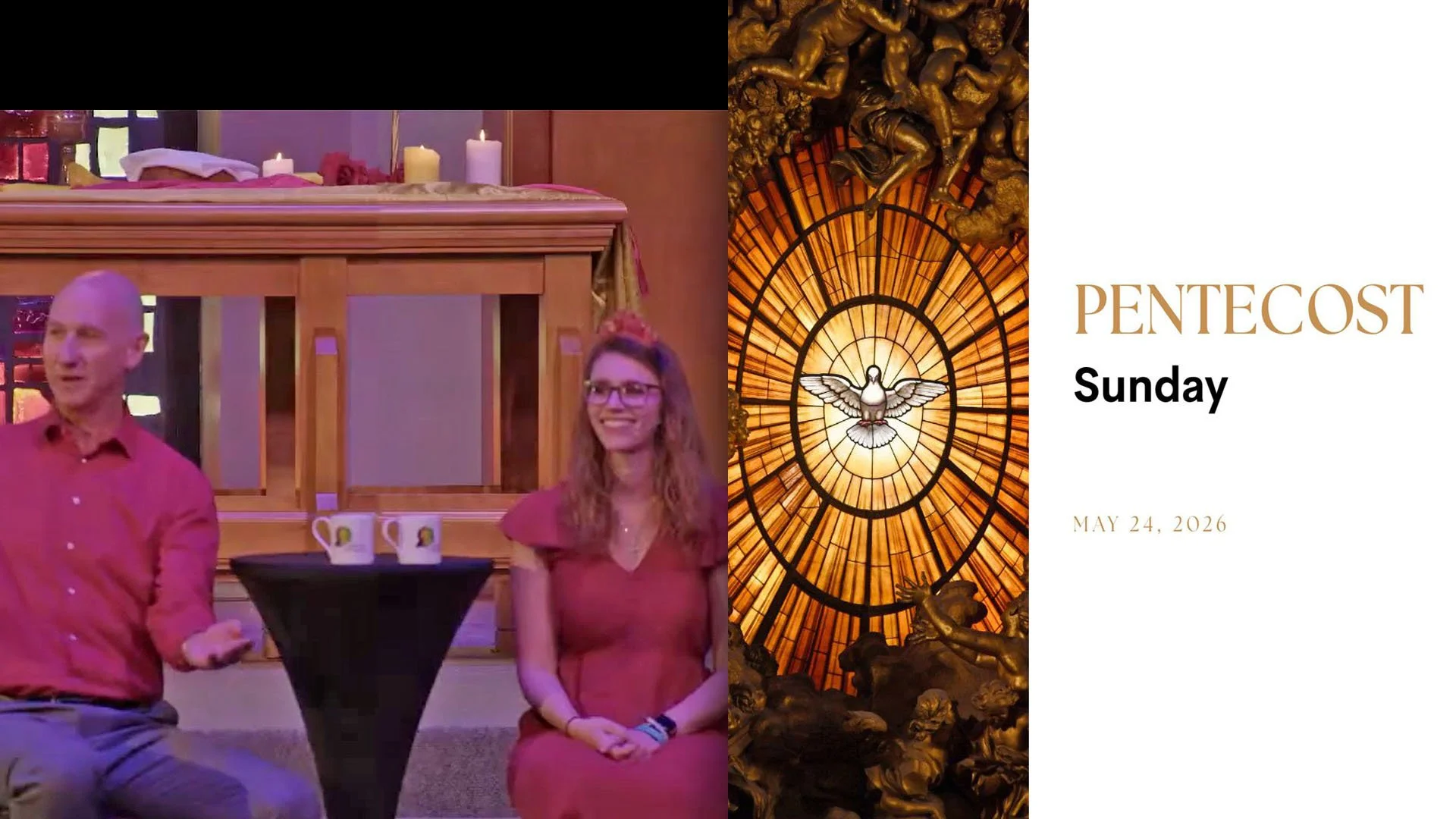
Steve: Welcome to Pentecost Sunday, but not only to Pentecost Sunday, because did you know that today the stars have aligned like they only do every certain number of years? When Pentecost Sunday and Aldersgate Day fall on the same day? What is Aldersgate Day? Some of you might be saying, I’m so glad you asked. Aldersgate Day is when we remember a very significant event in the life of John Wesley, the founder of the Methodist movement. And how great that not only do the stars align today for those two things to be on the same day, but also on the Sunday right after Marisa and I have just returned from England, where we spent ten days with eight other people, including Catherine, my wife, our district superintendent, and some other clergy and their spouses, walking and tracing the steps of Wesley and hearing about the story of the early Methodist movement, as well as looking at examples of how the Methodist movement continues to flourish today.
And right near the end of that journey, we found ourselves in front of a memorial to Aldersgate Day that is located outside of the building that used to be the Museum of London. I think we have a photo of our group gathered there. That thing that looks kind of like a flame in the background—this large, and you can see how large it is based on our size in front of it—is this wonderful memorial to this event in John Wesley’s life.
Marisa: And you’ll notice we’re all wearing coats; it was a little chilly, but I was so pleased to be able to be a part of this pilgrimage. This is the first time that I have traveled like this, and especially across the pond to England. I have studied John Wesley and the Methodist movement my entire adult life. And, you know, when we do that, we run the risk of seeing these incredible figures as simply a person on a page.
We read their quotes and we forget that they actually lived life. They were human people with human thoughts and emotions and experiences. And so being able to walk through England, tracing John and Charles’s lives, helped me put a human face back on this movement and this incredible story of how God was at work through incredible people.
And one of the examples of John being incredibly human is actually some of the words that you see on that flame, which helps set the stage for that moment at Aldersgate. He said in his journal, ‘In the evening I went very unwillingly to a society in Aldersgate Street.’ Now, how many of us have said that about something we were going to, that we were very unwillingly going?
I know I say it almost every day.
...where one was reading Luther’s preface to the Epistle to the Romans. About a quarter before nine, while he was describing the change which God works in the heart through faith in Christ, I felt my heart strangely warmed. I felt I did trust in Christ, Christ alone for salvation. And an assurance was given me that he had taken away my sins, even mine, and saved me from the law of sin and death.
Steve: Now, when John described that experience in his journal, he, of course, when he talked about his heart strangely warmed, was not talking about the gift of coffee. However, if you know anything about Marisa and me, you know that we both appreciate a good cup of coffee. And so we felt like we had to get these mugs from the Epworth Old Rectory, which say, “I felt my heart strangely warmed,” as a memory of the occasion.
Marisa: The Old Rectory was where John grew up, his father was a rector at a church in Epworth, and we got to see that house and found these awesome mugs.
Steve: So as you look at that quote and hear Marisa read it, you know, this is a pivotal moment in John’s life and his experience of God’s presence in his life. So a little bit of background before this: this happened May 24, 1738. Before this, John had already been ordained as a priest in the Anglican Church. He had participated in the Holy Club with his brother Charles and with other men in Oxford, and they had felt compelled, as a response to their faith, to practice good works that make a difference in the lives of others, particularly in the lives of those who were impoverished and suffering, many of whom were struggling to have food to eat.
They felt compelled to go to the prisons and visit the inmates. John had also, by this time, already traveled to the Americas, feeling compelled to be a missionary across the pond, and he failed miserably, as we know from his journal, and then came back to England. So this was not his first experience of faith, and yet this moment in the spring of 1738 was a time at which the Spirit did a work in his heart that really changed things for him.
And he came to really understand that God loved him no matter what, and that nothing could take that away. And so from this point forward, as we read in his sermons and in his journals, he begins to see more clearly that the works are the fruit of a life that has been given over to God. The works are not the means to being saved. It’s not that he’s trying to accumulate doing as much as he can in order to achieve salvation, but rather the works are the outgrowth of a life that has found freedom in God’s love. And so this changes everything.
Only three weeks after this, John is back in Oxford again for a period of time. And on that Sunday, three weeks after his heart-changing experience, he is preaching at Saint Mary’s Church in Oxford, and he chooses for his text Ephesians 2:8.
Ephesians 2:8 is the verse that says, “For by grace you have been saved,” and it’s set in the context of this larger section from that second chapter that I’ll read for you now:
“But God, who is rich in mercy, out of the great love with which he loved us, even when we were dead through our trespasses, made us alive together with Christ. By grace you have been saved, and raised us up with him, and seated us with him in the heavenly places in Christ Jesus, so that in the ages to come he might show the immeasurable riches of his grace in kindness toward us in Christ Jesus. For by grace you have been saved” [there it is again] “through faith. And this is not your own doing. It is the gift of God, not the result of works, so that no one may boast. For we are what he has made us, created in Christ Jesus for good works.”
So notice in the Scripture there, that shift—that it is not a works-based righteousness, but it is grace and faith that lead us into the works that God calls us to, which God prepared beforehand to be our way of life.
So this sets John on this new trajectory and path. But did you know that as well as John having a heartwarming experience in May of 1738, his brother Charles, in his own writings, also describes a transformational experience that actually happened three days earlier on May 21, 1738?
Marisa: And the plaque that you see a picture of on the screen is commemorating both of these moments. You know, we hear a lot about John Wesley when we sit in Methodist churches, but we don’t always hear about Charles, his brother. And they very much both had immense roles to play in the trajectory of the Methodist movement. John was the organizer, and Charles was the poet that put thoughts to paper that became a multitude of hymns.
In fact, that Holy Club Steve was talking about at Oxford was Charles’s idea. Charles got it started. He got all of those friends together in a room and invited John to be a part of it, and asked John for some advice about how to structure that time together to make it the most fruitful. And so, really, Charles was that one that would connect people together.
The tour guide at Charles’s house described him as a man who was made for friendship. And so right after he had this experience of the Holy Spirit for himself, a couple of days before John, he responded by putting some words together in a verse of a hymn.
And this is that hymn. He said:
‘Come, O my guilty brethren, come,
Groaning beneath your load of sin.
His bleeding heart shall make you room;
His open side shall take you in.
He calls you now, invites you home.
Come, O my guilty brethren, come.’
Steve: Charles was quite the prolific writer, particularly of poems and hymn texts. In fact, one of the things that we know about him is that he wrote somewhere between—this is the range, and scholars aren’t exactly sure how many—but somewhere between 6,500 and 9,000 hymns over the course of his life.
And many of those hymns, even the ones that we know, we are only singing a few of the verses. Typically we sing three, four, or today we actually sang six verses of one of his hymns. Many of his hymns contained anywhere from 10 to 12 verses because he was teaching theology as he wrote. He was helping people express the faith through song. And Marisa, when we were in his house in Bristol, you had a really great insight into the impact of that. Share about that a little bit.
Marisa: Like I said, we hear all about John Wesley and not so much about Charles. Maybe not everyone, but most of us who are sitting in United Methodist churches or Methodist churches around the world can’t actually quote from memory John Wesley quotes unless you are deeply entrenched in that scholarship. But we, more often than not, can think of a verse of Charles Wesley hymns.
‘Hark! the herald angels sing—’
Steve: What’s the next line?
Marisa: ‘Glory…’ [congregation: ‘to the newborn king’] You just quoted Charles Wesley!
Steve: ‘O for a thousand tongues to sing—’
Marisa: ‘My great Redeemer’s praise.’
Steve: So you all can do this!
Marisa: Yes! And so that’s the lasting impact. John and Charles together set this trajectory, the Methodist movement, in motion. But today we are still quoting Charles Wesley, the theology he put to paper. What a gift we have of his talent that continues today.
Steve: Yeah. And the impact of those hymns and the way they’re just embedded in our memory, the way songs do.
So Charles’s house that we had the opportunity to visit is located in Bristol, which is one of the towns where we spent a little bit of time because it is a significant site both for John and for Charles and for the Methodist movement. In fact, it is in Bristol where John for the first time decided to try something that was very surprising and very outside of anything he would have seen himself doing.
We know from John’s journals that the idea of preaching outside of the walls of a church building felt improper, perhaps even blasphemous, to him.
Marisa: Heaven forbid.
Steve: Right. But he had a friend, George Whitefield, who was also a preacher, who had started ministering to people in Bristol and realized that there was a need to go outside the church in order to connect with people who didn’t feel welcomed by the church. These were folks who were living in impoverished conditions, people who were working in the mines called colliers, for whom conditions were horrific.
And so Whitefield began to go out and to share the good news with them so that they also knew of God’s love for them. And he wrote to John—and we have their correspondence in the letters he wrote to John—and said, ‘John, you really need to come over here and do this work with me.’ And John resisted for a while, but finally he relented and went to have this experience of first observing and then actually stepping into the practice of preaching in that manner.
Marisa: So he goes to join George Whitefield just a few months after his heart strangely warmed experience. He goes to Bristol and follows George out to this place called Hanham Mount, which you can still go to today. And I think we might have some pictures of us.
I think we do, well, see, there I am!
Steve: Look at that preacher on the mount.
Marisa: Look at that. And behind me it’s sort of a natural amphitheater. If you could use your mind’s eye, you can see that there are some houses right there, but back in John Wesley’s day there wouldn’t have been houses. It would have just been fields. And you can imagine a multitude of people coming to that place to listen to the good news that John had to share.
And so he goes, and he witnesses George do that very thing and saw all these people come and realized that this was where the next movement he was invited to make. And we see that in his journal on that very day. He says, ‘At four in the afternoon, I submitted to be more vile’—what a great phrase—‘and proclaimed in the highways the glad tidings of salvation, speaking from a little eminence in a ground adjoining to the city to about 3,000 people.’
Steve: And what a coincidence, right, that in his journal he captures that moment and mentions 3,000 people, which is the precise number that we hear in today’s story in Acts 2—that the response to the movement of the Holy Spirit and to Peter’s first sermon was this outpouring of the Spirit on 3,000 people.
Marisa: And this opened up a whole world for John. Literally on Hanham Mount, right next to that little alcove where you could step in, is the quote, ‘The world is my parish.’ And so what a great expanding moment for John.
Steve: So while we were there at Hanham Mount, I believe we have a photo of another preacher standing on the mount.
There you go. There’s our esteemed district superintendent sharing a good word from the mountaintop!
Marisa: And you shared a good word too. It was a good word. And we’re about to share it with you. Every day on our trip, the preachers who were among us were invited once a day to give a devotional, and Steve gave one on Hanham Mount that actually really helped me put something into perspective that I had never thought about before. Steve, can you share with us?
Steve: I’d be happy to. So for me, the work of the Holy Spirit comes in different ways in different times in our life. There is the work of comfort and assurance that the Holy Spirit brings. And we see that in John’s own experience of the Spirit on that Aldersgate Day, when he knew for sure that God really loved him. And for that particular way in which the Holy Spirit comes, the image of the dove, which is perhaps our most familiar image of the Spirit, comes to mind for me.
But the Holy Spirit also comes at times with discomfort and pushes us out of our comfort zone and disrupts things as we know them, and calls us to risk going somewhere and doing something that we would not choose to do on our own. And the image of the Holy Spirit for me that resonates with this work of the Holy Spirit is one that comes to us from the Celtic Christian tradition, and it is the image of the Holy Spirit as a wild goose.
Because the wild goose is untamable. The wild goose is unpredictable. And the wild goose honks loudly and makes sure it is heard so that we might respond and go where the Holy Spirit is leading us.
And so it’s this wild goose image that, for me, captures what happens to John in this moment in Bristol. And I don’t think it would be a stretch to say that from this point forward in John’s life, as we look at the work of the Methodist movement through his leadership for the rest of his life, he was on a wild goose chase. And it led him to do things far outside of his comfort zone or ways that he would have imagined.
So, for example, he begins to license preachers who are not ordained because he sees the need for them.
Marisa: Some of them haven’t even been to seminary.
Steve: Correct. And he sees the fruit of women preaching, and so he starts recognizing and authorizing women to preach as a part of the movement in the 1700s. He begins to send ambassadors for the church over to America, coming across the pond. He recognizes that part of the work of the church and part of his calling is not just to care for the spiritual needs of people, but for the physical needs of people as well. And so reaching out in service and becoming one of the early advocates for the abolition of slavery in his time—the wild goose was constantly moving John out into new and different territory.
Marisa: Another example of that is actually right in Bristol, in the same area as Hanham Mount where he was doing the field preaching. He actually put up a significant portion of his own money, along with the collections of others, to help establish what we call the New Room. And it’s still an active building today.
And in this New Room is a space—a very much multi-purpose space—for worship, for education, for a medical dispensary. Folks who didn’t have access to medical care were able to come and receive homeopathic ways of helping them with medicines they needed, and clothing for those who didn’t have adequate clothes—all in this New Room space. Very much an example of this wild goose chase that leads him to do something miraculous for that community, to care for those in need.
Steve: I love the way that the New Room today is bridging the past and the present. So you walk in and you see that quote on the photo that we captured while we were there: ‘I love this place. It’s Bristol’s best secret.’ And when you walk in the entrance, there is a café where people gather today. But then as you continue in, you walk into the worship space that has largely been preserved just as it was in Wesley’s day.
And so you can see this next photo where you see the pulpit with a couple of preachers you know standing in the pulpit there inside the worship space at the New Room, and it continues to be utilized today for the purpose of worship and other gatherings.
And as we look at that and think about the impact of Methodism not only back then but even now, it draws me kind of toward how we might wrap this up today, Marisa. And I’m struck by a quote that you noticed on one of the walls in the display upstairs in the New Room today: ‘I continue to dream of the time when the potential of each person can be unleashed.’
And I’m wondering, as you think about that quote that Wesley made almost 300 years ago now, how do you see that and the Methodist movement and the work of the Spirit then connecting with us today?
Marisa: I think when we think of stories like Pentecost or the beginning of the Methodist movement, we almost see it as a story that’s completed. It’s written down. It’s a closed story. But very much the movement of the Holy Spirit and this idea of the wild goose is a story that is still unfolding for us today.
God is not finished doing a good work through the Methodist movement that exists today and through each of us. The wild goose is calling us still to go out and to push the boundaries we thought existed. The wild goose is honking somewhere in Gainesville, right here in this community, for us to consider how we might respond to the movement of God’s Spirit here and now.
Each of us has potential that can be unleashed to do good work as a response to the faith that has been established within us.
Steve: For me, that quote really links together the two expressions of the Holy Spirit that I mentioned. On the one hand, there is the comfort and the assurance that the Holy Spirit brings. And when we know that we are loved by God no matter what, it sets us free to take chances, to risk doing things and going places and being with people in ways that we might not have chosen for ourselves.
And then that becomes that work of the wild goose, taking us on these surprising journeys to be a part of what God is doing even now. But it’s grounded in that knowledge that there is nothing that can separate us from the love of God. And that assurance that Wesley first felt when he was there in that gathering on Aldersgate Street continued to lead him through the rest of his life, even to the point of his death.
And one of the last places we visited was John’s house in London, and we were standing in his bedroom where he actually died with friends gathered around him. And records report that his final words before he breathed his last were—and they’re captured in the upper part of this stained glass window that was in one of the churches we visited—but those words are: ‘Best of all is, God is with us.’
That’s the good news, friends, that as we journey through this life of faith and as we respond to the Spirit leading us out into surprising places, best of all is, God is with us always. Thanks be to God.
Amen.