
-
Have you ever experienced a moment of doubt in your faith journey? Looking back, where do you see God meeting you in that season, even if you couldn't see it at the time?
The disciples doubted even as they worshiped — does it comfort you to know that doubt and faith can coexist? How does that change the way you think about your own moments of uncertainty?
The pandemic forced many of us to reimagine what community and connection look like. How did that season reshape the way you think about being part of a church or a faith community?
The new vision of loving boldly, serving joyfully, and leading courageously — which of those three feels most natural to you, and which one feels like the most growth edge?
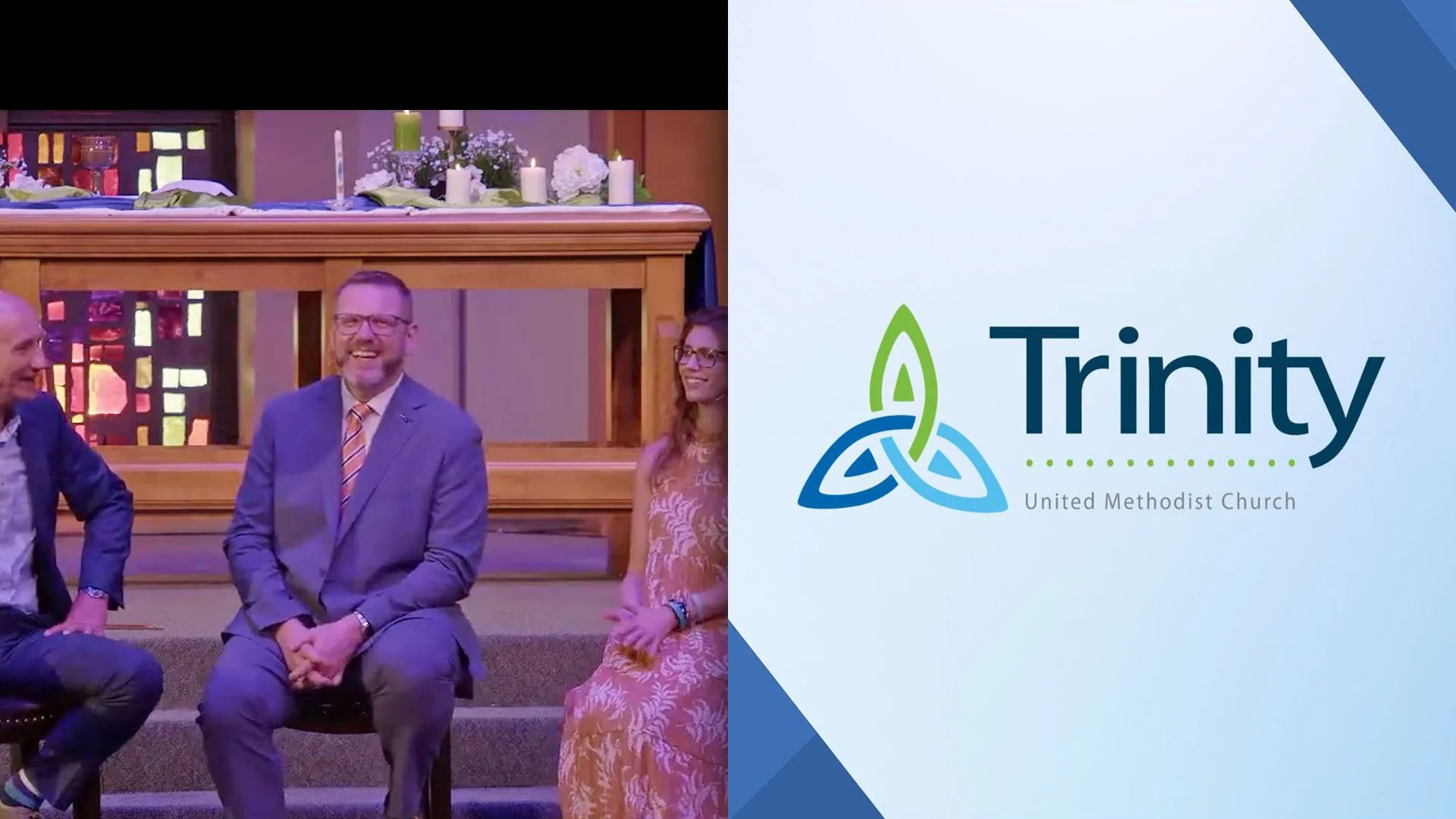
Transcript:
Marisa: Hi everybody! We come to you today to have a conversation. And there's a moment that I think each of us have experienced — I know that I have — when the Holy Spirit lays something on your heart that you would like to share, or the Spirit would like for you to share in a moment like this, and you have it all planned out, and then you realize you don't have a scripture reference.
So one of the things that I like to do, and that we did together collectively, was start with a tool called the lectionary. It is a tool that sets Scripture passages — Old Testament, New Testament, gospel song — with the calendar of the church. And so this morning's lectionary passage actually fits really well with what we would like to talk about this morning.
We love when that happens. This story, though, is peculiar, and why it was chosen for today. It's the final words that Jesus shares with his disciples right before he ascended to heaven, and it's in Matthew's Gospel. And if you remember, last week we celebrated something called Pentecost, where the Holy Spirit came to the disciples in that upper room. Jesus had already ascended. So why is it that today we are talking about Jesus's final words that happened way before the moment of Pentecost?
I wonder if, in that upper room, right after the Holy Spirit came and Peter gave his wonderful first sermon, all those disciples were wondering, "Well, what on earth do we do next?" And collectively they remembered the words that Jesus left them with. And so I invite us all to listen to these words anew this morning as it sets our conversation. This is from Matthew chapter 28.
Now the eleven disciples went to Galilee, to the mountain to which Jesus had directed them. When they saw him, they worshiped him, but some doubted. And Jesus came and said to them, "All authority in heaven and on earth has been given to me. Go therefore and make disciples of all nations, baptizing them in the name of the Father, and of the Son, and of the Holy Spirit, and teach them to obey everything that I have commanded you. And remember, I am with you always, to the end of the age."
My friends, this is the Word of God for us, the people of God. And we say, thanks be to God. Will you pray with me? Gracious and loving God, we give you thanks for the gift of your Holy Word and the gift of your Holy Spirit. Meet with us once again in this moment. Breathe into us the breath of life through the words that we have to share, and may they be a word from you that will refresh our hearts and our minds this morning. It's in Christ's name we pray. Amen.
Steve: Some weeks ago, friends, after we learned that Charlie would be coming to serve as your next lead pastor, Charlie and Marisa and I were talking a little bit about how we could help you start to get to know him and get to know all of our hearts for the future of Trinity and the United Methodist Church. And so you see in your bulletins that the theme we chose for our conversation today is "Why It's Great to Be United Methodist Right Now." This scripture really bubbled up as a place to ground that, because there's so much there that I think speaks to where we are right now — including the fact that while there is a lot that we are excited about in this particular moment, it's not in our too distant past when there were some real struggles and challenges happening.
I love the fact that in our passage this morning, there is a verse that we often rush right past in our hurry to get to the Great Commission. We miss the fact that it also says, "When they saw him, they worshiped him, but some doubted." I love the fact that in that verse there is permission to doubt as a part of the life of faith, that it's not always rock solid. There are things that we struggle with along the way, and we have faced some struggles recently. So I wonder, for the two of you — looking back before we get to what we're really excited about — what was that season of doubt and challenge like for you, and where did you see Christ meeting you in the church in that season?
Charlie: What was it like? It's crazy — we're sitting here in 2026 and honestly, March 2020 feels like decades ago, but it also just feels like yesterday. It's the strangest sensation that we've come through these seasons of struggle, which have included a global pandemic. You'll remember that, right? So we've had that global pandemic, that experience that really did unite us across the world in many ways, but also then divided us. And particularly in the church, we're called to love our neighbors — well, we decided that we would even fight about what it meant to love your neighbors. So that was a particularly stressful time.
And then, coming off what we thought was the back of that, we moved into the sort of hot point of a season of division and debate and ultimate split, which had been impacting the people called United Methodist for decades, but really in the last ten or fifteen years had come onto our radar. It was a remarkably stressful time to be a leader in the local church, and really a time of learning a lot about people as you get to know them.
And so, doubt — in terms of this passage — "some worshiped the Lord when they saw him, and some doubted, some wondered." I would say personally, and I'm sure the two of you did the same at some point, I had moments of, "Lord, what are you doing? This can't be good for us. Why? What is this?" So I can relate very much to the disciples in this moment who doubt and who say, "What's going on here?" Yeah, I can relate a lot.
Marisa: I come to this from a slightly different perspective. Both of you were already serving in full-time ministry at the start of the pandemic, and I was finishing my last year of seminary. I started my very first full-time appointment in ordained-ish ministry in June of 2020. We were already away — we weren't worshiping together — and that's when I started full-time ministry. I didn't know anything prior to that. I was thrust into the fire, if you will.
And even right before that, as we were in seminary, there was that special General Conference of 2019, which was really the culmination point, the heat point, that launched into what would eventually become the division within our denomination. I remember when that General Conference happened — I was watching it on my computer from North Carolina, and I was just about to start writing paperwork for the process of ordination. And I thought to myself, "Is there even going to be a church for me to be ordained in? And if so, is it a church that I'm going to want to be a part of — that I could, with my heart and soul, say, yes, God is calling me to serve this church?" There were so many questions, and what came with that was so much fear.
I think there's a real connection between doubt and fear. Doubt is so closely connected to fear — fear of the unknown, fear of what might be next. But what that gave me was a unique opportunity. I didn't know anything else. I didn't know how good it could be prior to the shutdown of 2020. So I had the opportunity to come into ministry with fresh ideas and fresh eyes, not knowing anything else and only seeing possibilities. So for me, yes, there was some fear, but there was also a whole lot of excitement, because everything was up for grabs. I didn't know anything else.
Steve: And I think one of the gifts that young clergy brought to the church in that season was this risk-taking spirit, because everything was new. I also think that one of the ways in which Christ met us in that season, where there were a lot of challenges, is that it forced us to really get clear — to have clarity about who we were going to be and where we were going to focus our efforts and energy. That happened at the local church level and at the denominational level.
What that meant was that churches like Memorial and Trinity had to reimagine what it looks like to be a flourishing church, because it's not going to look the same way it looked before. So fast forward now to where we are today, and I feel like there is so much to be excited about, because the hard work happened over the last few years — because people stepped into a new way of being church and of investing in the community around us.
Which brings me to the next question for us: what's exciting you right now? What do you get excited about when you think about both the local context and the conference and the global context for United Methodists?
Charlie: This is the first service, and I want to hear from young clergy first — it breaks my heart that I am no longer young clergy — but I want to hear it from Marisa.
Marisa: Well, one of the things that I'm most excited about is that our conference — the Florida Conference — really met the young clergy where we were and embraced the excitement that we brought to try new things in bold ways. One of the ways they do that is through a pathway for folks who are considering starting something new, whether that's a new church or a new type of ministry. We have something called Fresh Expressions, which takes church community outside the walls of what a normal church looks like. If you have an idea, there is some seed money available, and the conference will come alongside you and help you get started going where the Spirit is leading you. There's this sense that everything is up for grabs — if you have an idea, go ahead and try it, and we'll help you see what happens. That is exciting for me and for other clergy who are coming up with new and fun and alternative ideas, because the church does look different.
And specifically here at Trinity, there is a lot to be excited about. This year I have had the privilege and opportunity to spend a lot of time with our young adult women. We launched a new young adult Bible study opportunity last summer — we're almost a year out — on Wednesday or Thursday nights in my home. Young adult women have been gathering for a year, and it has been so amazing to watch them not only come together and create connections, but get excited about the Bible and social justice issues that are happening, and about what we as United Methodists think about them. Watching them be empowered to step into leadership for themselves has been wonderful. And I know that is not the only group that is being empowered and doing amazing things at Trinity — that's just a small snapshot of the array of wonders that are happening in this community. So I'm excited about the future and about what new possibilities there are, both for our conference and for here at Trinity.
Charlie: There is a lot to be excited about. In my work at the conference level — Steve and I actually go back about six years, serving on the Board of Ordained Ministry on the same interview panel — we get to talk to ordinands, or potential ordinands, coming through the system. That is just exciting work: to see the theological work that they're doing, to listen to their stories of call, and to know that God continues to call people to this life of ministry and to this life together in the church. I find that a particularly exciting thing.
Certainly over the last six years, when we were still working out who we were as United Methodists, we were seeing the numbers of interviews diminished greatly. And I think it's fair to say we're now seeing a rise in those numbers — and that's something to be excited about.
Another layer of my work there is in the Residency in Ministry program that I get to lead for our conference. I've seen Marisa come through that just a few years ago. The work of the program is really to help prepare those who are on their way to ordination — to help them get their paperwork done and guide them through those couple of years on that journey. I've gotten to work with all of the young clergy and new clergy coming through. When I get to go to the ordination service at Annual Conference, I spend that whole time on my feet because I see all these people coming through. It's an exciting thing to see God calling and God working in the lives of people and bringing them through into the ministry and leadership of our church.
And I think we can be excited because we know who we are as United Methodists. We have said that and made it clear to the world. And I think people who were wondering and doubting are now saying, "No, this is what I want to be a part of. I want to be a part of the work of the Spirit through the United Methodist Church." I think that's a profoundly exciting thing.
On the local level, I'm going to talk about Memorial, because I'm still the appointed pastor there. Similar to what you've got going on, Marisa — five years ago we started a midweek Bible study online during those pandemic days, and that has just continued. From that has spawned Zoom prayer meetings five and six mornings a week, where people are just getting out of bed and coming to pray together. A couple of years ago, we got to start a men's Bible study group, which is again a great place of gathering men around the Scripture and finding a sense of unity together. We're not all coming from the same philosophical standpoints in life, but we are gathering around the Word and asking, "What is the Lord saying to us through this?" And I think that is an exciting part of this — that the Lord is at work through our churches and through this fellowship and through this unity and through the connection.
Steve: Yeah. Well, that's one of the gifts that that season of doing church very differently brought us — we've realized that there are different ways to connect. And I think I heard in that some opportunities that might be bubbling up in the future for me.
Marisa: But I want to know what excites you. You don't get out of this question.
Steve: I don't want to get out of it. So one of the things that Charlie mentioned earlier at the earlier service this morning was the excitement about what's happening not just in the clergy space, but among the laity of the church. For those of you who don't know, I am married to a pastor, as well as being a pastor myself, and the one I'm married to currently serves as the superintendent for our entire district — overseeing about sixty churches from here up into the Panhandle over to the time change. So I get to have conversations with her and hear about some of the things that are happening in other settings.
One of the things that strikes me is the revitalization that is happening, especially in small and rural communities — and it's the laity that's driving it. For example, there is a county up in the Panhandle that, post-disaffiliation, did not have a United Methodist Church left in it, because every church voted to leave. But there were two areas where remnant groups of people who still wanted to be United Methodist gathered together, wanting to be a church going forward — a welcoming, loving, inclusive community for the future in their area. They said yes to continuing to meet and to find ways to serve their community. Before there was ever a pastor appointed to them, they were already at work. And just a few weeks ago, both of those churches experienced a launch and a celebration, and they now have a pastor who's appointed.
They chose really interesting and beautiful names for these new communities of faith. One is called Open Hearts United Methodist Church, and the other is called Abundant Grace United Methodist Church. Doesn't get much better than that, right? And in those places and in other places, people are finding ways to bless and to serve their community while they also gather and continue to grow in faithfulness and in worship.
That's a thing that really excites me. I'm also excited about things that are happening here in the life of this church and the way laity serve. I think about people who every month show up to be a part of one of our mobile food pantries — we have three locations around Gainesville now, and every month that takes a pretty large cadre of volunteers to make that happen. I think about the people in our congregation who, month after month, go to visit persons who are incarcerated as a sign of hope, a sign of our love for folks, and a sign of grace to them. I think about the people who, just in the last couple of years, have said yes to an invitation to join our visitation ministry — as we realized we had an expanding number of people who could no longer connect with us in person but still needed to feel connected to the church and to their church family — and who have been trained to go and offer face-to-face presence and be there with them. That is really powerful. So those are a few of the things that excite me.
Marisa: I know — time flies because we're having so much fun.
Steve: It is. And the good news is there's enough to be excited about that we could sit here and talk for a really long time. The bad news is we have to do this for another group later, which means we can't keep going with you all. But let's just real quickly, before we wrap up — certainly a powerful part of this scripture today is the sending out, the Great Commission. The church is not meant to stay inside the walls; the church is meant to go. So maybe say a word about the power of that message to the disciples then and the disciples now.
Charlie: I like to run on time — you're going to learn that about me in the future — so I'm going to be really quick. The exciting thing about the word from Jesus to the disciples at the end, about the future and about how they are sent, is that Jesus says to them, "And surely I am with you to the very end of the age."
You go out from church today, friends, and you're not alone as you carry your faith with you into the world — into your workplace tomorrow, to the lunch table today. Christ is with you. Christ is leading you — in the best of moments and in the worst of moments — and is always accompanying you. That is what the abundance of grace is. And that is the good news: that we are never, ever alone in living out this call. Surely I am with you to the end of the age.
Marisa: And mine is a very similar thread. But you see, at the very beginning of Jesus's statement: "All authority is upon me, and now I give it to you." It's this great empowering — it has nothing to do with our own power at all. And if it did, our church would not be as vibrant as it is. It is not our power, but the power of Christ, the authority of Christ, that is given to us as this great gift in the Great Commission. And we are sent out, trusting that we are not alone and that it is Christ's power that goes with us.
Steve: I love that. And I also love the work that our denomination has recently done around a new vision statement that gives us clarity about how we go out into the world. So I'm going to invite you all to really start embedding these three things in your hearts and lives as ways in which we are invited to go out as United Methodists: that we are people who love boldly, who serve joyfully, and who lead courageously. That gives us some strong messaging for how we want to show up in the world as clergy, as laity, and as the church.
And I'm excited — I'm also excited about Team Charlie and Marisa. Are you all excited about Team Charlie and Marisa?
Marisa: Yes.
Steve: Yeah. I'm really grateful for this opportunity to have the conversation today, and just really looking forward to what God will continue to do through this church as you all work together. So thank you. Blessings.
Marisa: Amen.