
Dear Church: Confidence | 9/6/26
-
The sermon opens with the image of a church member who has sent nearly 2,700 handwritten cards since 2020 — one small, faithful act of love repeated over and over again. Is there a small, consistent act of love or connection that you sense you're being nudged toward, and what has kept you from starting or sustaining it?
The construction project analogy is a vivid one — that season of drywall dust in your coffee when you wonder if the whole thing is falling apart, before you realize the contractor knew what they were doing all along. Can you think of a season in your own life or faith journey that felt like that, and what did you find on the other side of it?
The sermon makes the point that church communities often waste enormous amounts of spiritual energy arguing over things that don't ultimately matter, and that love is what gives us the clarity to tell the difference. Is there something your church, your family, or your own inner life is currently spending energy on that, if you're honest, probably doesn't really matter — and what would it free up if you let it go?
The rugby analogy makes the point that unity doesn't require uniformity — that props and wingers look completely different and play completely different roles, but they're bound together by a shared goal. When you think about the people in your church or community whose gifts, personalities, or perspectives are very different from yours, how easy or hard do you find it to genuinely see them as teammates rather than obstacles?
John Wesley's words — "though we cannot think alike, may we not love alike?" — are a powerful challenge in a moment when so much in our culture pushes us toward hostile division. Is there a relationship in your life right now where you disagree significantly with someone, and what would it look like this week to extend your hand to them anyway?
Transcript:
You know, there is nothing quite like receiving a handwritten letter in the mail. I think you'll probably agree with that. Way back during the isolated days of the Covid pandemic, I preached a sermon to a camera, and it was aimed at encouraging and building up our church in what felt like some of the hardest of those times. Although we were not able to gather and to be together in that specific season, I was encouraging our people to stay connected to one another. I said something like this: make the phone call, send the text, mail a card or letter to let another person know that they are not forgotten and that they are not alone.
One church member was listening to that sermon that day, and she sensed this nudge of the Holy Spirit to begin sending a card every week to one of her friends or to a congregation member, and to do so with absolutely no other agenda than to lift them up and to stay connected. She has not stopped since then. She has personally written and sent almost 2,700 cards to folks: simple expressions of love and care. And I've received a few of them myself during that time, and I have to tell you, it's such an encouragement every time to receive one.
Now, the New Testament book of Philippians is a biblical example of the kind of ministry that my friend has been engaged in since those days in 2020. This is a letter that is written to express the love that Paul has for this church community in Philippi, as well as some of the joy that he experiences when he thinks about them and when he reflects on all that God is doing in them and among them and through them.
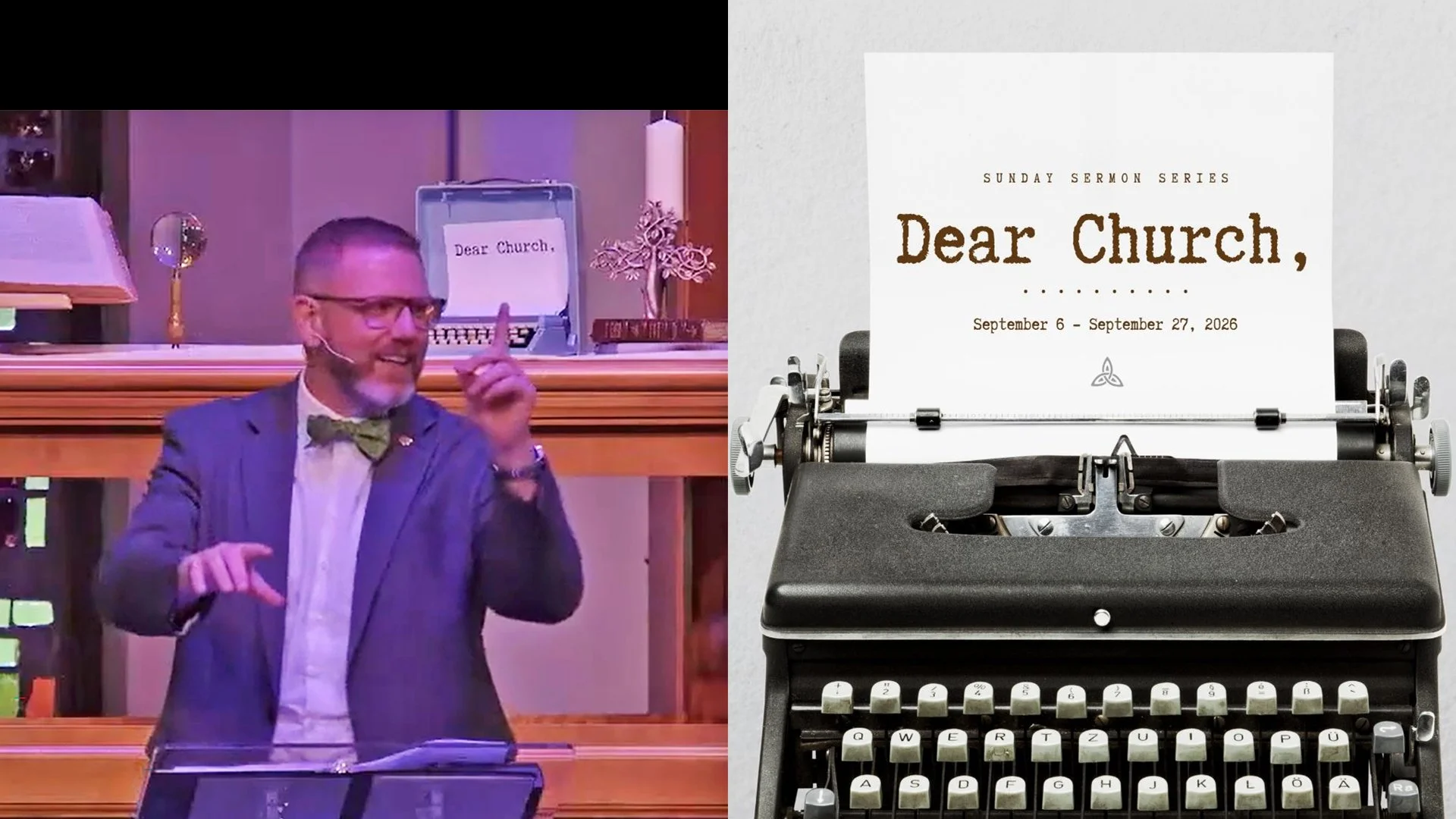
So today we're going to begin a sermon series that's going to take us through the entirety of the letter to the Philippians. We're going to explore a different chapter every week, and I'm encouraging you from the pulpit to go home this week and just read through Philippians chapter one and do it repeatedly through the week. And then in week two, I'm going to invite you to read Philippians two as well. And our hope is that as we read of the encouragement that Paul takes from and gives to the Philippian church, we also — Trinity — will take encouragement. We also will be drawn closer to Christ.
And so today, I just want to read you a selection of verses from chapter one. This series is entitled Dear Church, by the way — the whole letter thing, right? So, dear church.
I thank my God for every remembrance of you, always in every one of my prayers for all of you, praying with joy for your partnership in the gospel from the first day until now. I am confident of this, that the one who began a good work in you will continue to complete it until the day of Jesus Christ.
And this is my prayer —
We're going to verses nine through eleven now -
And this is my prayer, that your love may overflow more and more with knowledge and full insight to help you to determine what really matters, so that in the day of Christ you may be pure and blameless, having produced the harvest of righteousness that comes through Jesus Christ for the glory and praise of God.
And then we're going to read finally, verses twenty-one through twenty-seven:
For to me, living is Christ and dying is gain. If I am to live in the flesh, that means fruitful labor for me, yet I cannot say which I will choose. I am hard pressed between the two: My desire is to depart and to be with Christ, for that is far better. But to remain in the flesh is more necessary for you. Since I am convinced of this, I know that I will remain and continue with all of you for your progress and joy in faith, so that by my presence again with you, your boast might abound in Christ Jesus because of me.
Only, live your life in a manner worthy of the gospel of Christ, so that whether I come and see you or I'm absent and hear about you, I will know that you are standing firm in one spirit, striving side by side with one mind for the faith of the gospel.
My friends, this is the Word of God for the people of God. Thanks be to God.
Now put up your hand if you have ever lived through a construction project in your home — like a new kitchen, or a bathroom remodel, or a room addition. Put those hands up high. Yes, yes, yes — I thought that might be the case. So you know, you know the exact life cycle of such a project. At the start there is excitement and potential. You're dreaming of what can be. You're imagining color schemes of the finished product, and you are picturing in your mind's eye just how amazing and perfect it is all going to be.
Then the sledgehammers come out and the contractor opens up a wall and finds some outdated wiring or some rot, and suddenly the timeline for the project — maybe the price tag too — doubles. Before you know it, there's drywall dust in your coffee in the morning. You're putting your kids' lunches together on an ironing board — ask Margaret and myself about that, we have done it. You haven't had a functional sink in three weeks, and you're asking yourself, why on earth did we start this thing? Is it ever going to be finished? Yeah, if you know, you know, right.
And those middle weeks of a project like this, your confidence in the contractor begins to take a beating. But then it turns a corner and slowly it starts to take shape. The drywall goes up, the fixtures get installed, the mess gets swept away. And when you finally stand in that completed room, you realize — well, you should have just trusted the process all along. You realize that the contractor did actually know what they were doing when you were living in the dust.
Now, that kind of confidence — that's where Paul launches his letter to the Philippians. You see, after greeting them and telling them how much joy he feels every time he prays for them, he offers them an anchor for the anxiety that they are feeling in this moment. He says, "I am confident of this, that the one who began a good work in you will continue to complete it until the day of Jesus Christ."
You see, in local churches, it is so easy to fall into the trap of believing that the ultimate weight for the work and life of the church rests entirely on our shoulders. We think to ourselves, well, if we just pray harder, work harder, give a little bit more, launch better programs, and strive more intensely, then we can guarantee our future. And when things feel messy, when we enter seasons of transition, or when cultural pressures build, or when progress feels slow, we start to panic. Like the homeowner living in a dusty kitchen, we wonder if the project is completely falling apart.
But Paul looks at the Philippian church — a church that is in a little bit of anxiety. They're anxious about his situation, about his imprisonment, and they are also a little bit worried, maybe, about their own future. And he invites them to enjoy a massive sigh of relief. He says, "Take a breath, church. You're not the master architect here. God is." I mean, yes, your effort matters. And yes, our partnership in the gospel matters. But the ultimate outcome does not rest on your human performance — it rests on the nature and character of the God who initiated the project in the first place. God does not abandon jobs halfway through. The God who called us is the God who saved us, and the God who planted the Philippian church is the God who will carry the job through to completion.
I think we need to hear that same word today, church. It might feel like we're living in the middle stages of a renovation project. Things might feel a little bit messy or unfamiliar, or stuck in transition between what was and what will be. But Paul's word to the church in Philippi is a word also for us, Trinity — the God who began a good work in this church family is the God who will bring it through to completion.
Paul has confidence in God's faithfulness to carry a job through to completion. Paul also has confidence in love's power to guide the mission and the life of the church. In verses nine through eleven, we read these words: "And this is my prayer, that your love may overflow more and more with knowledge and full insight to help you determine what really matters, so that in the day of Christ you may be pure and blameless, having produced the harvest of righteousness that comes through Jesus Christ."
I want us to notice what Paul is praying here. You see, he's not praying some kind of soft, sentimental, Hallmark card kind of loving prayer. He is praying for a love that is sharp, intelligent, and full of wisdom and spiritual insight. He's praying for a love that runs so deep that it helps them determine what really matters. Paul has immense confidence in the power of love to guide the church. He believes that when a community is saturated in the love of Christ, that love begins to guide their steps.
Over the last six months or so, I've been leading a coaching cohort of a group of clergy colleagues right here in the Florida Conference. We started out back at the beginning with some core teaching material, and now we're in a process of having one-to-one coaching conversations over a duration of about six months, to process how they are putting the material that they learned into practice in their ministries. And during those calls in the last five or six weeks, I've noticed an encouraging pattern beginning to emerge. Many of the cohort members have shared with me how these concepts that felt a little strange or clunky at the beginning of the program — well, they're now starting to shine through clearly in how they show up at home and in work. And this is happening quite naturally in them, without them even having to think about it, sometimes without them even noticing. Their practice over the months of the program has helped that material sink in, taking it from their heads and putting it right into their bones. It's becoming second nature to them.
That's what Paul is praying for the church to experience in Christ. He longs for our love of God and for one another to become so deeply practiced, so ingrained in our life together, that then discerning what really matters becomes our second nature.
The Apostle Paul knows what happens to us when anxiety or uncertainty creeps into the life together of a church family — we start to lose our focus. A church family gets distracted by the noise, by the panic, and then they waste vast amounts of spiritual energy arguing over things that do not ultimately matter. I mean, my goodness, don't we know this as United Methodists? But here's the thing — when our confidence is anchored in Christ's love, that love becomes our navigator, guiding us in the steps that we are called to take. Love gives us the clarity to look at all of the competing demands around us and instantly recognize what really counts. Love tells us, "Hey, this thing over here — that's worth the energy. But this other thing over here — well, that's just a distraction." Or, "This thing over here builds the kingdom. But that thing back there — that's just noise. This thing brings healing. That — well, that's just an argument."
Paul is helping the church in Philippi see that when this kind of mature, second-nature love is the default setting for a community of faith, the ultimate result is the harvest of righteousness. It is a life together that honors God and bears real, lasting fruit for the world.
He then moves into the third thing that he wants to express confidence in, and that is quite simply a confidence in Christ. And the way he does this one is by hitting right at the root of the greatest and most certain of all human fears. In verse twenty-one, Paul writes, "For to me, living is Christ, and dying is gain."
Now, to get a sense of the weight of these words, we need to remember where Paul is coming from and where he sits as he writes this letter. He's in a Roman prison cell where he is awaiting a trial that could end up leading to his own execution. Roman authorities believed that they had the ultimate leverage over Paul's life. They thought that they could threaten him with execution, or squeeze him with restrictions, or force him into silence. But in this single sentence on your screens right now, Paul completely disarms such a notion. Taking stock of his circumstances, he basically says something like this: "If you let me live — wonderful. I get to preach and pastor more. I get to share good news more. But if you execute me — well, that just means I get to be with Christ and see him face to face."
And in saying these words, Paul has then created a scenario where the things of this world that would normally bring deep fear in any of us are actually declared impotent. They no longer have power or dominion over his mindset. If he lives, Christ is glorified, and if he dies, he gains Christ. Paul has discovered the secret to freedom. When a life is securely anchored in this unconditional love of God that has been made real in Christ Jesus, fear loses its power. Or, as we read in another book in the New Testament — the First Epistle of John — "perfect love casts out fear."
Anxiety, whether it's in our personal lives or in the life of a community such as a church family, is almost always driven by a bent towards self-preservation. We become scared of what we might lose. We worry about losing control, security, comfort, about stepping into an unfamiliar future. And when we become gripped by these kinds of fears, we make decisions that are more about self-protection than anything else. So we pull back, we circle the wagons, we hoard our energy and our resources.
But Paul's word to the Philippian church, and by extension Paul's word to you and me today, church, is that in Christ, fear's threat is gone. If even our most ultimate fear — that is, the fear of death itself — is transformed into gain, then what is left for us to be afraid of? When we begin to grasp this kind of confidence in Christ and in the gospel, everything changes. Everything changes. We stop operating out of fear and self-preservation, and we become free to be bold, to be extravagantly generous, and to step into the future with courage and with grit and faith, because we know that whether we live or whether we die, we belong to the Lord.
And then finally, with all of that said, Paul gets to his final encouragement in this opening chapter. It is the call to take confidence in these things and to live it out together, to live it out together. In verse twenty-seven, he writes, "Only live your life in a manner worthy of the gospel of Christ, standing firm in one spirit, striving side by side with one mind for the faith of the gospel."
Everything Paul has said so far in chapter one of this letter has been building to this moment. I mean, if we know that God finishes what God starts, if we know that love has retrained our instincts to focus on what really matters, and if fear has actually been declared impotent, then we are freed to do something extraordinary, church — to stand together without fear.
That phrase, "striving side by side," is the English translation of a Greek word, συναθλέω (sunathleó). Sunathleó — it means to strive together or to contend together. It's actually the root of where we get our word "athlete" in the English language. And so Paul is using a team sports metaphor here — I approve of this message. He isn't picturing a row of isolated individuals doing their own thing. No, he is picturing a team on the field working together toward a shared goal.
Five or six weeks ago, on our first Sunday together, I told you that my first sporting love is rugby. And I know college football just started — I know it — but we're going to talk about rugby today. Okay. Yes, yes, yes. For those who may not know much about rugby, it's a game played by a team of fifteen people that is made up of radically different roles and requires radically different types of players.
For example, we have prop forwards in the front row of a scrum. They are usually built like a brick wall. The prop is known for bringing pure raw power, designed to anchor the whole scrum. Props are not generally known for their speed — they are known for their power. Wingers, on the other hand, are more built like a track star — usually very well groomed as well. Wingers are agile, they are fast, and they are made for the open space. Wingers are not known for their raw power — they are known for their speed. Props look differently, move differently, and operate completely differently from wingers. If a prop forward tries to run like a winger, or a winger tries to anchor that scrum, the team just is not going to succeed.
The players on the team don't have to look alike, run at the same speed, or play in the same position to be of one mind. What unifies them is not uniformity. It's that every single player on that field is bound together by a shared goal and direction — moving the ball forward, scoring points, and celebrating wins together.
And I say to you today that in a sense, that is Paul's vision for the church. In a society where we have become so quick to other one another, to point fingers, and to divide ourselves into these hostile tribes, Paul is inviting us to a radically different way of being the community of faith. And this is something that John Wesley — the founder of the Methodist movement — understood deeply. In 1739, in the midst of fierce political and religious divisions in England, John Wesley famously wrote these words: "Though we cannot think alike, may we not love alike? May we not be of one heart, though we are not of one opinion? Without all doubt we may. If your heart is as my heart, give me your hand."
Unity in the church does not demand uniformity. You do not have to agree with every person sitting in this worship center on every secondary matter, every political opinion, every cultural preference. You do not have to agree on all of those things in order to roll up your sleeves, link arms, and get on with the work of sharing good news and living lives of sacrificial love. We do not have to think alike on all things in order to love alike, friends.
So as we step forward into this new season together, let me say this.
Dear church, let's trust the God who finishes the things that God starts. Let's allow Christ's love to become our second nature and guide our steps and mission. Let's live lives completely free from fear, to the best of our abilities. And let's stand together, shoulder to shoulder, striving side by side on the field for the hope that is the gospel.
Friends, may it be so in your life. May it be so in my life too. May it be so in our life together. In the name of God who is Father, Son, and Holy Spirit.
Amen.