
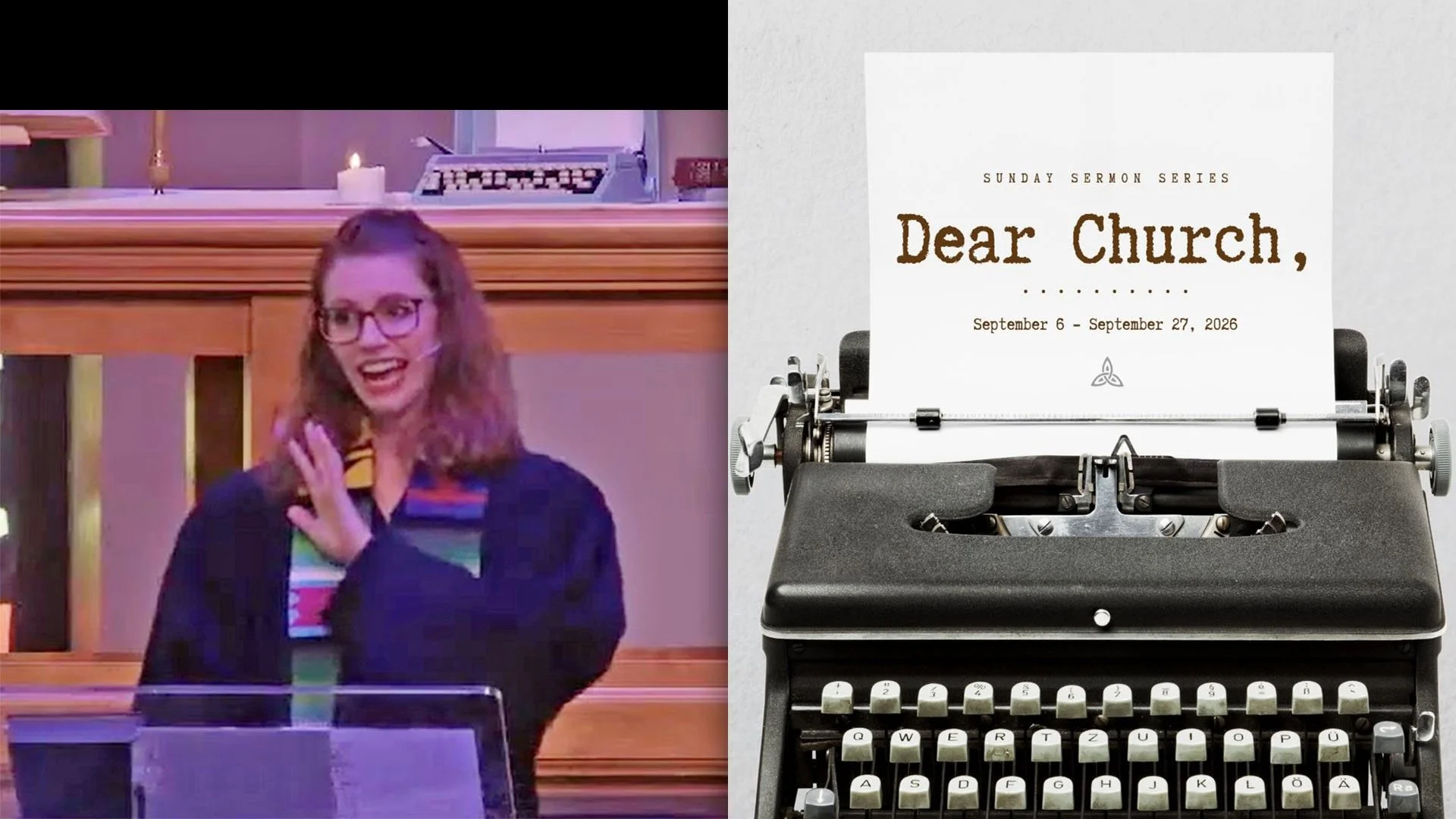
Dear Church: Humility | 9/13/26
-
The sermon opens with the observation that we are the busiest we've ever been and the loneliest we've ever been at the same time. Does that ring true for you personally, and when you think about the fragmented pieces of your life — all the roles you play and identities you carry — which one feels most disconnected from your faith right now?
The sermon reframes humility not primarily as something we do toward other people, but as something that happens in us when we orient ourselves toward Christ. How does that shift change the way you think about humility — does it feel more accessible, or does it raise different questions for you?
Mary Oliver's line — "attention is the beginning of devotion" — is a striking one. What are you giving the most attention to right now in your daily life, and what does that tell you about where your devotion actually lives, as opposed to where you'd like it to live?
The sermon describes humility not as something that diminishes us, but as learning to think more truthfully about ourselves — loved by God, gifted by grace, limited in understanding, dependent on others, and always in need of mercy. Which part of that definition is easiest for you to accept, and which part do you most resist?
The sermon offers a series of people through whom we might see Jesus more fully when we're living from a place of humility — the unhoused person on the corner, the colleague who presses all the wrong buttons, the child who won't stop screaming, the leader whose decisions we question. Who on that list is hardest for you to see Jesus in right now, and what do you think that's telling you?
Transcript:
Y'all. Did you know that it is illegal to read other people's mail? You might have forgotten that because nobody uses snail mail for anything fun anymore — it's all bills or credit card applications — but apparently we value our privacy a whole lot, because that is a federal offense. And I think about it every single time I open my Bible and read one of Paul's letters to the various churches that he helped to establish. I am positive that he had absolutely no idea that those letters would be preserved, and that a bunch of people sitting in a church would read the words that he wrote in 60 AD to the Philippian church right here in the year of our Lord 2026, in Gainesville, Florida. I'm sure that was not on his mind at all. And yet, here we are with the audacity to believe that the word that he had for the Philippian church is a word of encouragement and hope for us today.
So if we're going to read another church's mail, it might be helpful for us to know a little bit about the community that letter was intended for. Originally, Philippi was a key metropolitan city in the Roman province of Macedonia — modern-day northern Greece. It was situated along a very long east-to-west road called the Via Egnatia. And because it was an urban center of this particular province, the citizens had easy access to different cultures and different people through the gift of trade at the time. They also retained dual citizenship, both to Rome and to Thrace, which was the ancient Greek city-state that was there prior to the Roman Empire's presence. So they consistently lived with competing identities. The residents of Philippi enjoyed the privileges that came along with citizenship in the Roman Empire, and they also struggled with the challenges of being a part of a conquered people.
And for the Philippians who went to that church, they also got to add in the identity of being a Christ follower — which, at the time, Christ followers were persecuted by the Roman government. Paul identifies with the people of Philippi and their struggle with being a member of a persecuted group. At the time that Paul wrote this letter to the Philippians, he in fact was sitting in prison for the faith that he held and the work that he was doing. And so he ended chapter one with these verses. He said to them, "For God has graciously granted you the privilege not only of believing in Christ, but of suffering for him as well, since you are having the same struggle that you saw I had and now hear that I still have."
But Paul doesn't leave this church in a place of mutual suffering. Instead, he challenged them by saying, if we are going to move forward, if we are going to continue to participate in the ongoing work of the Holy Spirit, we have to do it together, unified as one body. So he continues in chapter two of this letter to the Philippian church saying:
Dear church, if then there is any comfort in Christ, any consolation from love, any partnership in the Spirit, any tender affection and sympathy, make my joy complete. Be of the same mind, having the same love, being in full accord and of one mind. Do nothing from selfish ambition or empty conceit, but in humility regard others as better than yourselves. Let each of you look not to your own interests, but to the interests of others. Let the same mind be in you that was in Christ Jesus, who, though he existed in the form of God, did not regard equality with God as something to be grasped, but emptied himself, taking the form of a slave, assuming human likeness, and being found in appearance as a human. He humbled himself and became obedient to the point of death, even death on a cross. Therefore, God exalted him even more highly and gave him the name that is above every other name, so that at the name given to Jesus, every knee should bow in heaven and on earth and under the earth, and every tongue should confess that Jesus Christ is Lord, to the glory of God the Father.
Friends, this is the Word of God for us, the people of God. And we say, thanks be to God. Will you join me in prayer this morning?
Holy God, we give you thanks for this gift of Scripture and of Jesus, that we have the opportunity to be in your very presence. We ask that your words would transform our hearts and our minds. May we be open to what you have to say to us this day. In the name of Jesus we pray. Amen.
We may not know what it was like to retain Roman citizenship, or to be constantly afraid of being persecuted on account of our beliefs, like the Philippian church was so long ago. But we do know what it's like to feel fractured, to feel like our lives are split up into tiny little fragments of different identities, to be pulled in so many different directions with our various commitments. We are students and professors. We are parents and grandparents. We are required to show up with our very best selves in our workplaces and at home. We are in this club. We hold this leadership position. We go from baseball to soccer to gymnastics to the doctor's office. We are Gators and all those other teams. We are red and we are blue and everything in between.
And in all of this fragmentation, each of us has a longing to feel connected, to feel grounded and secure. As a society, we are the busiest we've ever been, and we are the loneliest we have ever been — unsure of how to make real, authentic connections with someone in a world that feels like you have to walk on teeny tiny eggshells with every step that you take.
For Paul, the road to unity, the road to connection within community, begins with humility. But that can be a hard ask when you already feel like your needs are the last to be considered — in your household, your workplace, the classroom, or when you're caring for a loved one or an aging parent. The call to even greater humility can feel like a punch in the gut when you feel like you can't go any lower than you already are.
Somewhere between 60 AD, when Paul penned this letter, and 2026, the virtue of humility became synonymous with self-deprecation and self-sacrifice. It feels like what is required is for each of us to lay our entire beings upon the altar of humility. When we think of this virtue of humility, it always seems to be a quality of interpersonal relationships — a way to interact with or establish a new relationship with someone else. But what if it's not? What if humility is not about the way that we relate with other human beings at all? What if it's actually about the way that we are invited to relate with the divine?
If we take a careful look at the way Paul chose to structure this persuasive invitation to the Philippian church — the invitation to cultivate greater humility — we see something interesting. After Paul lists all of the ways that we, the church, should be interacting with one another — and I'll remind you of that list quickly: be of the same mind, having the same love, doing nothing from selfish ambition or empty conceit, but in humility regarding one another as better, letting each of you not look to your own interests but to the interests of others — after he gives us that pretty lengthy list, he then points us to the incarnation, to the life, death, and resurrection of Jesus Christ. He says, "Let the same mind be in you that was in Christ Jesus."
For Paul, humility is not something that just happens in the blink of an eye. It isn't simply a function of growing interpersonal relationships with someone else. For Paul, cultivating humility is a work of Christian discipleship. The invitation, then, for greater humility is actually an invitation to greater connection with Christ our Lord. Humility begins when we focus and orient our hearts and our minds not to the needs of everyone else, but rather to the person of Jesus Christ, and it requires us to turn our attention away from the fragments of our lives and the bits of identity that seem to be swirling all around us, and fix our eyes on Jesus.
The famous poet Mary Oliver has been known to say this: attention is the beginning of devotion. Attention is the beginning of devotion. Paul pulls the attention of the Philippian church away from their relationships with one another and jolts them back to Christ with a reminder. And in doing so, he uses words from what was thought to be a well-known hymn or poem that was circulating during the time of early Christianity. It's called the Christ Hymn now, because it focuses on the story of the incarnation. Some scholars have even wondered if Paul himself wrote this beautiful hymn or poem and then circulated it among all of the churches that he helped to establish.
For the Philippian church, hearing this letter from Paul and coming across these words would have been like hearing the first few words of "Amazing Grace, how sweet the sound" right smack in the middle of a sermon. It would have sent the people back to a time when their faith felt brand new. It would have been like bringing them back, recentering their hearts and their minds on what truly mattered for them.
It's true that sometimes we just need a little reminder — something that brings us back to the heart of it all, to refocus our hearts and minds on Jesus Christ. So this morning I'm going to invite us to do something a little bit different. I would like for us together to take this time, in this moment, to reorient our lives toward the life of Christ, using the words that Paul offered to the Philippian church in this Christ Hymn as a sort of guided meditation.
So I invite you to get into a prayerful position, whatever that might look like. It might be leaning back in your chair just a little bit, it may be closing your eyes — whatever feels comfortable to you. I'm going to slowly read through each phrase of this hymn, and as I do, I invite you to think about moments of Christ's life that you've read about in Scripture. If you need some help with that, there will be pictures that will pop up on the screens as we are going through this hymn. I also invite you to pay attention to your own emotions. I invite you to actually feel them, to call them up, and to not shy away from the emotion that rises within you. Let's do this together. I'll begin with a few moments of silence.
Let the same mind be in you that was in Christ Jesus.
Who, though he existed in the form of God,
did not regard equality with God as something to be grasped,
but emptied himself, taking the form of a slave, assuming human likeness,
and being found in appearance as a human, he humbled himself
and became obedient to the point of death, even death on a cross.
Therefore, God exalted him even more highly and gave him the name that is above every other name,
so that at the name given to Jesus, every knee should bend in heaven, on earth, and under the earth, and every tongue should confess that Jesus Christ is Lord, to the glory of God the Father.
I invite you to come out of that moment of prayer.
That feeling — that sense of awe, or maybe the sense of smallness that the psalmist who wrote Psalm eight captured in the words, "What are humans, that you are mindful of them?" Maybe it's a feeling of hope that you feel, or empowerment. All of those feelings — all of that is humility. It is a humbling moment to realize that God, the one who is all powerful, the one who is sovereign over everything, chose a posture of humility and servanthood on our behalf. And our response to that overwhelming gift of abundant grace is the invitation to take on that same posture.
Humility, then, becomes an outpouring of our connectedness to Christ Jesus. It becomes an outpouring of love that was first shown to us. Therefore, humility isn't a virtue that is meant to diminish us. God never intended for us to be tamped down or for our God-given gifts to be pushed away. God never wanted for us to shut out the pieces of our identity that make us who we are. Rather, humility invites us to think more truthfully about who we were created to be.
Pastor Sean Robinson, who is in the Georgia Conference of the United Methodist Church, has said this: "Humility is learning to think truthfully about ourselves. We are loved by God, gifted by grace, limited in our understanding, dependent on others, and always in need of mercy."
Friends, when we see ourselves more truthfully, we are able to see Jesus more fully in the world that is around us and in the people that we meet in our everyday lives. The unhoused person who's holding his sign on that street corner. The colleague at work that likes to press all of the wrong buttons. The child who is supposed to be in bed but won't stop screaming. The people whose leadership we question. The woman with the accent that is too hard to understand.
The invitation to cultivate greater humility requires us to remember who we are, and to reorient our hearts and our minds — our very lives — back to the life of Christ. Not just once in a while, not just on Sunday mornings when we are sitting in this room together, but every single day.
So I invite you to do something for me this week — two things, actually. I invite you to continue reading through chapter two of Philippians, because there's more amazing goodness to be found in Paul's words. And I invite you to read through and pray through the Christ Hymn that we just did together, in the same way, as a way to reorient each of us to the life of Christ. You could do it in the morning, or at night, or right smack in the middle of the day when you just need a reminder. And I invite you to do it just for a week, as I will be doing with you. You can find it in verse five of chapter two of Philippians — just one week. I invite you to reorient your life to Christ and see how that might have an impact on the way that you offer humility to the people around you.
Dear church, may our humility grow as we allow ourselves to have the same mind that was in Christ Jesus our Lord.
Amen.