
Dear Church: Identity | 9/20/26
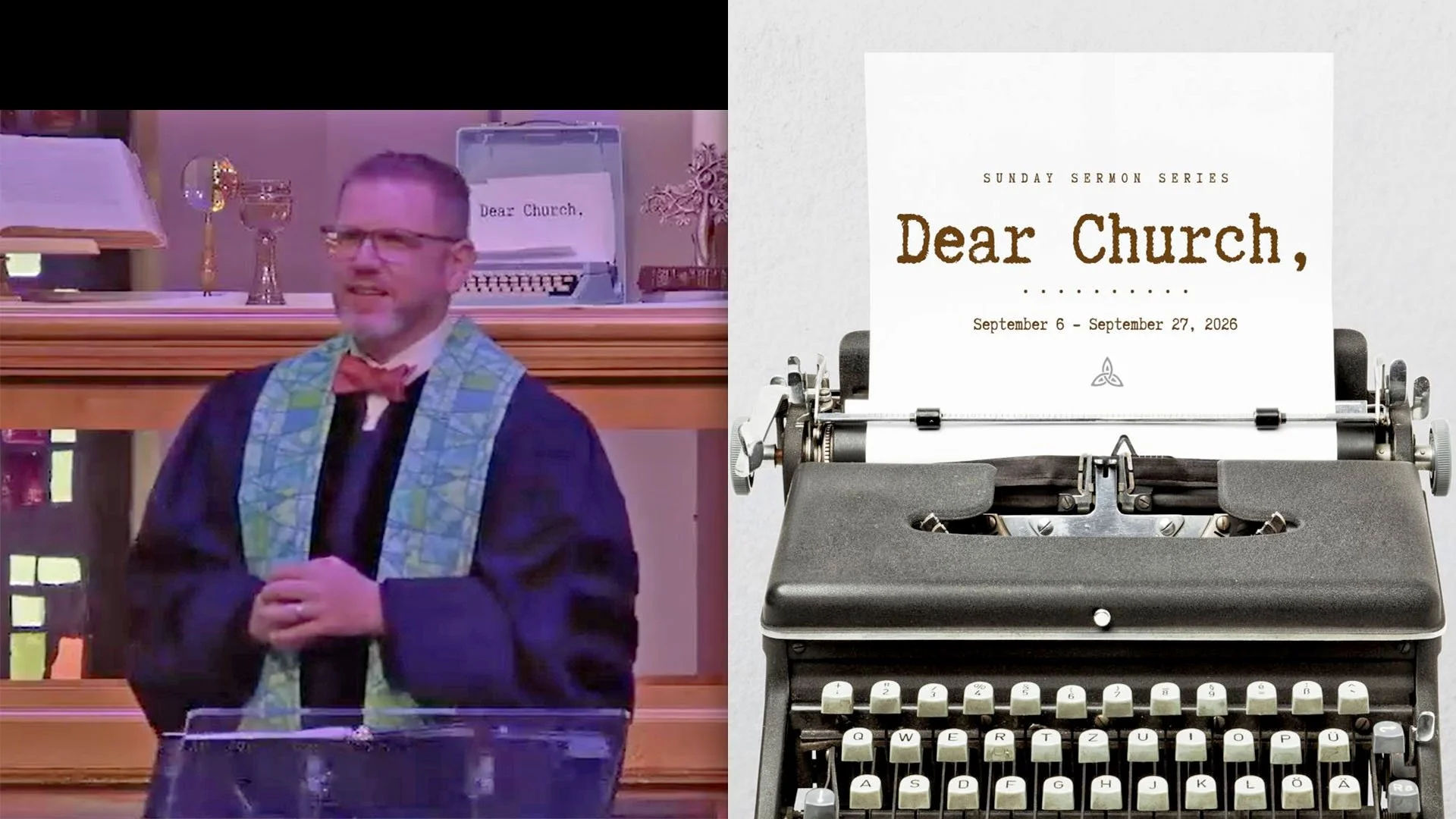
-
When you think about your own "résumé," the degrees, titles, reputation, or background you've built, which of those do you find yourself leaning on most to feel valued or secure?
Many of us spend time looking in the rearview mirror, either fixating on past failures or longing for how things used to be. Which of those pulls at you more, and what might it look like to loosen your grip and lean into what God is doing today?
If your primary identity were truly being a citizen of God's kingdom, how might that change the way you handle your daily routines, your relationships, or your worries?
What does it mean to you that you come to the Lord's table with nothing in your hands? Is it a relief, a challenge, or a little of both?
What is one practical step you could take this week to lay down a "self-made résumé" and rest more fully in who you are in Christ?
Transcript:
Last Sunday morning, Pastor Marisa brought us a rich word from Philippians chapter two. She invited us to see true humility, not as some kind of self-loathing or the putting down of ourselves, but instead as an invitation to draw closer to Christ. She also sent us home with a wee bit of homework. We were to pray our way through the hymn to Christ.
Each morning I'm wondering, did you do your homework, and how did it go? We don't have time to take answers, unfortunately, but I hope you did and I hope it went well. Over the last couple of weeks, we have explored a couple of themes from these opening chapters of Philippians. First, I talked about the sense of confidence that we found in chapter one, confidence that Paul has in Christ and is encouraging his readers to have also. And then last week we went into that theme of humility, and Marisa was pointing us towards that. Today we are moving into Philippians chapter three, where Paul continues to emphasize these same things, confidence and humility, but also begins to lift them to an even bigger theme. That is the theme of identity. Here, then, is this selection of verses from Philippians chapter three.
Dear church, if anyone has reason to be confident in the flesh, I have more: circumcised on the eighth day, a member of the people of Israel, of the tribe of Benjamin, a Hebrew born of Hebrews; as to the law, a Pharisee; as to zeal, a persecutor of the church; as to righteousness under the law, blameless.
Yet whatever gains I had, these I have come to regard as loss because of Christ. More than that, I regard everything as loss because of the surpassing value of knowing Christ Jesus my Lord. For his sake I have suffered the loss of all things, and I regard them as rubbish, in order that I may gain Christ and be found in him, not having a righteousness of my own that comes from the law, but one that comes through faith in Christ.
Not that I have already obtained this or have already reached this goal, but I press on to lay hold of that for which Christ has laid hold of me. Brothers and sisters, I do not consider that I have laid hold of it. But one thing I have: forgetting what lies behind and straining forward to what lies ahead, I press on toward the goal, toward the prize of the heavenly call of God in Christ Jesus.
But our citizenship is in heaven, and it is from there that we are expecting a Savior, the Lord Jesus Christ. He will transform the body of our humiliation, that it may be conformed to the body of his glory, by the power that also enables him to make all things subject to himself.
Friends, this is the Word of God for the people of God. Thanks be to God.
You know, to begin to grasp what Paul is talking about in Philippians chapter three, we really have to begin to understand the religious scene of the times, which is simple enough for us because it was actually somewhat similar to our own times, in that there were many, many voices theologizing and making statements about God and about how to belong to the family of God.
Now for Paul, and this is common across a lot of his letters, many of these other voices out there are placing unnecessary demands on anyone who would desire to become a part of the family of God. Specifically, he is referring to their demands for circumcision. Paul takes great issue with this point, teaching very clearly in this and other letters that belonging in the family of God is established only by faith in Christ Jesus, and not by any human act of obedience.
So, to emphasize this point, Paul lists his own pedigree, the privileged reasons that he could confidently assume his own belonging in the family of God. He was circumcised on the eighth day. He belonged to the tribe of Benjamin. He was a Hebrew of Hebrews, a Pharisee, blameless under the law. In his world, Paul was right at the very top of the religious ladder. He had the right lineage, the highest education, the moral credentials, and the social status. If anyone had a right to feel confident in their own résumé, it was the apostle Paul, right?
But then in verse eight of the reading today, he does something quite amazing. He looks at that entire wall of accolades that he has, and he says these words: I regard them all as loss. I count them as rubbish compared to the surpassing worth of knowing Christ Jesus, my Lord. Now, Paul is not saying that education, heritage, and hard work are bad things per se. He calls his résumé rubbish because he has realized a different and yet fundamental truth: that no human credential can define or shape your ultimate identity. When we rely on our degrees or our titles, our reputations, or our background for our sense of worth, we are turning them into substitutes for Christ Jesus.
I can relate to this. Back in 2019, I completed my Doctor of Ministry degree at Wesley Theological Seminary in Washington, D.C., something I was immensely proud of because, and this will be hard to believe for you, back in the day when I was a wee boy, I was not the most stellar of students at all. Not by a long stretch. I do have the report cards to prove it, if you find yourself questioning that. I never believed that I had in me what it would take to get to the point at which I was on that graduation day. So getting to that place, it felt like a massive deal. Honestly, I felt that becoming a doctor of the church might finally make me feel qualified and able to do the work that I was doing, instead of always feeling like I was faking it until I might one day make it. I know, messed up. None of you have ever felt that way, right? It was a very real thought for me.
Now, graduates of Wesley Theological Seminary have a unique privilege. We get to graduate inside the National Cathedral in Washington, D.C. That's the reaction I was looking for. Thank you. I have to confess to you that as a fan of the greatest television show that was ever made, which is The West Wing, I was absolutely buzzing about the opportunity to graduate there. It was a major draw when I was selecting the school that I would study at anyway.
The day finally arrived and the stage was set. I had done the work, defended the thesis, and the project earned a doctorate. I had the full gown and cap on as well. My parents had flown over from Northern Ireland. Margaret, Eva, and Jackson were all there as well, sitting in the pews. This was supposed to be the grandest, most fulfilling, peak achievement moment of my life. I waited for my name to be called, and then I walked across that platform. I took the diploma, I received it, and I took the handshake. And then I turned back and headed towards my seat, and right there, as I was walking down the aisle of the National Cathedral, with the gown on my back and the degree in my hand, a thought started to enter into my head. Is that it?
Have you ever experienced something like that? You work hard for the promotion. You finally buy the house. You get the degree or you reach the financial target. You build the reputation, and the moment you lay hold of it, the achievement-based high rapidly starts to dissolve and disappear, and your soul whispers to you, is this all there is?
Paul is sharing with the church in Philippi that he has encountered Christ in such a way that all of those other things, all of those other symbols of status and expertise and success and experience, mean nothing when compared to the richness of knowing Christ. And in doing so, he's actually holding up a mirror for all of us here today, gently asking, hey, what's on your résumé? What are the credentials or trophies or titles or status that you've been relying on to feel worth or safety, or just to feel that little bit of superiority against someone else?
Paul learned that when you set even your greatest accomplishments alongside the overwhelming love of God, the résumé loses all its leverage. It's not that those achievements don't matter. Don't hear that today. Don't take that away, church. Take this: it's just that those achievements were never meant to carry the weight of your entire identity. You see, that's the trap of self-reliance. It promises ultimate fulfillment, but usually leaves us standing in the aisle asking, is that it?
Paul has discovered that true freedom only begins when we stop trusting in our self-made pedigree and start resting entirely in Christ. But laying all of that stuff down isn't easy. It requires us to do something that we often resist. It requires us to intentionally unlearn the habits of self-reliance that we have spent a lifetime building. Which is precisely why Paul continues in verses 12 to 14 by saying these words: Not that I have already obtained this or have already reached the goal, but I press on to make it my own, because Christ Jesus has made me his own. Beloved, I do not consider that I have made it my own. But there's one thing I do: forgetting what is behind and straining forward to what lies ahead, I press on toward the goal for the prize of the heavenly call of God in Christ Jesus.
Now I want you to notice what Paul is not saying here. He's not saying, hey guys, because I finally worked all this out about my achievements, I've got it all figured out now, I have arrived. No, he says, I press on. I press on. He keeps going, moving forward. And to do that, he says he has to do one crucial thing. Did you pick it up in the text? He's got to forget what is behind.
Now, I told you already that I play a wee bit of guitar, and I do so at a very basic level because I'm more or less completely self-taught. I learned way back in the days before YouTube video tutorials, online chord charts, and instant internet lessons were available. I simply sat down one day with the instrument, got my buddy to teach me the chords of G, C, and D, and figured the rest out from there. And because I figured it out more or less by myself, I actually believe that I have managed to teach myself every single bad habit of chord structure, awkward hand positioning, and bizarre fingerpicking styles that you could possibly imagine. If I were to sit down today with a teacher, and if I decided that I wanted to become a much more polished guitarist, the hardest part of that journey would not be learning the new tricks and licks. Actually, the hardest part would be the frustrating, deliberate work of unlearning the bad habits that I have spent decades teaching myself.
That is what Paul means when he talks about forgetting what is behind. It isn't about having some form of spiritual amnesia. It's about the intentional unlearning of our old spiritual muscle memory. So we have to unlearn our self-protective habits. We have to unlearn our tendency to keep score or our need to prove ourselves. Our old grudges, our reliance on past achievements, our attachment to past failures. Many of us spend our lives following Christ while staring constantly in the rearview mirror, obsessing over where we have stumbled along the way, or romanticizing about how things used to be. But Paul says to us, release the grip on what's behind you so that you are then free to strain forward to what Christ is doing in and through and around you today.
And that is what brings Paul to his ultimate destination in this chapter, which is the anchor of identity for those who are followers of Jesus. Now, you all know that I'm not from around these parts, right? You've all worked that out. Yes, yes, you've worked it out. I come from the most wonderful little country in the world, Northern Ireland. That's where I was born. And because Northern Ireland is one of the four countries that make up the United Kingdom, well, that means something. Actually, let me get to my visual here. It means that I have a British passport. Yes, I do, a British passport. But the thing about Northern Ireland is that it's part of the island of Ireland, and thanks to the 1998 Good Friday peace agreement, having been born on the island of Ireland, I have a claim to an Irish passport, and that's an offer that I have taken the Irish government up on. So I also have an Irish passport.
But you're picking up a few things about me. You know that I'm not from here, but I've lived here for 13 years and I've filled out all the forms. I have done all the tests and I've written all the checks. And in September 2023, I became a citizen, a naturalized citizen of the United States. So guess what that means? Yes, you guessed it. I got one of these little blue boys too. Yeah, I also have a US passport. I happen to hold three different passports. And that means that I know a little something about dual loyalty and a slightly complex and complicated sense of national identity.
When Paul writes to the church in Philippi, he's writing to a community with Greek roots in terms of their geographical location. But by this time, Philippi has been a Roman military colony for decades. Residents there are now fiercely proud of their Roman status, and even though they live hundreds of miles from Rome and from the epicenter of the empire, they dress in Roman fashion. They speak the Roman language, they enjoy Roman tax exemptions, and they answer to Roman law. They were an outpost of the empire, yes, but their Roman citizenship defined how they walked through the world. And into that environment, Paul holds up a completely different standard when in verse 20 he says these words: But our citizenship is in heaven, and it's from there that we are expecting a Savior, the Lord Jesus Christ.
This is Paul's reminder to the Philippians, to you and to me, of who we ultimately are. Yes, we live here in Gainesville, Florida. We navigate daily life. We carry out our routines, and we hold our earthly credentials. But for the Christian, none of these things actually define our ultimate identity. We, as followers of Jesus Christ, have been adopted into the family of God, and we are first and foremost, therefore, citizens of the kingdom of heaven.
And when that becomes our primary identity, when it becomes our lived reality, Paul says that Christ will transform the body of our humiliation, that it may be conformed to the body of his glory. I know what you're asking right now. What does he mean by "body of humiliation"? Great question. I'm glad you're asking. It's all of the fragile stuff, the temporary stuff that we have been talking about today. It's our anxious self-reliance. It is our fragile egos. It is our tendency to build identity out of earthly status. It is our fear of coming up short. I mean, left to ourselves, that's a heavy and humiliating way to live, friends, constantly trying to prove that we are enough.
But according to Paul, Jesus takes all of that, our limitations, our past mistakes, our fragile human résumés. He takes it and transforms it. He conforms us to His glory, and we don't have to any more carry the weight of self-made glory, because in Christ we have been clothed anew with Christ's glory. When we know where our true homeland is, where our citizenship really is, we no longer need the status symbols of this world to prove that we matter. We stop trying to build our own little kingdoms because we know that we already belong to an unshakable kingdom.
So, dear church, as we take stock of our lives today, you know what? God has provided the table right before us as our place of response. And in just a few moments' time, we are invited to gather around the Lord's table again and to celebrate the Sacrament of Holy Communion. And I want you to notice what happens when we walk up these aisles today to receive these gifts at this table. None of us gets to carry our résumé. None of us. We cannot bring our titles. We cannot bring our credentials or past trophies. We leave all of that behind, and we come to this table with nothing in our hands, simply ready to receive the unmerited, overwhelming, abundant grace of Christ Jesus.
So if you're exhausted from having to try to prove yourself to the world, if you need to lay down the burdens of self-reliance, or if you came to church today just needing to receive God's grace afresh, why not let this table be the turning point?
Let us lay our self-made résumés down at the feet of Jesus.
Let us unlearn the bad habits of self-reliance and fear.
Let us forget what lies behind and strain forward together.
And as citizens of God's kingdom, those adopted into God's family, let us come, gather, and find abundant mercy and grace at the Lord's table.
May it be so in your life. May it be so in my life. May it be so in our life together. Amen and amen.