
-
The Book of Revelation can feel intimidating or even frightening to approach. What's a part of Scripture or your faith that you've avoided because it felt too hard or too confusing, and what might it look like to crack it open anyway?
In the vision, two very different groups, 144,000 from the tribes of Israel and a countless multitude from every nation, are marked by the same grace. Where in your own life or community do you see very different people being held together by something deeper than their differences?
Think of a "Lisa" in your own life, someone who welcomed you, saw you, and helped you feel known and loved by God. What was it about the way they showed up for you that made such a difference?
Lisa's charge to her small group was simple: edify someone else. Who is someone you could intentionally lift up or encourage this week?
The sermon ends with the idea that "it's our turn" to be the saint for someone else. Who in your life right now might need you to be that person, the one who helps them feel seen, known, and loved by God?
Transcript:
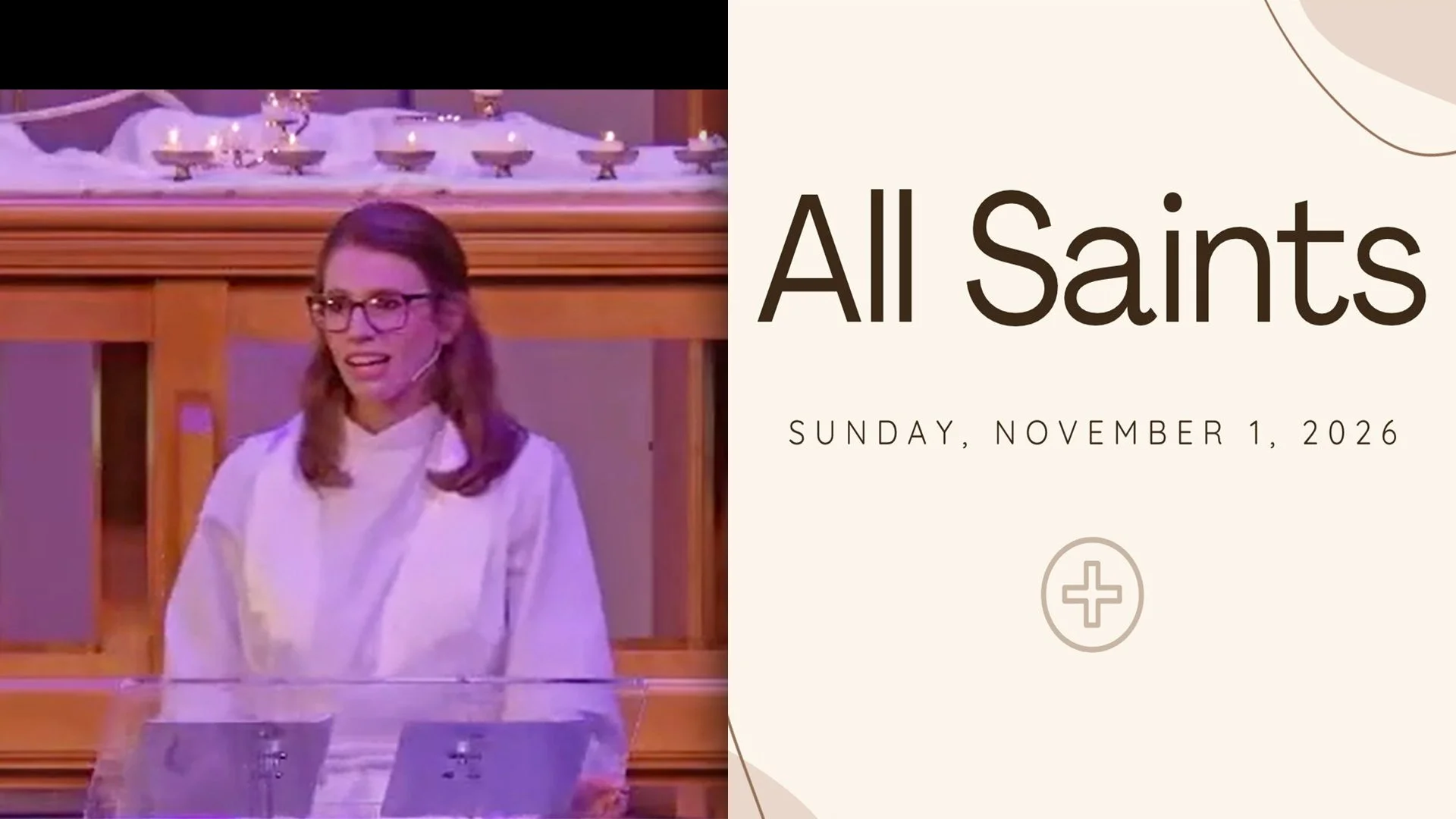
"Whose idea was it to preach from Revelation?" was the question that I asked on Monday afternoon across to Charlie's office. And his response, which was true and unhelpful in this moment, was "yours." At the time, I really loved the idea of the challenge and being able to check off another first from my Ministry First checklist, which there's not much to check off anymore. Friends, we're down to the last few.
I imagine the tension that lies underneath that initial question is one that clouds many of our thoughts together about the Book of Revelation. The idea of even attempting to crack open the last book of the Bible might feel a lot like how it feels to get my youngest son, Ansel, to eat a fruit or vegetable. It is hard. It's complex, and at times it includes imagery and symbolism that can be frightening to us. And it is a book that is vital and important to our walk of faith, to understanding the totality of the witness of Scripture. The Book of Revelation is a gift, just like the prophets, the Gospels, the letters to the churches that Paul wrote. All of those are gifts, just like Revelation is a gift to crack open.
The fruit Revelation has to offer to us this morning, though, we need to know a little bit about the context. It is the description of one singular vision given to John while he was in exile on an island called Patmos, which is about 60 miles southwest of modern-day Turkey. He was writing to seven churches that were on the mainland around 95 A.D. The genre of this writing is apocalyptic literature, which means that it heavily relies on the use of symbolic language to reveal something that seemed to be hidden or concealed, namely, the mysteries of the transcendent world. Though what feels like language that is mysterious to us, it would not have been as mysterious to the people who were receiving this letter and this vision in the ancient world.
Revelation has the same message as what is witnessed across all the other pages of Scripture, but it tells us in a different way. It uses a different method of delivery to activate the imagination of us as the reader. Michael Gorman says it this way: Revelation is not about the Antichrist, but about the living Christ. And it's not about a rapture out of this world, but about faithful discipleship in this world. Like every other New Testament book, Revelation is about Jesus Christ, and about following him in obedience and love.
So what might Revelation have to say to us today, especially on a day where we're holding close to our hearts the people who have paved the journey of faith before us? As we read a portion of this vision together this morning, I invite you to engage your imagination. How does your curiosity and your imagination and your wonder put shape to the vision that is described in these words?
I'm reading a portion of the vision. It's Revelation chapter seven, verses one through seventeen. Here are these words:
After this I saw four angels standing at the four corners of the earth, holding back the four winds of the earth so that no wind could blow on the earth or sea, or against any tree. I saw another angel ascending from the rising of the sun with the seal of the living God, and he called with a loud voice to the four angels who had been given power to damage earth and sea, saying, do not damage the earth or the sea or the trees until we have marked the servants of our God with a seal on their foreheads. And I heard the number of those who were sealed: 144,000 sealed out of every tribe of the people of Israel. From the tribe of Judah, 12,000 sealed; from the tribe of Reuben, 12,000; from the tribe of Gad, 12,000; from the tribe of Asher, 12,000; from the tribe of Naphtali, 12,000; from the tribe of Manasseh, 12,000; from the tribe of Simeon, 12,000; from the tribe of Levi, 12,000; from the tribe of Issachar, 12,000; from the tribe of Zebulun, 12,000; from the tribe of Joseph, 12,000; from the tribe of Benjamin, 12,000 sealed.
After this I looked, and there was a great multitude that no one could count, from every nation, from all tribes and peoples and languages, standing before the throne and before the Lamb, robed in white, with palm branches in their hands. They cried out in a loud voice, saying, salvation belongs to our God, who is seated on the throne, and to the Lamb. And all the angels stood around the throne, and around the elders and the four living creatures, and they fell on their faces before the throne and worshiped God, singing, Amen. Blessing and glory and wisdom and thanksgiving, and honor and power and might be to our God forever and ever. Amen.
Then one of the elders addressed me, saying, who are these robed in white, and where have they come from? I said to him, sir, you are the one who knows. Then he said to me, these are they who have come out of the great ordeal. They have washed their robes and made them white in the blood of the Lamb. For this reason they are before the throne of God, and worship him day and night within his temple. And the one who is seated on the throne will shelter them. They will hunger no more and thirst no more. The sun will not strike them, nor any scorching heat, for the Lamb at the center of the throne will be their shepherd, and he will guide them to springs of the water of life. And God will wipe away every tear from their eyes.
Friends, this is the Word of God for us, the people of God. And we say together, thanks be to God.
Will you pray with me? O God, we give you thanks for the gift of our imaginations and the gift of your holy Word. We ask that by the power of the Holy Spirit, you might speak to us anew this day. Remind us of who we are and who you are, and who you have called us to be. It's in Christ's name we pray. Amen.
Around this time last year, I was giving my oldest son, Christian, a bath, and he asked me a really important question. But before I share it with you, that question, here's a little hint, you already have a hint of what he's going to ask. Before I share with you that question, a little backstory. I decided not to have my boys, Christian and Ansel, baptized as infants, because I knew that they were going to be thrust into the life of the church, and I wanted them to have ownership over a choice in their walk of faith. And so I waited. And the question Christian asked while he was in the bathtub was, "What is baptism?"
And y'all, the glory cloud showed up, I was so excited. I had been training my whole career for this moment. And look, we were in the best place for him to ask this question. And so, my seminary professors would have been so pleased with me as I described how the water and the Holy Spirit worked together to make us clean, and the whole nine yards. As I finished that speech, Christian looks at me and says, "Mom, you did it wrong. I need Pastor Steve."
Which, if you're new here, if this is your first time, Pastor Steve was our lead pastor. He retired a couple of months ago. He and his wife, Catherine, who is also one of our pastors, is now our district superintendent. There's some more backstory. So he's like, "You didn't do it right, I need Pastor Steve," and a piece of my heart broke. But also, I was so happy that I had the resource I had.
So I reached out to Steve and Catherine, and we made plans to go over to their house. A few days later, Christian and I roll up with a McDonald's Happy Meal, because that was the kind of day it was. And we sat at their kitchen table, Christian with all of us. And what an image to hold in our minds, that there were not one, not two, but three ordained clergy people sitting at this table with Christian to talk about baptism. And so we were there, all of us, and somehow, someway, Catherine Price connected baptism to McDonald's.
"When you see the golden arches on the highway," she says, "you know that there must be a McDonald's somewhere." She said, "It's a sign for you that indicates something that you can't see yet." Brilliant. I will never look at McDonald's the same way again. "Baptism," she says, "is this very same thing." As United Methodists, we believe that baptism is an outward and visible sign, like the McDonald's golden arches, of an inward and spiritual grace, which is something that happens in our hearts that people out yonder can't fully see. At our baptisms, friends, we have been marked by grace through water and the Holy Spirit, indicating to the world that something has occurred within us.
At the beginning of this vision that we hear from John, he hears about a group of people who were also marked by God's grace in a similar way, with a seal on their foreheads, an indication to the world that they were a part of God's family. The record shows that there were 144,000 people in total from 12 tribes of Israel. This mark meant that even though they would have to face the difficult times that were ahead, they would not be harmed. They were protected by God's grace.
What John sees, though, with his eyes, was very different from what he heard about. When he looked, he didn't see just 144,000, but a multitude of people, a number much greater than anyone could count, people from all over, all nations, every language, every culture, all in one place. A great diversity of people in a throne room, wearing white robes and waving palm branches and worshiping the Lamb in beautiful song, a scene that puts the palm parade of Jesus's triumphal entry into Jerusalem to absolute shame. This was a vision of victory, of joy. There was no impending tribulation in sight.
These two groups are held together in this passage: the smaller group of Israel, marked by that special seal, held side by side with the multitude of diverse friends, marked by white robes that had been washed in the blood of the Lamb. Different groups, from different moments in time, different marks, same grace. Holding these two distinct groups together begs the question: how? How did we go from the 144,000 people, from one nation, to a countless number of people, from everywhere, from all languages, both marked by grace in their own ways? This is the question of the entire Book of Revelation. Revelation asked this question of the church back in 95 A.D., and it asks this question of us this morning, in the year 2026.
At its core, Revelation is about the ultimate victory of the Lamb, which opens wide the experience of God's grace and transformative love to people of all nations. It is the same message that we hear time and time again throughout the Gospels, through the life, death, and resurrection of Jesus Christ. The question remains, how is it that we, as people who claim to be marked by grace, participate in the transformative work that will make John's vision in Revelation a reality here and now?
A key to answering this question lies in what we acknowledge with gratitude on this holy All Saints Day. This morning we are holding together two important groups of people: the saints, both named moments ago and in our hearts, and the second group, those of us who are gathered in multitude here and online, and those who are gathered in the very same way, in churches all over the world, who are recognizing and remembering their own saints.
You are most likely here, sitting in this place or online, because a saint, someone in your life, faithfully witnessed to the radical and transformative love of Jesus Christ. Someone in your life took time to share their story of the way Christ met them, in moments that they couldn't imagine for themselves. They took time to intentionally connect with you in a way that helped you feel seen and known and loved by God, who has opened wide the experience of grace to include you.
For me, one of those saints was Lisa Andrews Moore, whose name means nothing to you but meant everything to me. Her name will be called this morning at First United Methodist Church of Lakeland, Florida. When I was in sixth grade, coming to youth group for the very first time, it was Lisa who I met at the doors. She was also my small group leader all the way through middle school, and the way that she welcomed me, the way that she led that small group, made me feel seen and known for the first time in that way, ever. Lisa, her favorite word was "edify." And after every small group, before she sent us back to go do more worship, she would invite us to be sure we edified someone else, lifted them up. That was our charge going out from small group. She did pass away this year. Her name will be called.
And as I remember Lisa, I bet you all have a Lisa from your life that you are remembering too. You see, friends, we are living proof of what happens when people who have been marked by God's grace lean into the call of their baptisms, the call to transform the world with the extravagant love of Jesus Christ. This is the invitation of Revelation. It's an invitation that has been lived out across the centuries of the church.
We just finished a sermon series for the past four weeks where we remembered and learned from saints of the church. They lived out their call in such a way that it inspires the church today to live out the same call. The saints in your lives have inspired you to live out your faith in a way that inspires others. So now, friends, it is our turn. It is our turn to continue the legacy of the saints that have paved the path before us. It's our turn to live out the legacy and participate in the ongoing, transformative work of Christ, the Lamb of God.
As people who have been marked by God's grace, we too are called to share our own stories of the way God has met us on the journey and brought us to this moment. It is our turn to choose intentionality as we engage with the people who are around us with absolute love. It is our turn to be the saints for someone else, so that one day all the world, every nation, every language, every culture, the multitude of diversity, will all be marked by grace.
In the name of the Father, the Son, and the Holy Spirit.
Amen.