
The End of Me… The Beginning of Us | 7/26/26
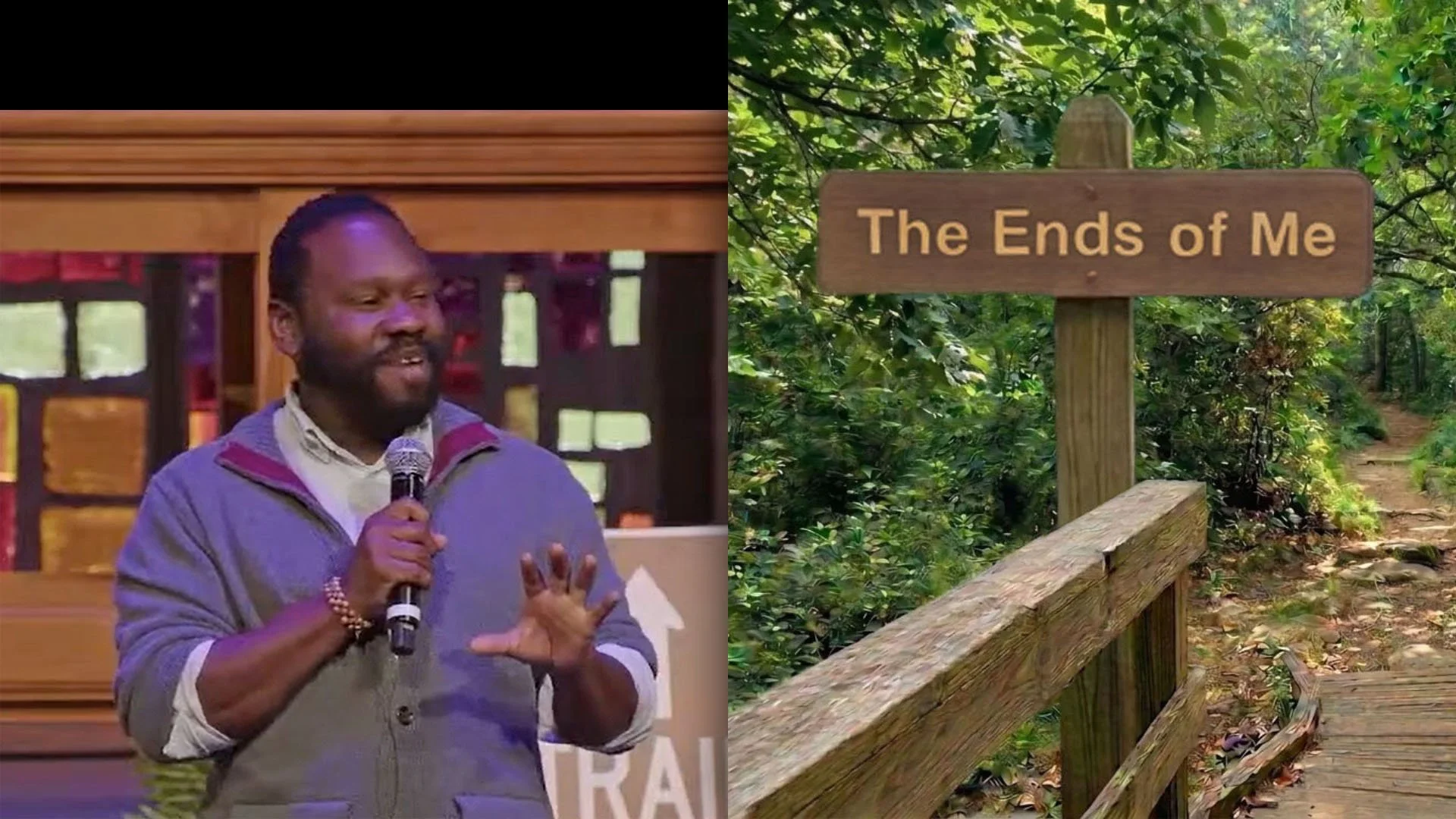
-
The sermon draws a distinction between mercy and justice that are connected to a bigger mission of welcome, versus mercy and justice that are really just about making ourselves feel better or fulfilling an obligation. Which one do you think tends to describe your own acts of service most honestly, and what would it look like to shift that?
Bishop Berlin describes a "new longing" that comes when Jesus truly becomes Lord — a shift from wanting more for yourself to genuinely hurting for those who are suffering. Where do you see that new longing showing up in you, and where does it feel like it still hasn't quite taken root?
The master in the Matthew twenty-two parable keeps sending the servant out further and further — to the highways, the hedges, the blind, the lame — because the people he expected to show up didn't. Who are the people in your own community that you wouldn't naturally think to invite, and what's one concrete way you could extend that invitation
The families in Amsterdam made a deliberate choice to give up upward mobility and plant themselves in one of the most overlooked neighborhoods in their city because they believed Jesus is Lord. That's an extreme example — but is there a smaller version of that kind of sacrifice or inconvenience that you sense God might be inviting you toward?
The question at the heart of the sermon is simply this: when people look at your life — not just your church attendance or your giving, but the actual shape of your everyday life — would they say, "Oh, those are the Christians"? What would need to change for that to be more true of you?
Transcript:
Well, good morning again, friends.
As Marisa said, Derrick Scott III, again. I have been in campus ministry 23 years. So for those who are trying to track it, I'm 46 years old. Some people see me and they're like, "When did you start?" Like, I was 22. Trust me, that was a beautiful season of my life — so many gifts working with and being in ministry with college-age young adults, and I got to do a whole lot of really cool stuff with them.
One of the things that I got to do — actually before Marisa's time, when she was in my campus ministry — I got to take some students to an intentional community in Amsterdam. There was a Dutch Reformed community in the red light district of Amsterdam. These families — for generations — lived in this community, this major complex right in the middle of the red light district. And in addition to housing their own families, they also had housing for people who were coming off of addictions, housing for people who were seminary students, as well as immigrants who were literally moving to the Netherlands, and also individuals who were leaving some occupations and needed a transitional space to get into new occupations.
I took students over every summer, around about this time, to go over and help them with their summer cleaning. They would send most of their residents away for a week, and then we would roll in and literally get our hands dirty — just doing some deep cleaning and putting together new IKEA furniture. And it was just a really rich time for me and my students. One of the greatest, most powerful memories for us was the mealtimes. The mealtimes took place in this room where we'd all be sitting at this table together, and literally people from everywhere. You could look at this table and realize these people do not all come from the same place. They don't all see the world the same way, but they are sitting at this table, and it is a table of connection.
Now, what was really interesting about this particular moment — and as I told you, this was an intentional community in the red light district, a huge tourist area of Amsterdam — people are obviously walking in this touristy area, and windows are a big deal. And that's all I'm going to say to you about that, only then to say — and I asked Marisa if it was okay if I told the story, and she said I could. So send the emails to Charlie, actually, when he gets here. But the thing that was interesting: the room where we had the meals had this big window that looked out into the city, and to the tourists who were walking down the street, looking in windows. This room, with this table and these people sitting at it together, was so normal that in the red light district it was odd. People, tourists walking down, and every now and then you'd hear somebody as they were walking — they'd see this table of people in the red light district and say, "Oh, those are the Christians."
One of the things I know about this community — this intentional community called Oz 100 — these families decided that they were going to cash in the upward mobility life and literally raise their families committed to this neighborhood, because they confess that Jesus is Lord. And their belief that Jesus is Lord drove them to really ask the question, "How do we make more room for people at the table? How do we literally exist in such a way that we can continue to make more space and create more room for people?" It was the greatest privilege to take college students to a space where they could experience that kind of ministry, and then to hear them say on the plane ride home, "Yeah, that was church. That was church."
I mean, yes, there are a lot of examples of really great church — great things that the church does, great songs. Y'all's choir is awesome, by the way — so, so great. Great songs the church sings, great campuses the church builds. But man, the testimony of that intentional community in Amsterdam — those people believe that Jesus is Lord. It was so beautiful to experience. But it wasn't a new concept. It wasn't this brand-new innovative ministry. It actually was something really, really old. It's something that the first followers of Jesus actually did. And I just want to read to you a little bit of Acts chapter two. The first people who experienced the power of the resurrection — their response to the risen Lord, their response to the Holy Spirit living inside of them, was a very similar scene to what we experienced in that intentional community in Amsterdam.
Hear these words this morning from Acts chapter two, starting at verse forty-two.
And they devoted themselves to the apostles' teaching and the fellowship, to the breaking of bread and the prayers. And awe came upon every soul, and many wonders and signs were being done through the apostles. And all who believed were together and had all things in common. And they were selling their possessions and belongings and distributing the proceeds to all, as any had need. And day by day, attending the temple together and breaking bread in their homes, they received their food with glad and generous hearts, praising God and having favor with all the people. And the Lord added to their number day by day those who were being saved.
Friends, this is the Word of God for us, the people of God. Thanks be to God.
Friends, let's pray together. Holy Spirit, this morning I just pray that you would inspire us to be the people you're calling us to be in this moment, and that our confession that Jesus is Lord would cause us to ask the question, "Who's missing at this table?" May it be so for us. In Christ's name, Amen.
So again, the people in Acts chapter two — these first followers of Jesus, everyday ordinary people — their automatic response, the thing that they did next after being filled with the Holy Spirit, was gathering at tables together and seeing that they all had everything in common, selling their possessions and making sure that there were no needs among them. And this was the testimony of the people who saw that first church: "Oh, those are the Christians. Those are the people who confess that Jesus is Lord."
And friends, this is the question this morning — this is the wondering, the curiosity. When people look at Trinity United Methodist, what do they say about us? It's my first time worshiping with you. I've been on your campus many times, but it's my first time being in your space. And let me just say, third service feels quite good — okay, I'll just say it out loud. The first two were really cool, but third service I might be a fan, and it feels really good in here. But friends, it was never just meant to be about this. And it's the question: who's not sitting at this table? Who doesn't know that they're welcome in this space?
And friends, our confession that Jesus is Lord should drive us to ask, "How might my life not just be about me?" It's the title of the sermon — The End of Me. It is not just about my life. My confession that Jesus is Lord drives me to the beginning of us, to ask a question about the world beyond me, not just about me. To ask the question, does everyone know they have a seat at Jesus's table? Like that Acts two community, like that community in Amsterdam.
Marisa told me that y'all have been reading through and discussing Bishop Tom Berlin's book Jesus is Lord, and I've personally found it helpful — particularly in the ways that me calling myself a Christian, calling myself a follower of Christ, calling myself a person who professes that Jesus is Lord, has been helping me to move from a place of it just being about me to thinking about the world around me. And I want to just read to you a little bit of chapter six, because I actually thought it might be helpful for us this morning as we think about Acts two and what it means to make this profession that Jesus is Lord.
Hear these words from chapter six in Bishop Berlin's book Jesus is Lord. It's called "A New Longing."
"One of the most noticeable changes to occur when Jesus becomes your Lord is a transformation of longing. Before, you may have longed primarily for possessions, waking each morning with a hunger for what the world offers. Some people approach life like contestants in a game show, racing through aisles with a shopping cart, grabbing whatever they can carry in their allotted time. They want more things, better things, expensive things, and expansive homes to contain it all. Others chase experiences instead of objects — exotic destinations, luxury accommodations, curated moments designed for social media admiration. This pursuit of possessions and experiences, the accumulation of both greater goods and grander getaways, is often held up as life's ultimate goal."
And so this is the moment that I would look at Bishop Berlin and just be like, "Could you stop talking about my life right now, please?"
And he goes on to say: "When Jesus becomes your Lord, you begin to long for help and healing for those who experience injustice. You know people in bad circumstances and you want them to get better. You see relationships you pray can be repaired. You see poverty and wonder if something can be done. You see systems in society that seem broken or weighted toward some people and away from others. You notice that some people seem to suffer more than others. You see vulnerability and it sticks with you. When you hear the principal of a local school say that her students miss meals and are hungry, it jolts you. While compassion makes you focus on that child, the new longing pushes you to consider children more broadly. It asks the bigger question of what happened to get us to this place where children might be hungry in the first place." Bishop Berlin goes on to say, "This change is a key aspect of your growing faith in Christ and your desire to be like him."
I think about that intentional community in the red light district of Amsterdam, and I think about these people who have professed Jesus as Lord, and it has driven them to be a very specific type of people in the world — where the world looks back and says, "Oh yeah, those are Christians." I think about Acts two. I think about the first followers of Jesus — not seminary trained, not professional activists, just everyday ordinary people who have experienced the resurrection power of Jesus. And their obvious next response is to gather around tables and to make sure that they all had all things in common. And the world's confession back to them is, "Yep, looks like Christians."
So what about us, friends? I'm from Jacksonville, and I'm a part of a little congregation in Jacksonville — San Marco Church, United Methodist. They're meeting right now as we're meeting as well. And we do a lot of things in our building and try to leverage it, but at the end of the day, what really matters is: do people experience the love and grace of Jesus and get the sense that they are welcome among us, in our space? And we're on our journey, as I believe you're on your journey, because we're all confessing that Jesus is Lord. Amen.
Well, Bishop Berlin seems to think that those who confess that Jesus is Lord now have a new longing, a new desire — not simply a life that's about me, but a life that is now about us. And that is asking the question, "How do we get more people at the table?"
So later this afternoon, I want to invite you to go home, grab a choice beverage, and read Acts chapter two. Feel free to read all of it — I read the last little bit of it, but I want to invite you to read Acts chapter two and see what comes to you. See how the Spirit might be inviting you into something. And then I just want you to hold your finger in Acts chapter two and flip back to Matthew twenty-two, because Matthew twenty-two has a beautiful story that I'd also love for you to reflect on.
Now, you'll read the New Revised Standard Version or Common English Bible. I'm going to give you Matthew twenty-two, Derrick Advised Standard Version, if that's okay. Matthew twenty-two — Jesus tells this parable about a master of a house who wants to have a party. And so he says to his servant, "Hey, servant, go to my friends and tell my friends that I want to have a party." So the servant goes out to the friends and says, "The master wants to have a huge party — come and fill the seats." And the friends tell the servant — again, Derrick Advised Standard Version — "Yeah, no, I'm busy doing my own thing. I'm busy working on my own life. I've got my own stuff to worry about. Sorry, I won't be able to come to the party." And so the servant goes back to the master and tells him what the friends said about the party. And the master is like, "Well then, fine — go to the highways and the hedges, go to the blind and the lame, and bring them into my house, that my house might be full."
This is a story for people who confess that Jesus is Lord and therefore want to live in such a way that every seat is filled. Some ways that we might be like that servant, some ways we might embody the same spirit that the Acts two church embodied, some ways we might even be like that intentional community in Amsterdam — some tools that help us essentially make sure that people know that there's a place for them at the table. Some of those tools are called mercy and justice.
Now, we in the United Methodist Church talk about mercy and justice all the time. Mercy — the ways that we address the immediate needs, the ways that we try to deal with the suffering that is right in front of us. And justice — the ways that we speak truth to power, the ways that we deal with systems. Now, we could engage in acts of mercy and justice for their own sake. We could totally do that. But when mercy and justice are removed from this greater desire to see that everyone finds their place at the table — that everyone knows that just because they don't look like us doesn't mean they're not welcome, just because they don't see the world the way that we do doesn't mean they're not welcome — when people know that, and when mercy and justice get connected to that kind of mission, oh man, friends, we find ourselves being people who aren't just confessing that Jesus is Lord. We find ourselves being people who literally embody the grace of Jesus Christ.
Mercy, when it's detached from the table, can be just about us. "I need to fill this need so I can get on with my day. I need to make sure this kid is fed so that they're not bothering me." Justice removed from the table — justice disconnected from our living of Jesus as Lord — becomes sometimes just acts of politics. Not that politics is all bad, but sometimes just acts of politics. "I'm tired of seeing that in my news feed." But when mercy and justice are tools by which we are trying to make sure that people find their place at the table, we become people who are not simply living for ourselves. We become people who, because of our confession that Jesus is Lord and because of the power of the Holy Spirit, begin to be like that servant in Matthew twenty-two — going to wherever we need to go to make sure that every seat is filled.
So Trinity Church, this morning I want to invite you to consider how the Holy Spirit may be inviting you — calling you in your confession that Jesus is Lord — to live beyond yourself. In your confession that Jesus is Lord, to ask that question: who's missing at this table? And how might I use the tools of mercy and justice to make sure that we all have all things in common?
In a few minutes, Marisa is going to lead us to the Lord's table. And I am a Lord's table guy — I'm a communion guy. In fact, I chose San Marco Church because we have communion every Sunday. I love coming to the table to receive the body of Christ and the blood of Christ. I love it, I'm grateful for it. It is a sacrament and grace to me. But friends, I need you to know this table is not an end in itself. This table — if I could say it this way — it's not actually the point. This table: we are invited to get what we need so that we can then go back out into the world and ask the world what it needs. And so this morning, as you come before the table, yes, come and receive. Come and confess — yes, Jesus is Lord. And as you receive, as you confess, let the Holy Spirit open your heart to those who are not in this room. Let the Holy Spirit open your heart to those not sitting in these seats, that you might leave this place — yes, confessing that Jesus is Lord — and being about the business of embodying his grace in such a way that people would know there's a place for them at his table.
Friends, let's pray together. Holy Spirit, I just pray that some of what I said this morning would awaken your church to be who you're calling us to be in this moment. We confess that you, Jesus, are our Lord, and that confession will call us to leave a life that is just about us, just about me, and to ask some bigger questions. So come, Holy Spirit — give us courage to be like the Acts two church. Give us eyes and ears to perceive those who need the invitation, to be invited and to find their place at this table. May it be so.
In Christ's name, Amen.