
-
Finishing well was described as less about gritting your teeth and more about letting God’s grace do its work. Where in your life are you running on raw willpower right now, and what would it look like to loosen your grip?
The sheep in the parable were genuinely surprised when they were commended, because caring for others had simply become their instinct. When was the last time you helped someone without thinking about it, and what does that tell you about what’s been growing in you?
Faith that’s performative, forcing holiness on the outside so you look the part, can be exhausting. Is there any area of your faith right now that feels more like performance than transformation?
The goats weren’t cruel, they were distracted, looking for God in impressive places while missing the need right in front of them. Who or what might be right in front of you that you’ve been too busy or distracted to notice?
Instead of asking “How can I try harder this week?”, the question was whether you’ll allow Christ to do deep work in your heart. What habits or spaces in your life could help you encounter Christ and make room for that work?
Transcript:
Hey, before I get into things, actually, listen, just a moment of personal indulgence here. I thought I'd like to show you something. Look at that. Woop woop woop.
I want to say a huge thank you to so many of you who, you know, it was actually quite worrying how many of you were able to stalk. Sorry, I mean, track my steps around the course last week. For those of you who did that, I thank you. Thank you for those who sent encouraging text messages, for anybody who prayed for me as I ran the New York City Marathon. Knowing that your support was behind me as I found my way around that course, and over those five stupid bridges, and ran through the city, I can tell you, it really meant a lot to me. So thank you just for being my church family. I know we're only getting to know each other, but that meant a great deal to me as I approached the finish line last Sunday morning. Sunday evening, actually, Sunday evening.
I find myself reflecting on how different this marathon felt to previous marathons that I've run. In past races, that final stretch has always been an absolute grind, like a battle of raw willpower, where I was essentially dragging my exhausted body across the finish line, quite literally running on empty. Well, last week, as I navigated those final few miles, I actually felt a strength that was new to me, so very different compared to previous efforts. And as I've reflected on all of that this week, I've been thinking that the difference wasn't just in the physical training, or in the nutrition plan that I followed on Sunday morning and afternoon, as important and vital as those things were. No, it was actually something tangibly different, a physical reflection of an ongoing inner work of transformation that I believe Christ has been doing within me in this season of my life.
I have been learning that finishing well is not always just about gritting your teeth and keeping going. Actually, finishing well happens when we allow God's transforming grace to do its work, to liberate us and to set us free, to live abundantly and to function at our best potential.
Now, speaking of finishing well, did you know that we are almost at the end of another church year? Did you all know that? Yes, I hope you did. As we enter into November, we're coming up on the end of the Christian liturgical calendar, and in just a few weeks' time we will enter Advent. And so what we're going to do in these three or four weeks that we have left in the liturgical year is enter into a mini series of sermons that is going to focus our attention quite singularly on Jesus. We're going to look at Jesus through a very classic biblical lens, one that the church has used for centuries to better understand who Christ is and how Christ transforms us.
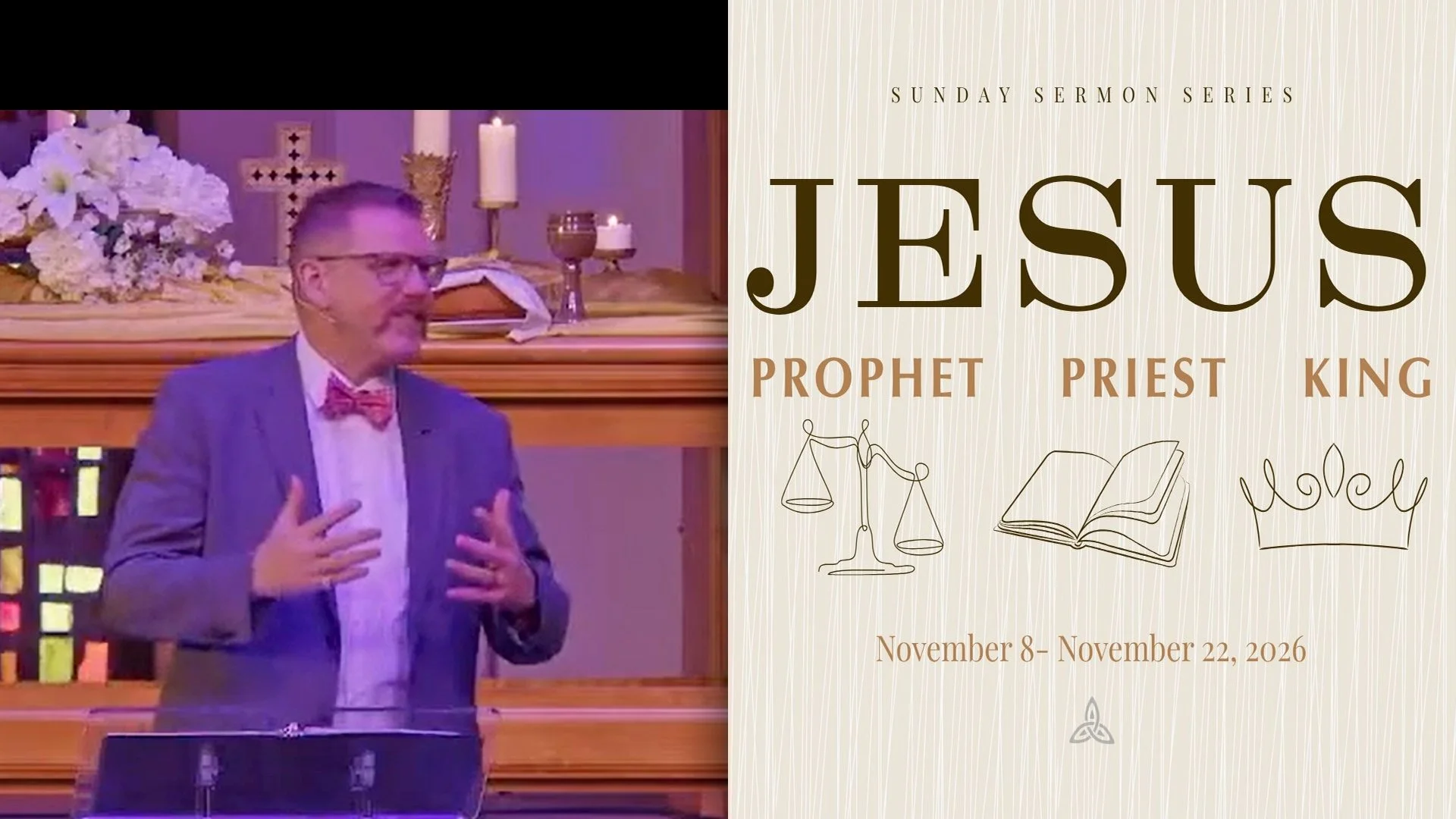
Now, throughout the Old Testament, whenever God set leaders apart for a holy calling, they were anointed with oil. There were only three specific offices that received such an anointing. There were prophets, who were called to speak God's truth. There were priests, who were called to mediate God's presence and closeness in the world. And there were kings, who were called to lead with justice. Now, when it is literally translated, the word Christ means "anointed one." And when Jesus came to dwell among us, he actually embodied all three of these roles. And so over this week and the coming two weeks, we're going to look at Jesus as priest, prophet, and king.
Today we're going to focus on that priestly role, and what I want to say is that it is all about the work of sanctification. The priestly role represents God among God's people and leads in the work of nurturing and forming disciples, whose lived experience, then, is a noticeable transformation of heart and mind. A priest enters into the life of a community and seeks to draw people near to God, and does that quiet, deep work that seeks to change hearts and lives from the inside out.
Now, we see such a transformation on full display in our Scripture reading today from Matthew's Gospel, chapter 25, in which Jesus paints a picture of what it looks like when his inner work of grace takes root in our daily lives. Listen in to the word from Matthew 25, verses 31 through 46:
When the Son of Man comes in all his glory, and all the angels with him, then he will sit on the throne of his glory. All the nations will be gathered before him, and he will separate people one from another as a shepherd separates the sheep from the goats, and he will put the sheep at his right hand and the goats at the left. Then the king will say to those at his right hand, come, you that are blessed by my Father, inherit the kingdom prepared for you from the foundation of the world. For I was hungry and you gave me food, I was thirsty and you gave me something to drink, I was a stranger and you welcomed me, I was naked and you gave me clothing, I was sick and you took care of me, I was in prison and you visited me. Then the righteous will answer him, Lord, when was it that we saw you hungry and gave you food, or thirsty and gave you something to drink? And when was it that we saw you a stranger and welcomed you, or naked and gave you clothing? And when was it that we saw you sick or in prison and visited you? And the king will answer them, truly I tell you, just as you did it to one of the least of these who are members of my family, you did it to me.
Then he will say to those at his left hand, you that are accursed, depart from me into the eternal fire prepared for the devil and his angels, for I was hungry and you gave me no food, I was thirsty and you gave me nothing to drink, I was a stranger and you did not welcome me, naked and you did not give me clothing, sick and in prison and you did not visit me. Then they also will answer, Lord, when was it that we saw you hungry or thirsty or a stranger or naked or sick or in prison, and did not take care of you? Then he will answer them, truly I tell you, just as you did not do it to one of the least of these, you did not do it to me. And these will go away into eternal punishment, but the righteous into eternal life.
My friends, this is the Word of God for the people of God. We say together, thanks be to God.
Hey, who are some of the people who have impacted your spiritual journey greatly, to the point where you changed on the inside because of their influence and example? I mean, just for a second, think about those people in your life for a minute. Who were they? What did you learn from them? What changed inside you because of your proximity to them?
Me, I think of my dad. My dad taught me about grace and mercy and how to extend that to other people. I also think of my best friend Stevie. Because of his friendship, example, and testimony, I was introduced to Jesus Christ. I think of Father Gerry Reynolds, the Redemptorist priest from Clonard Monastery in Belfast. He modeled peace and reconciliation during some of the darkest days in my homeland, and being around Father Gerry taught me much about gentleness. I think of Pastor Rene, the most formidable leader I ever got to work with, as I was learning about what it is to be in ministry in the local church. Spending time with each of these godly influences brought about changes within me that have shaped the person that I am continuing to become.
We could say, actually, that each of these have fulfilled a priestly role in my life, because that's precisely what a priest does. A priest stands in the gap between God and humanity, seeking to draw people nearer to the heart of God, becoming an instrument of sanctification, a channel of God's transforming grace. Now, these human mentors that I mention, they have been amazing in that work. However, they have also just been reflections of what Jesus and his high priestly role has done and continues to do.
Let me explain. Human mentors can influence us as we watch and learn from them. But Christ, the High Priest, Christ actually moves into our lives, inhabits us. He doesn't just stand beside us to give us good advice. No, he enters into our lives, into the places of peace in our lives and the places of chaos too, into the tidy parts that we would show anyone around us, and into the messy parts that we don't want anyone to see, into the strong places as well as the broken places of our hearts. And as Christ moves in, he does this work of washing us and cleansing us and renovating us from the inside out. Christ does the sanctifying work of changing us from the inside, so that we aren't just individuals trying to act and look like Christians. We are actually being made new, and being motivated into new action as our hearts are transformed.
Now, I think that this is the kind of change that we see in the Gospel reading that we just shared from Matthew. Think about the sheep in Jesus's parable when they are commended for feeding the hungry, and welcoming the stranger, or visiting the prisoner. How is it that they responded? They did not say, oh, you're welcome, Lord, we worked really hard on getting that just right, it is the least we could do. No, they are genuinely surprised. Genuinely surprised. And they ask, Lord, when? When was it that we saw you hungry or thirsty or a stranger or in prison?
Now, can you see what's going on in their response? They had not actually been keeping a list of all the good things that they had been doing. They weren't tracking their volunteer hours or trying to rack up righteousness points. They weren't checking off religious boxes to make sure that they had earned their spot among the sheep. They weren't forcing themselves to be charitable out of guilt or fear of judgment. No, it was none of that. Acts of care and generosity and service towards those who needed them had become their default setting, had become their instinct. Their hearts had been transformed, and they had learned to walk in the way of Christ, which is always the way of sacrificial love. Because they had been in close proximity to the High Priest, because his grace had been doing that quiet, transformational work within them, loving the person in front of them, whatever situation that person was in, had become natural to them, as natural as breathing.
That's the profound difference between a faith that is performative and a faith that is rooted in the transforming work of Christ, our High Priest. Performance is gritting your teeth to force holiness on the outside so that you look the part. Transformation is what happens when Christ does his priestly work to change your heart on the inside, so that love overflows.
And that stands in stark, heartbreaking contrast to those on the other side in this parable, the goats. Now, look at their response when they are confronted. Listen to what they ask: Lord, when was it that we saw you hungry or thirsty or a stranger or in prison? Do you notice that their question to the King mirrors exactly that of the sheep? But the heart and the motivation behind it could not be more different. Now, these goats weren't necessarily malicious folks who actively hated the poor and the marginalized. No, no. The tragedy of their situation was that they had entirely missed the point in regard to life with God. They had missed out on that deep priestly work of sanctification, and because their hearts had never been changed, transformed, and renovated by Christ, they had ended up operating purely on external appearances, looking for God in high or impressive or overtly religious places, while remaining completely blind to God's heart for those in need who were right in front of them.
And if we pay attention as we flick through the pages of the whole Bible, we will recognize that this very issue is a common one for God's people. The prophets of the Old Testament bring this issue up again and again. What was it that the prophet Amos says on behalf of God? He says, I hate, I despise your religious feasts. And then just a while later, but let justice roll down like waters, and righteousness like an ever-flowing stream. God's work among God's people has always been about transforming the hearts of people, so that their motivation for all things is to share the great love they have received, in all of the ways they can, to all of the people that they can, for as long as they can.
The goats in this parable, they clearly had given in to distractions and missed the point. I sympathize greatly with them, because I know how easy that is to get caught up in, right? It is easy to be distracted. Amen. Yes, it is. But the bottom line is still that they missed out on the sanctifying work of Christ that would have transformed their hearts and might have brought changes into the lives of those around them.
So what do we do with all of this? What do we do in response to a word reminding us of Christ's priestly work in our lives? I think the very first thing I would say is that the big question out of this for us is not, well, how can I just try harder or do more this week? That's not it. The question is actually much simpler than that, and it's more like this. Friends, will we allow Christ the High Priest to do that deep, transforming work in our hearts?
Will we allow Christ the High Priest to do that deep, transforming work in our hearts? Are we hungry for it? Are we willing to create habits and spaces in our lives where we will encounter Christ and invite this work of sanctification to take place within us? Finishing our race well, that is, living as faithful, fruit-bearing disciples in our homes, our workplaces, and in our city, it was never, ever meant to be a battle of raw willpower. It was never meant to be about dragging our exhausted, depleted souls across the finish line of the journey, trying to force ourselves to do good out of guilt or duty or fear of falling short. It was never meant to be about that, because that is not the gospel. That's a formula for spiritual exhaustion and burnout.
Christ's priestly work of sanctification is not a heavy burden. It's liberation. It is freedom. It is the transforming grace of Jesus that liberates us from having to prove ourselves, setting us free to live abundantly, to love generously, and to function at our best God-given potential.
Today, Christ, who is our High Priest, is present with us. Do you believe that? Do you remember that when we gather in the name of Christ, we gather in the presence of Christ? Christ, our High Priest, is present with us and is ready, willing, and able to continue that quiet, deep, renovating work within you and within me. Christ wants to move into the tidy parts and the messy parts, the strong places and the broken places. Christ wants to move in, to cleanse, and to make you and me new.
Whatever your age or stage of life, whether you have been a Christ follower for decades, or whether you haven't even got there yet and you're not sure about it, and today is the first time you would like to invite Christ to do that in your life, Jesus, the High Priest, is eager, eager, eager and ready to do that priestly work within us. And here's the good news: the only thing that is asked of you and me in response to this eagerness is to open our hearts and our minds and our lives, to open ourselves to this work.
So my prayer for us today, as we close this sermon, is really, really simple, actually. May we each stop striving in our own depleted strength. May we open our hearts to Christ, who is the High Priest, today, allowing his transforming grace to liberate us and set us free, so that his love becomes our default setting, overflowing from our lives into this world that we are a part of, that so desperately needs it. Oh, so hungry for it. May we each open up our hearts and lives to receive the grace of this work of Christ, who is our High Priest. Amen and amen.
Let us pray together. Lord Jesus Christ, our High Priest, who stands in the space between us and the very heart of the triune God, thank you for all that you do to draw us closer to God's heart. Thank you for all that you do to shape us in your way, the way of sacrificial love. And today, as we respond to your eagerness to continue that work, gracious God, give us strength and courage and faith to open up our hearts and our lives, and to say yes to your priestly work within us. We ask it through Christ our Lord.
Amen.