
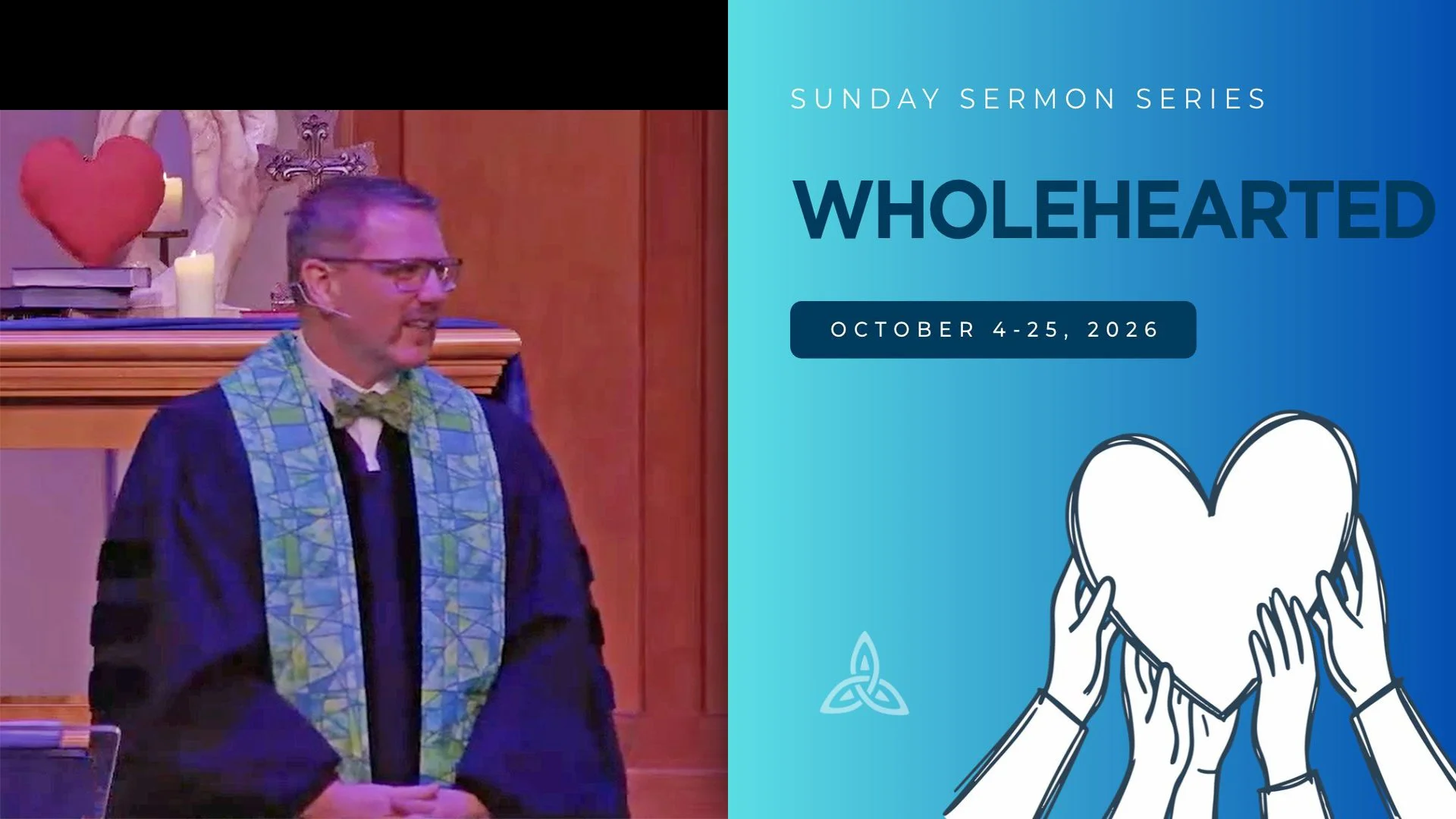
Wholehearted: Patrick of Ireland | 10/4/26
-
Both Paul and Patrick had their lives broken open before they found a deeper wholeheartedness. Has there been a season of loss or hardship in your own life that, looking back, became the place where something new was formed in you?
The sermon suggests that gratitude is the foundation of generosity, that we can't truly give until we recognize everything we have is already a gift. What's something you currently hold, your time, your resources, your abilities, that you might be thinking of as self-made rather than received?
Paul moved from encounter to action almost immediately, barely pausing before he began living out his new purpose. Where is there a gap in your own life between what you believe and what you're actually doing about it?
If you thought about giving not as meeting a budget goal but as a tangible expression of gratitude, how might that change the way you approach your time, talents, or finances this season?
What would it look like for you, specifically, to "leave it all on the field" in this coming year, not in a general sense, but in one concrete area of your life?
Transcript:
Over the last number of weeks, we've been moving through a series called Dear Church. It was based on the letter to the Philippians. And in that series, we wrestled with what it means to push the roots of our lives deep down into Jesus, to lay down our self-reliance, and to live as citizens of God's kingdom right here and now in our own community.
Well, today we are moving into a brand new series of sermons. And if a journey through Philippians challenged us to marinate deeply in God's grace, then, friends, I say to you today, hold on to your proverbial hats, because this next journey, Wholehearted, is going to take us even deeper. You see, this is a series about what it means to live a life that leaves everything on the field. It's about a life of faith that gives it all. It's about taking the entirety of who we are, our time, our talents, our energy, and our resources, and dedicating them fully to the purposes of God in our time and place.
Over the coming weeks, we are entering into what is our annual season of reflection and thought around Christian stewardship, and we're going to explore what it is to live our lives as wholehearted followers of Jesus, wholehearted stewards of all that God has entrusted us with. Yes, that's because it is, as Marisa rightly said earlier, it is October. Believe it or not, this is a time when we annually enter into this season of prayer around how we will join in with the work of God that takes place through our life together, about how we will be involved in that work, about how we will support that work with our own financial gifts.
But this series, it's more than just numbers and budget line items. It's actually more about the posture of our souls, of our very lives, more than it is anything else. Now, to anchor this journey, each week we're going to look at one of the pivotal stories from the book of Acts. And we're going to look at that alongside some of the life stories of four incredible saints from the life of the church, who have embodied this radical, generous, difference-making life of faith.
So today we're going to begin in Acts chapter nine, with the dramatic transformation of a guy whose name was Saul, Saul of Tarsus, a man who began his journey brimming with self-reliance, control, and authority, only to be brought to his knees by a holy and quite literally blinding light. I want to read to you from Acts chapter nine today, the first nine verses.
Meanwhile, Saul, still breathing threats and murder against the disciples of the Lord, went to the high priest and asked him for letters to the synagogues at Damascus, so that if he found any who belonged to the Way, man or woman, he might bring them bound to Jerusalem. Now as he was going along and approaching Damascus, suddenly a light from heaven flashed around him. He fell to the ground and heard a voice saying to him, Saul, Saul, why do you persecute me? He asked, who are you, Lord? The reply came, I am Jesus, whom you are persecuting. But get up and enter the city, and you will be told what you are to do. The men who were traveling with him stood speechless, because they heard the voice but saw no one. Saul got up from the ground, and though his eyes were open, he could see nothing. So they led him by the hand and brought him into Damascus. For three days he was without sight, and neither ate nor drank.
And then from verse 17 through to 22:
So Ananias went and entered the house. He laid his hands on Saul and said, brother Saul, the Lord Jesus, who appeared to you on your way here, has sent me so that you may regain your sight and be filled with the Holy Spirit. And immediately something like scales fell from his eyes, and his sight was restored. Then he got up and was baptized, and after taking some food, he regained his strength. For several days he was with the disciples in Damascus, and immediately he began to proclaim Jesus in the synagogues, saying, “He is the Son of God.” All who heard him were amazed and said, is not this the man who made havoc in Jerusalem among those who invoked this name, and has he not come here for the purpose of bringing them bound before the chief priests? Yet Saul became increasingly more powerful, and confounded the Jews who lived in Damascus by proving that Jesus was the Messiah.
My friends, this is the Word of God for the people of God. Thanks be to God.
Now, to help us unpack this radical transformation of Saul over these next four weeks or so, like I said, we are going to meet four saints of the church who lived out their faith with a very similar kind of wholeheartedness. Now, some of them you will have heard of, and you might even know well. Others of them might be new to you. But you can be sure of this: all four lived lives worth knowing and learning from.
Who are these four? Well, I already told you that in the letter that we pushed out to your email inboxes earlier this week. If you did not get that email, first of all, why don't you get our emails? Sign up for them and let us communicate with you. Secondly, if you didn't get it, that's okay, we printed some copies there on the left-hand side as you walk in the doors of the sanctuary, please get one and have a read through of that. Now, in that email I told you who the saints are. I actually messed up a little bit in the order that we're going to preach through them, but that just means you're going to have to come back every week in October to find out what saint we're tackling on that day.
I can tell you about today's saint, though. It's a little bit obvious given my 100% Irish heritage. Yes, we are going to talk today about Saint Patrick of Ireland. Now, Patrick, he's a bit of a celebrity among the saints of the church, celebrated every single year with great enthusiasm all across the world. But here's the funny thing about it, the way that Saint Patrick is usually celebrated often has very little to do with who he actually was or how he lived his life. What are you saying, pastor? Are you saying that Patrick didn't dye entire rivers green to celebrate himself? Are you saying that he didn't lead these massive parades in major cities to celebrate himself? Yes, friends, that's exactly what I'm saying. And don't even start me on corned beef and cabbage.
Now, Patrick lived a life of wholehearted devotion to God, but it took him a while to get there. As a young teenager in Britain, he was actually kidnapped by raiders. He was taken across the Irish Sea, where he was sold into slavery. And for six brutal years he worked for a chieftain, tending the sheep on a cold, lonely hillside. Now, later on in his Confessio, he wrote that those six years were actually his spiritual furnace. It was in the isolation of the lonely hillsides that, he says, he learned to pray, turning to God with his whole heart for the very first time.
Well, after six years of tending the sheep and learning to pray, Patrick then receives this vision in a dream, telling him that his boat was ready. Well, he fled his captors. He walked two hundred miles across Ireland to the coast, and he escaped on a ship, eventually making it home to his family. After this, he begins his theological studies. Ultimately he is ordained, but again, years after this, he receives another vision, and in this one a man has come to him from Ireland, bearing countless letters, and in these letters Patrick hears the voices of the Irish people crying out in unity, we appeal to you, holy servant boy, to come and walk among us again.
Now, to make a long story short, Patrick chooses to go back. He returns to Ireland, carrying a wholehearted commitment to Jesus Christ and to the mission that he has been called to. He spent the rest of his days traveling throughout the island of Ireland, befriending more chieftains, planting Christian communities, and sharing the gospel there. In fact, the very first community that he is said to have planted is just down the road from where I grew up, a little townland by the name of Saul. Wouldn't you think that's pretty funny? Today there's actually a church there to this very day.
It's no overstatement to say that Patrick's wholehearted, self-giving commitment to the mission that he had been called to introduced Christianity to Ireland, and it absolutely altered our history there. He poured out his time, his energy, his resources, and his life, and the echo of that gift still resonates there today.
Now, the story of Saul, who we now know as the Apostle Paul, of course, and the story of Patrick of Ireland, they're separated by time and geography, that much is true. But they actually share a profound spiritual landscape. You see, both of these men had their lives broken open by God. One was through the violent trauma of kidnapping and slavery, and the other by this holy light that blinded him and struck him to the ground. Yet, right in the middle of those hard, unraveling moments, a radical new wholeheartedness was forged in them both.
Today, as we begin this season of exploring what wholehearted stewardship means for us, we're actually starting out with a little bit of a paradox. Wholeheartedness is rarely born out of effortless abundance. Wholeheartedness is rarely born out of effortless abundance. It is born out of deep gratitude for what was lost, but then restored by the grace of God.
Take a look at Paul on the road to Damascus. He lost his sight. He lost his reputation, his mission, and his identity as a respected Pharisee. He was stripped bare and became completely dependent on others. You might remember in the reading that those who were traveling with him had to lead him by the hand into Damascus. He lost everything that he thought he controlled. And take a look at Patrick, on a cold hillside in the north of Ireland. He lost his freedom, his privilege, his youth, his comfort. Patrick lost everything he thought he was. Yet in those very places of loss, a new vision was born. Patrick wrote that his enslavement was where he really learned to pray. Paul, in his three days of blindness, was forced to listen to the very voice of Jesus that he had previously been trying to silence.
My friends, wholehearted stewardship begins right in that place. A radical gratitude for all that Christ has restored to us when life has been stripped bare. It is the overwhelming realization that our lives, our breath, our gifts, and our days are not self-made possessions. They are gifts given to us by God. We cannot truly give until we recognize that everything we possess is a gift already received. Our deepest gratitude is the foundation of our deepest generosity.
But gratitude is only the launching pad. The second step is action. It's the crucial move from feeling grateful to taking action, the willingness to take the very life that God has restored to us and give it back for God's purposes.
Take a look again at Saint Patrick. There, after escaping captivity, he is safe and free and with his family back in Britain. He could have settled into a somewhat comfortable, respectable clerical career. Who could have blamed him? He had earned his peace through all of those years of suffering, right? Yet when he hears that voice and the vision he had, we appeal to you to come and walk among us again, Patrick doesn't choose self-preservation. He takes his freedom, his education, his life, his gifts, and he returns to the very land and people where he had suffered. He gives his freedom back to Ireland, but he does it in a transformed way. He gives it back as a gift of love and the gift of the good news of Jesus Christ. That is sacrificial, Christlike love: returning to the place of your greatest trial to bring life. That demands a commitment that supersedes our comfort.
We see that same exact return in Paul. Once Ananias lays hands on him and his sight is restored, well, Paul, he could have gone back to Tarsus for some rest and recuperation, right? But that's not what he does. The passage that we read says that immediately he began to proclaim in the synagogues, proclaim Jesus, saying that he is the Son of God. Paul takes all of his formidable gifts, his brilliant mind, his training, his intense zeal, and he returns them to the service of the very Lord he once opposed. He takes his life, and he gives it to the one who gave him a new name and a new purpose.
This is the very heart of wholehearted stewardship. It is not about God needing our money, our time, or our talents. It is God inviting us to the radical return of our lives. It's taking the time, energy, and resources that God has poured into us and consciously placing them back into God's hands for God's mission, be it here at Trinity, across Gainesville, and throughout the world.
Patrick and Paul, they show us what it looks like to move from gratitude to action, but they actually do one more thing on top of that as well. They finish the work with endurance. Wholehearted stewardship is marked by an unwavering commitment to leave it all on the field. Patrick's mission was fraught with danger and physical threats, yet he stood firm. In his Confessio he wrote that he was ready to give up his very life for the Irish people he had come to love. His whole life was his pledge.
Paul's commitment was just as bold. Immediately after his sight returned, he began confounding the opponents in Damascus by proving that Jesus was the Messiah. Paul didn't just dip a toe in the water after all of this. No, he dove in head first. He was all in. Wholehearted stewardship is about being all in. It's the giving of ourselves in every way we can for the sake of Christ and his kingdom.
And it's with all of that said that I get to the invitation of this season, an invitation to you, to me, to all of us here, to pray about how we will join in with the work that God is doing in and through our life together here at Trinity. Over these next few weeks, I am inviting you to seek God in prayer. I'll be doing it myself. And then my hope is that each of us will make our own financial commitment, a pledge to our 2027 ministry year.
Now, I've learned a couple of things down through the years as I have preached through this kind of series year on year. First of all, I've learned that when I talk about financial commitments and pledges, you all don't like it. I want you to know as well that I don't like talking about it either, but it's got to be done, friends. It's got to be done, because it's part of our life together.
The word "pledge" can sometimes feel heavy. It can feel like an institutional obligation, or it can feel like a fundraising goal on the wall, and we're just trying to meet it, and that's our job. But I want to invite you today to think about this in different terms, and to actually do it through the lens of the lives of Patrick and Paul. You see, a pledge made to join in with the work of God through your local church, it is quite simply that: a concrete and tangible evidence of a heart that is filled with gratitude. That's what it is, evidence of a heart filled with gratitude. It's your way of saying, Lord, thank you for my life, for amazing grace, for saving my life, and then, out of gratitude for all that you have given me, I'm returning a portion now back into your hands, dedicating it to your mission and joining in on that mission through my church.
Friends, I'm asking you to pray about what it means for you to be a wholehearted steward in the year ahead. Don't make a pledge out of obligation or habit. Come away from that. Instead, pledge out of a fresh vision of what God is doing here at Trinity, your church, and out of a joy of getting to be a part of it. Friends, we get to be a part of what God is doing in and through our life together here.
So this week, my invitation to you is to carry the stories of Patrick and Paul with you. Ask God to give you a clear vision of what it is that you have received, and what is worth giving back. Patrick gave his life by giving it to the people of Ireland in mission. Paul gave his life by proclaiming the gospel to the nations. And in their giving, both of them left everything on the field. They were wholehearted stewards, and their lives changed the world.
So, friends, may we too be wholehearted stewards who live wholehearted lives of faith, for the sake of and the impact of the gospel in our time and our place. May it be so. In the name of the Father, and the Son, and the Holy Spirit.
Amen and amen.