
-
The early church's generosity wasn't born out of easy, simple times, it happened in the middle of real instability and hardship. Does that change how you think about your own excuses for not giving more freely right now?
Barnabas's gift was described as a statement about where his security really came from. If someone looked at how you spend or give your own resources, what would it say about where you place your sense of security?
Think about the image of giving as a dowry for future generations, securing something for people who aren't even here yet. Who in your life, or in this community, are you investing in for a future you may not fully see?
A pledge was described as a covenant rather than a contract, something closer to a spiritual commitment than an obligation. How does reframing giving that way change the way you feel about it?
If giving really is "an act of sheer radical joy" rather than a burden, is that how it currently feels in your own life? What would need to shift for it to feel that way?
Transcript:
You know, before moving here to be among all of you in Gainesville, I had the privilege of spending eight years of my life in Fernandina Beach on beautiful Amelia Island. And during those years, I became a little bit more involved in the work of our annual conference and in some of the leadership that takes place from there. And that meant that I had to be in Lakeland, Florida, for more meetings than I care to count. And that in turn meant that I had the opportunity to get to know really, really, really, really, really, really, really well the road between Fernandina Beach and Lakeland, Florida. I would get myself straight onto I-95. I'd head south to Daytona, where I would make a restroom stop at Buc-ee's, cleanest bathrooms on the road. I tell you, I would pick up a sandwich, I would fill up on gas if I needed to, and then I'd hop onto I-4 and make the stretch to Lakeland. And the Lord knows that was never a cinch, because traffic on I-4 is absolutely the worst.
So just a year ago, in October 2025, I was making that journey one more time, and I took my usual route. I made my regular stop at Buc-ee's, where I was both shocked and excited to see that Buc-ee's had already taken down Halloween and put it away, and they were now fully set up for Christmas. As I made my way through the store that day, I passed by the festive Buc-ee's pajamas, including their Buc-ee's Christmas onesie, and I fondly remembered the time when Margaret, Eva, Jackson, and I wore our onesies to church in Fernandina Beach on Christmas morning of 2022.
That is not AI. That is real.
As I continued through the store that day, I found myself looking at the rest of the Christmas gift section, and I started to think about how fun it is, how fun it is to find and to give just the right gift. I don't know about you, but that gives me a real buzz when I just get it right.
I remember when we got Jackson his own cell phone service for the very first time. He had already been using an old handset that we had given him like a gaming device, and it was ready, it was time, he was old enough now, and we wanted to get him a SIM card that he could put into that device. Now, obviously, SIM cards, they're very, very small. And so we attached his new SIM card to this much larger, quite random gift. It was a toy giraffe, a stuffed animal, okay. And so we packed it into this big box, and we wrapped it all up and made it look amazing. Well, he was excited, he was excited to have this big old gift. And he got right into it and ripped that paper off, and he took out this stuffed giraffe.
He completely missed seeing the SIM card on the giraffe as his main Christmas gift. But let me tell you, that boy, he's such a good soul, he tried to fake some serious appreciation for the toy giraffe. We pointed out to him that there might be something else to all of this, son, take a little bit of a closer look. And we encouraged him to do that, to see what he could see. And when he discovered exactly what his Christmas gift was, he must have jumped about four feet out of the seat with excitement. He had this big smile on his face. And Margaret and I, we had that experience of feeling like we had completely nailed Christmas for our boy. That is a good feeling, right? You see, giving, and then getting to see the difference our giving makes and the joy that it brings, that's a blessing. That's a blessing.
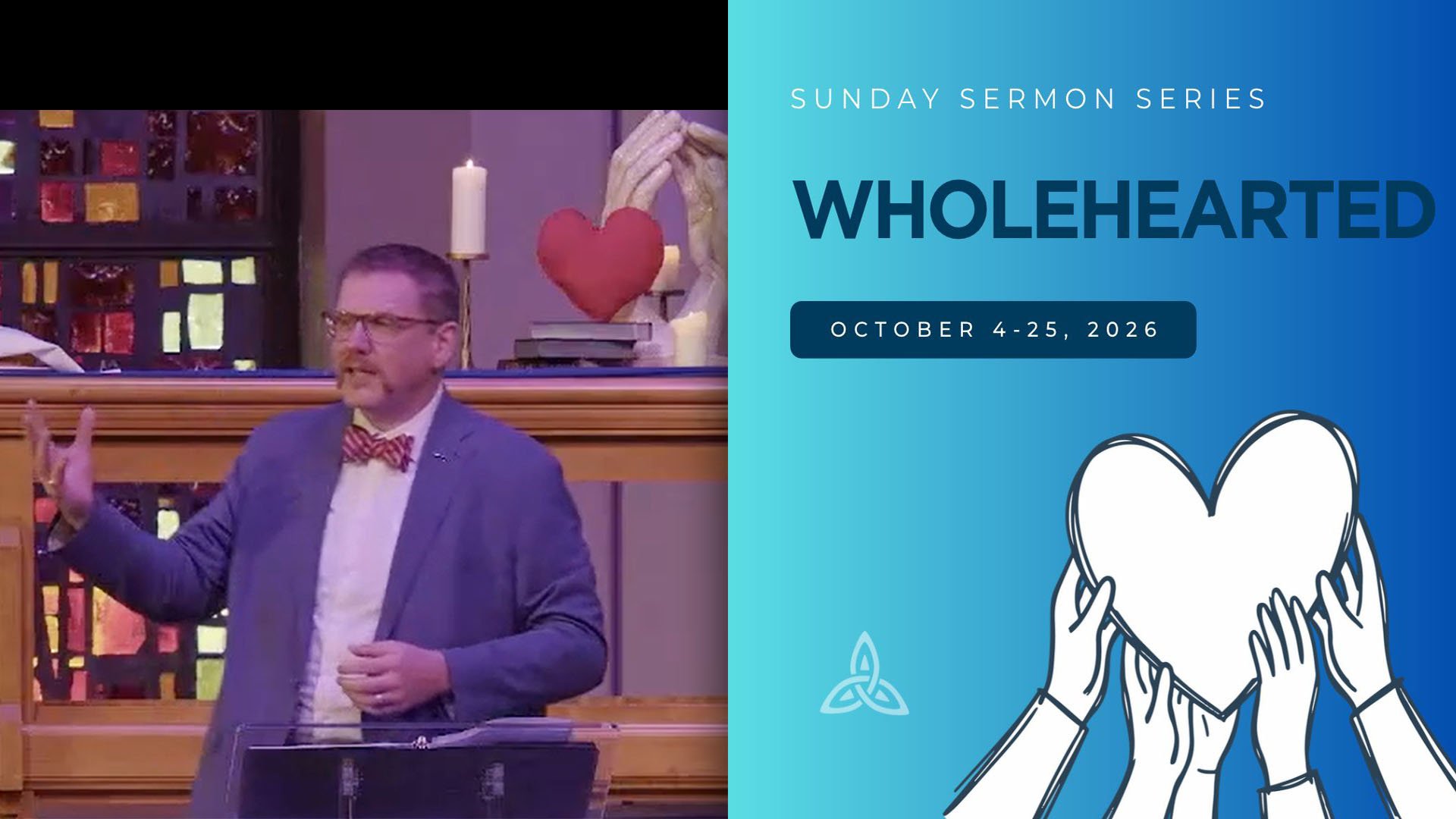
Last week we started preaching our way through this series of sermons which we have entitled Wholehearted. And each week we are meeting a saint from the church's history, and we're partnering up that story with a passage from the Acts of the Apostles. And all of this is to gain insight into what it actually is to live wholehearted lives of stewardship. And so last week we met Patrick of Ireland and the Apostle Paul, and they both helped us consider what it is to give our whole lives, to live wholeheartedly, as we join in on God's mission.
Now, in Acts chapter four, Luke paints a portrait of the early Christian community right after the time of Pentecost. And he paints a picture of the radical generosity that was their response to God's grace. You see, their giving, it wasn't some kind of institutional directive. It wasn't any kind of forced tax upon them to give to other churches. No, it was spontaneous, it was grace-filled, and an outpouring of radical generosity where believers shared what they had so that no one in their community was left in need.
Listen in to this reading from Acts chapter four, verses 32 through 37:
Now the whole group of those who believed were of one heart and soul, and no one claimed private ownership of any possessions, but everything they owned was held in common. With great power the apostles gave their testimony to the resurrection of the Lord Jesus, and great grace was upon them all. There was not a needy person among them, for as many as owned lands or houses sold them and brought the proceeds of what was sold. They laid it at the apostles' feet, and it was distributed to each as any had need. There was a Levite from Cyprus, Joseph, to whom the apostles gave the name Barnabas, which means son of encouragement. He sold a field that had belonged to him. Then he brought the money, and he laid it at the apostles' feet.
Friends, this is the Word of God for the people of God. We say together, thanks be to God.
So this week we're going to spend a little bit of time with Saint Nicholas. Yes, that Saint Nicholas, the one whose story gives us the beginnings of the story we now have in our culture of Santa Claus. Nicholas, though, was born back in the third century in the village of Patara in Asia Minor, that is modern-day Turkey. He was born to very wealthy parents who raised him well and raised him to be a devout Christian. Now, tragically, they passed away when Nicholas was still young, succumbing to an illness epidemic. And the story goes that Nicholas's faith was so strong, and his desire so deep to obey the words of Jesus, who had told the rich young man, sell what you have and give the money to the poor, he was so enamored with this that he used his entire inheritance to assist those who were in need, to assist the sick, to assist the suffering.
Nicholas committed his life to ministry, became ordained, and eventually became a bishop of the church in a region called Myra, and he became known for his generosity to those in need. He became known for his love for children, and also for his concern for sailors and for their ships.
Now, many stories of Nicholas's generosity have survived down through the years, and one such story tells of a poor man who had three daughters. Now, back in those times, a young woman's father had to offer a prospective husband a dowry, that is something of value, and without a dowry, a woman was unlikely to marry, and was destined, more than likely, for a profoundly difficult life. Now, this seemed like it was going to be the fate of this poor man's three daughters, because he had nothing to offer. However, mysteriously, on three different occasions, a bag of gold appeared in their home, providing the needed dowries. The bags of gold, tossed through an open window, are said to have landed in the stockings or shoes that had been left in front of the fire to dry out. Hence our custom of hanging stockings on Christmas Eve, in which gifts from Saint Nicholas might appear.
This Saint Nicholas, this saint of the church, he is known as a gift giver, a man of God, whose generosity and whose willingness to give wholeheartedly made a difference in the lives of many in his own community. And when you look at Nicholas, you realize that he was very simply living out what we have just read from Acts chapter four.
In the early church, the Holy Spirit transformed ordinary, everyday people into these generous gift givers, those who are willing to give out of what they had so that the needs of everyone might be met. And this story in Acts chapter four, it's not a one-off in the book of Acts. Actually, as you flick through those pages, you're going to see again and again stories of a church community who are willing to give generously of their time, and of their talents, and of their resources, so that the entire community can flourish.
Now, it might be tempting, or even easy, for us to read about this radical generosity of the early church and think to ourselves, oh, you know what, Charlie, those were simpler times, things were different back then, it was much easier for them to do that. No, I'm going to challenge that notion, just in case you were tempted to go there. Okay, these were not simpler times. The earliest Christians were facing economic instability, they were facing political persecution. And in the middle of all of that, they were giving up their financial security for a wild idea, that the risen Christ demanded a completely new way of living, a communal, wholehearted life where no one went without. What a wild idea. That's right, they weren't just giving to meet a budget, they were giving to prove something very important and very real in their lives, that the resurrection of Jesus Christ changes everything. Even your wallet.
We read that Barnabas, nicknamed son of encouragement, sold his field and laid the proceeds at the apostles' feet. This wasn't some minor transaction. No, not at all. This was a statement. It was Barnabas saying to his brothers and sisters in Christ, hey guys, my identity is no longer tied up in land or in any of the sense of security that comes from owning it. My security actually is in the risen Christ, who has made me a new creation, and who calls me to live in this new community in a new way. And I am all in. I'm all in.
And it's here that we start to bridge between the generosity of Nicholas and the example of Barnabas in Acts chapter four, and the call that comes to you and to me today. That we're not being asked to sell off our land tomorrow morning or our houses. I don't think the Bible is literal like that, okay, hear that clearly. But we are being invited to embrace the spiritual discipline of wholehearted giving, a generosity that says to the world, to anybody that's watching alongside us, I trust God more than I trust all of these other things in my life.
So what does that look like for us? What does that look like for the people called United Methodists at Trinity in Gainesville in 2026? You see, we're not an ancient church in Asia Minor, but we are a Spirit-filled family of Jesus followers who are called to be a courageous witness for Christ, who are, everybody look over here at this wall for a moment, if you can turn your neck around there, who are big-hearted, Spirit-led, Christ-minded, and bound by love. Those are our value statements. They're not just there for decoration. That's who we say we are to the world: big-hearted, Spirit-led, Christ-minded, bound by love. And we here, we want to do all the good that we can to ensure that our community, Gainesville, thrives as much as it can. Am I right about that? Is that what we want? Yeah, oh yeah, I'll take that.
We live into this calling in so many ways, friends, but a part of that does happen through our giving. Now, I said this last week, I said every time I preach about this kind of stuff, you don't like to hear it. I don't actually love to say it either, but we've got to hear it, we've got to say it, okay, because all of it takes this kind of support.
When we make our pledges of financial support, when we give wholeheartedly, what we're doing, friends, is we are doing our best to replicate the life of the early church that we are reading about today in the Acts of the Apostles. When we make our pledges of financial support, we are doing a few very important things. I've got three of them that I want to list here.
First of all, we are giving a gift of future. We are giving a gift of future. We are providing the dowry, so to speak, for future generations. We are ensuring that our children's ministry and that our youth ministry have the resources, and the people, and the opportunities that they need to thrive. Just as Saint Nicholas secured a future for those three young women, our generosity today secures the spiritual future for the young people that we get to have as part of our church family here. We're giving the gift of future.
We're also giving a gift of presence, a gift of presence. You know, one of the things that I've been most impressed with here at Trinity in the last few months is just how this whole beast of a campus is a gift to this community. Dog walkers, runners, pickleball players, softball teams, flag football teams, all of you who come here and use these resources, the groups who come in and use this space to meet and to gather. We are giving the gift of presence by keeping our campus, by keeping our doors open, lights on, air running, and staff supported, so that when a crisis hits, when a family is grieving, when a person needs a word of hope, or a meal, or some other kind of support, we get to offer that as a church family here. Trinity can be that gift, Trinity can be that presence. Our gifts fund the ministry of presence that reaches out to our neighbors in this community, and so much further beyond. We're giving a gift of future, we're giving a gift of presence.
We are also giving a gift of faith, because when we give, we are publicly declaring, like Barnabas did, that we are trusting God's provision for our lives. Financial pledges that we bring, they're not a bill, they're not this legally binding contract. It's actually an intentional and prayerful decision that we have come to. It's a goal that we have set in our relationship with God that says to God, you know what, Lord, I believe you are calling me to offer this back to you through my church family in the coming year, and I'm going to do my best to live into that.
But think back to my little story about Jackson on that Christmas morning and the cell phone SIM card. The joy in that moment wasn't about the little piece of plastic. Although if you ask my son, he might say it was actually in that moment about the piece of plastic. But beyond the piece of plastic, it was what happened when it was used. It was witnessing the transformation, the surprise, the excitement, the realization for him that his life and his ability to be connected to his friends in new ways was changing in that moment. And I'm pretty sure that's the same buzz that Saint Nicholas felt when he heard that that poor man's three daughters were saved from a potential life of poverty. It's the same joy that the early church experienced when all of the needs of their community were met.
My friends, here's the thing, giving and generosity is not a burden. It is an act of sheer radical joy that is birthed in the amazing grace of God. Read that again: giving and generosity is not a burden, it is an act of sheer radical joy, birthed in the amazing grace of God.
My friends, this is the time of year when we look ahead to the year that is coming, and I'm inviting all of us who are part of this Trinity Church family, myself included, I am asking all of us to prayerfully respond to God's great generosity towards us by making our own pledge of financial support for the ministry year 2027.
Like I said, it's not a contract, it's a covenant. It's not about filling a hole in a budget, it's about filling a gap in the world with the love of Jesus Christ, and doing our best to do that together, doing it through our gifts. This is how we plan, this is how we keep things going, this is how we commit to our mission together, locally and globally. And our prayerful response, written down on a little pledge card, becomes the roadmap that allows us to ensure that we live into this calling, to be those courageous witnesses for Christ who are big-hearted, Spirit-led, Christ-minded, and bound by love, and that we would do that with intentionality and with impact every single week of the year.
So I want to invite you, as you're praying this through in these weeks, to consider your pledge not as just some obligation that we do every year, but actually to consider it as a next step on your own spiritual journey, which is part of our spiritual journey together. What might be your part in that? What might be your part in that? What is the gift that, if you give it, would be that faithful next step in the journey? What is the gift that would involve you stretching just a little bit more, and trusting in God's goodness just that little bit more?
The wholehearted discipleship and stewardship that we see in Acts chapter four, it's actually within our reach. It's not so far off that it's out of reach. The transformative generosity that we see in the life of Saint Nicholas, it is actually part of our inheritance in the church. And the question for us today is this: what are we going to do about it?
Can we be the church that is willing to sell its security? Not literally, but spiritually speaking, for the sake of the gospel? Can we be the church that allows God's abundance to flow through us so that our entire community can thrive to the best of its ability?
It's a prayerful journey I'm inviting you to be upon in this month of October, and I'll do this every year that I'm here during this exact month. And it's my hope and prayer that we will pray together, we will listen for the leading of the Spirit, and that we will decide to be a part of this, whatever that part looks like, and that we'll be willing to write that down and pledge our own forms of support to the work that we get to do together this week.
It is my sincere hope that you're going to receive in the mail from me an envelope which will have in it a letter and a pledge card that looks something like, where is it, there it is, going to look something like this. You're also going to receive in there a document that I call a narrative budget. And a narrative budget just tells some of the story of what we've been up to in the last year, how we've put support here to good use. And it also invites us to consider how we can support in the year ahead as well.
And I'm asking all of you, and I'll be doing this myself, even as I write that document and as I read it again myself in the coming days, I'm asking you to read it prayerfully. And then in a couple of weeks' time on a Sunday morning, we're going to have what we call a Commitment Sunday, where we invite you to bring those pledge cards back and just return them in a moment of commitment as a church family together, as we commit ourselves to the ministry that we are called to in 2027.
I hope you can be a part of that. Now, if you don't get mail from us, first of all, put your address in the attendance pad so that you can get mail from us. But secondly, fear not, because I always have some of these at the door of the church on your way out, and you can pick one up and take it away and prayerfully consider how you might return it. There's always a way to do it, right?
Please, friends, enter into this time and this season with prayer, and with hope, and with enthusiasm to be those who bear the light of Christ here in this community, at this time, through our life together at Trinity United Methodist Church.
Amen.