
-
Thinking about the "Going on a Bear Hunt" analogy, is there a river of pain in your life right now that you've been trying to go over or under instead of going through it?
Is there a specific hurt you are carrying that you haven't faced honestly yet, perhaps because you've been denying the pain to avoid the discomfort of healing?
If you were to use your imagination, what would a future look like for you that isn't bound by your current circumstances or past hurts
In your relationships, are there times when a simple action—like a hand slide or just being present—could speak more powerfully than any words of apology?
Is there a relationship in your life right now where you feel a nudge to follow the path of forgiveness, even if the terrain ahead looks rugged and difficult?
Transcript:
Imagine having what you thought was the perfect marriage. The stars had aligned the day that you met, and there was no question in your mind that this person was the one—your forever soulmate. The one whose touch on your arm made you tingly all over. The one whose kiss made your heart explode like a fireworks display over Cinderella's castle. The one into whose eyes you could look and know that you were safe, and you were loved, and you were home.
Then one day, the unimaginable happens: betrayal. Everything you thought you knew to be true is piled on the ash heap of your marriage. Both betrayed and betrayer are wrecked beyond recognition. And then, without warning, you are plunged even deeper into the abyss of grief and sorrow when the news comes that your child, your young adult son, has been tragically killed. There will be no future birthdays of his to celebrate—no graduations, no wedding, no grandchildren. This is where the Hamiltons, Alexander and Eliza, found themselves in the year 1801.
[Ensemble singing “It's Quiet Uptown” from the Broadway musical, Hamilton]
There are moments that the words don't reach
There is suffering too terrible to name
You hold your child as tight as you can
And push away the unimaginable
The moments when you're in so deep
It feels easier to just swim down
The Hamiltons move uptown
And learn to live with the unimaginable
I spend hours in the garden
I walk alone to the store
And it's quiet uptown
I never liked the quiet before
I take the children to church on Sunday
A sign of the cross at the door
And I pray
That never used to happen before
If you see him in the street
Walking by himself talkin' to himself, have pity
Phillip, you would like it uptown, it's quiet uptown
He is working through the unimaginable
His hair has gone gray, he passes every day
They say he walks the length of the city
You knock me out, I fall apart
Can you imagine?
Look at where we are
Look at where we started
I know I don't deserve you, Eliza
But hear me out, that would be enough
If I could spare his life
If I could trade his life for mine
He'd be standing here right now
And you would smile
And that would be enough
I don't pretend to know the challenges we're facing
I know there's no replacing what we've lost
And you need time
But I'm not afraid
I know who I married
Just let me stay here by your side
That would be enough
If you see him in the street
Walking by her side talking by her side have pity
Eliza, do you like it uptown it's quiet uptown
He is trying to do the unimaginable
See them walking in the park, long after dark
Taking in the sights of the city
Look around, look around, Eliza
They are trying to do the unimaginable
There are moments that the words don't reach
There is a grace too powerful to name
We push away what we can never understand
We push away the unimaginable
They are standing in the garden
Alexander by Eliza's side
She takes his hand, it's quiet uptown
Forgiveness, can you imagine?
Forgiveness, can you imagine?
If you see him in the street
Walking by her side talking by her side have pity
They are going through the unimaginable
Source: Musixmatch
Songwriters: Lin-manuel Miranda
It's Quiet Uptown lyrics © 5000 Broadway Music
I just want to say a word of thanks for our choral music scholars who just offered that musical offering. Some of them are on their way out the door right now because they have to be in Ocala a little bit later this morning for a workshop that they're a part of, and they made the commitment to be here today to share that first. So thank you all; I appreciate you.
Colossians 3:13 says this:
"Bear with one another and, if anyone has a complaint against another, forgive each other; just as the Lord has forgiven you, so you also must forgive."
And then similarly, in Ephesians 4:32, we hear these words of guidance:
"Be kind to one another, tenderhearted, forgiving one another, as God in Christ has forgiven you."
Would you pray with me? Come, Holy Spirit, and breathe life into the words that I speak, that they might carry a word from you into our hearts and lives this morning. Amen.
"There are moments that the words don't reach. There is a suffering too terrible to name." Those are the opening lines to that song, "It's Quiet Uptown," that they just sang for us from the Broadway musical Hamilton. Forgiveness is hard. It is hard to ask for, and it is hard to offer. Sometimes the most difficult words to get out of our mouths can be, "I am sorry," or "I forgive you." Sometimes when they do come, they fall flat; they miss the mark and they betray hearts that aren't truly ready yet to experience healing.
Life would be so much easier if we didn't hurt each other, wouldn't it? But we do. Sometimes on purpose, sometimes carelessly, sometimes even unknowingly. And when we do, there is pain, anger, grief, emptiness, isolation, and despair. And the only pathway to healing and restoration travels through the rugged terrain of forgiveness.
Now, I don't have a magic potion this morning, or a perfect ten-step plan that will get you from here to there. I've learned enough to know that it doesn't work that way. So I'll simply share some things that I've learned to be true about this journey. The first is that there is no circumventing the pain.
A few weeks ago, Catherine and I got to be up in the Raleigh, North Carolina area with our daughter and son-in-law and our three-year-old granddaughter, Marion, who is at that age where she's learning lots of new songs and games. And when we were there, she had just learned "Going on a Bear Hunt." Remember that one?
So she wanted to do "Going on a Bear Hunt" all day long. "We're going on a bear hunt. I'm not scared. Oh, there's a river. Can't go over it. Can't go under it. Can’t go around it. Gotta go through it." Gotta go through it.
And that is the way it is with pain and heartbreak and sorrow that comes when we have been hurt or when we have hurt another. We have to go through it. And going through it can take some time. And let me just say this morning that sometimes going through it will require bringing along a trusted, or reliable voice who can help you navigate it: a pastor, a counselor, a wise soul that you trust. One thing is for sure—denying the pain will not heal it. Before forgiveness can be realized, the hurt has to be faced honestly.
Forgiveness also requires imagination. While it doesn't deny the past or try to skip over the present, it does picture a future that is not bound by current circumstances. It is able to envision the possibility of healing. It is able to live with hope. It longs for a better outcome than the pain that is currently being experienced.
Our faith plays a formative role here.You know, we believe in a God who is always at work for our good. A God whose love and mercy knows no bounds. The God who, like a shepherd, will leave the ninety-nine in order to go look for and find and rescue the one who has gotten themselves lost. The God who is like the father who stands on the front porch and day after day after day waits with hope beyond hope for the son who had left and traveled to a far-off country, perhaps never to return, to come back. And when the father sees him far off, he goes running out to meet him with open arms and to welcome him back home.
This is the God in whom we place our faith—a God whose love and forgiveness can bring transformation. And our capacity to know and trust in that God, the one who forgives and restores us, expands our capacity to imagine forgiveness and restoration in our relationships with one another. Forgiveness needs the imagination of a future not yet realized, but one that we hold on to with hope.
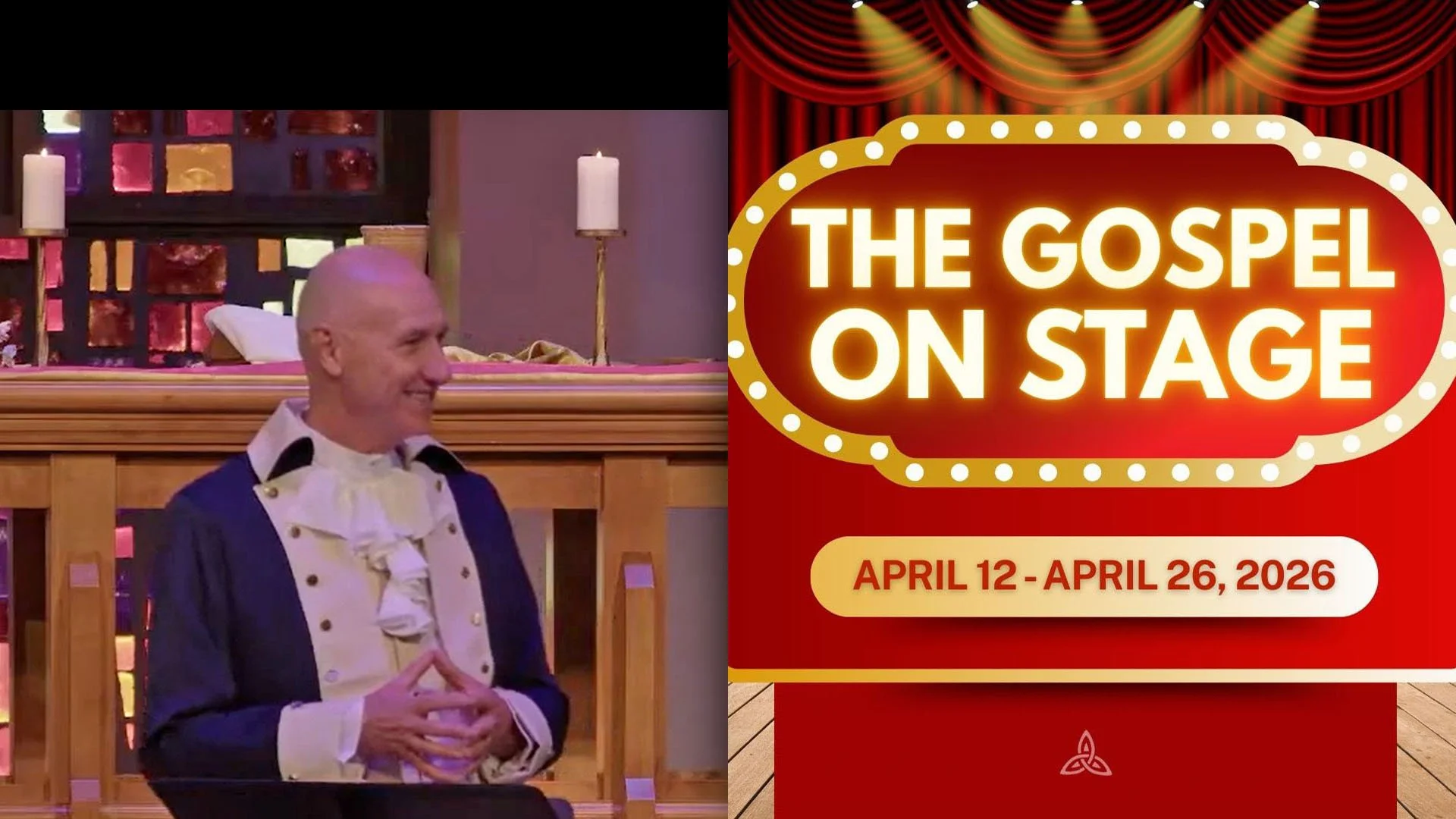
Forgiveness is best realized as an embodied gift. We don't merely speak it; we live it. There's this moment in that scene that the chorus just sang, "It’s Quiet Uptown," and toward the end of the song, Eliza sidles up beside Alexander, and she slides her hand into his. It is an action that speaks far more than any word ever could have in that moment. The gift of touch. The gift of presence. And as she does, we hear the voices around them singing, "There are moments that the words don't reach. There is a grace too powerful to name." Forgiveness is an act, a practice of grace.
There's this beautiful story near the end of the Gospel of John where Jesus models this way of forgiveness for us. Remember where Peter was a little bit earlier in the story, the night before Jesus dies? Jesus has been carried off, and it is dark, and it is chilly in the air. Peter goes to warm his hands by a charcoal fire in the courtyard, and somebody there sees him and recognizes him as one of those people, and he denies it. And then again, somebody comes and says, "Oh, yeah, you were with him," and he denies it a second time. And then a third time it happens, and Peter loudly says, "No, absolutely not. I know nothing of this man."
Imagine the shame that Peter must have been carrying in the days that followed that moment—those three denials that Jesus had told him that he would make. Peter had insisted, "No, not I, Lord." Imagine the weight that he was carrying; it was more than he could bear. And so early in the last chapter of John, we hear Peter say, "I'm going fishing." That's what we do sometimes, isn't it? When there's been deep pain, we go back to something that feels safe, familiar, or where we can hide away from whatever it is that we have done—or at least try to.
So Peter's out in the boat, and some of the other disciples have gone with him; they're a little worried about Peter. And so they're out fishing all night. And maybe you remember the story—they don't catch a thing. And then a stranger shows up on the edge of the shoreline, who turns out to be Jesus and says, "Hey, try throwing the net on the other side." And they catch 153 fish. Remember that? And then Jesus says, "Hey guys, come on up here on the shore and have breakfast."
And when they get there, there's a charcoal fire. Imagine Peter by a charcoal fire again with Jesus. And what does Jesus do? I imagine the next moment in the story as being one where Jesus, after everybody has eaten their fill, comes over and stands alongside Peter and puts his arm around him and says, "Hey, Peter, let's go over here and talk for a minute."
John tells the next part of the story this way:
"When they had finished breakfast, Jesus said to Simon Peter, 'Simon, son of John, do you love me more than these?' And he said to him, 'Yes, Lord, you know that I love you.' Jesus said to him, 'Feed my lambs.' A second time he said to him, 'Simon, son of John, do you love me?' He said to him, 'Yes, Lord, you know that I love you.' Jesus said to him, 'Tend my sheep.' And he said to him the third time, 'Simon, son of John, do you love me?' Peter felt hurt because he said to him the third time, 'Do you love me?' And he said to him, 'Lord, you know everything. You know that I love you.' And Jesus said to him, 'Feed my sheep.'"
Did you hear the cadence there? The memory weighing on Peter of the three times that he has denied Jesus, and now Jesus asks him once, twice, three times, "Do you love me?" And with each reply, Jesus is inviting Peter to be released from his shame and to be restored by the love and grace and forgiveness that Jesus is offering to new life. And you know what Jesus says then? "Follow me." The very first thing he had ever said to Peter, now he comes back and says it again: "Follow me."
Is there a relationship in your life right now where someone has caused you pain that is unresolved, or where you have caused someone else pain? Perhaps Jesus is uttering those words to you today: "Follow me." Inviting you to follow him into the rugged terrain of forgiveness. Can you imagine? Amen.